
 Recruit
Employer of Record in Tuvalu
-
 Drew Donnelly
- Published
- September 22, 2026
RemotePeople’s employer of record in Tuvalu lets you hire employees in Tuvalu with Tuvalu National Provident Fund compliance. We handle TNPF contributions at 10 percent employer share, retirement and medical education account management, and statutory leave administration.
Hire in Tuvalu — book a free 30-minute demo
Tell us what you need. You'll get a tailored, transparent proposal within 24 hours, plus a free call to walk through it.
Tell us about your company
So we can match you with a specialist who knows your market — and unlock volume pricing tiers.
* All fields are required.
Where and when are you hiring?
Tell us the geography and timing and we'll quote each country line by line, with onboarding timelines.
* All fields are required.
Help us beat your current setup
We'll benchmark your current deal and send a line-by-line proposal in 24 hours — showing exactly where we cut cost, time, or risk. After you submit, you can book a call to walk through it together.
* All fields are required.
Thanks! Your proposal is on its way.
Expect a tailored, line-by-line proposal in your inbox within 24 hours. In the meantime…
Want to walk through it together?
Book a free 30-minute call with one of our specialists. We'll explain every line, answer your questions, and tailor the proposal further if you need.
No obligation. Pick a time that works for you.








- Hire in Tuvalu — book a free 30-minute demo
- Tell us about your company
- Where and when are you hiring?
- Help us beat your current setup
- Thanks! Your proposal is on its way.
- How to Hire Employees in Tuvalu
- Tuvalu EOR vs Legal Entity in Tuvalu
- Using an Employer of Record in Tuvalu
- How Much Does a Tuvalu EOR Cost?
- Employment and Labor Laws in Tuvalu
- Payroll and Employment Taxes in Tuvalu
- Work Permits and Visas in Tuvalu
- Time Off and Leave in Tuvalu
- Employee Benefits in Tuvalu
- Terminations and Severance in Tuvalu
- Expand into Tuvalu Easily with RemotePeople’s Employer of Record (EOR) Solution
- Where companies hiring in Tuvalu expand next
- Frequently Asked Questions
- Related EOR Destinations

Start hiring in Tuvalu
Let RemotePeople handle payroll, compliance, and HR admin worldwide so you can focus on building your team.

Tuvalu is one of the world’s smallest nations, with a population of approximately 11,800 people and a land area of just 26 square kilometers spread across nine low-lying atolls in the South Pacific. Situated between Hawaii and Australia, the country relies heavily on fishing license revenues, foreign aid, and remittances. It also generates significant income from leasing the .tv internet domain, which has made it a point of interest for companies in the media and entertainment sectors.
The government is the largest employer in Tuvalu, and the formal private sector remains very limited compared to neighboring Pacific nations. Most of the workforce is engaged in subsistence activity, public service, or maritime employment. Internet connectivity has improved in recent years but remains constrained, which affects the range of roles that can practically be filled locally.
EOR arrangements in Tuvalu are typically suited to specialized roles, remote workers, or positions within the development and aid sector rather than large-scale commercial hiring. For companies considering a presence in the country, an EOR removes the need to establish a local legal entity while ensuring full compliance with the Labour and Employment Relations Act 2017, TNPF contribution obligations, and other statutory requirements. This guide covers the key labor laws, payroll obligations, and employee entitlements that apply to employers operating in Tuvalu.
How to Hire Employees in Tuvalu
There are three key ways to hire employees in Tuvalu:
Setting Up a Local Entity
Establishing a local entity in Tuvalu is the legal process of setting up a business in this country. It gives the company full control over the hiring process, with easier access to government contracts and community-based projects, and is the best choice for businesses with long-term plans for hiring in Tuvalu.
It involves subscribing to the Memorandum of Association, setting up as either a private company or a partnership, and gathering the necessary documents/fees to establish your company.
While it provides complete control over hiring, establishing a local entity can be time-consuming and expensive, perhaps being better suited to larger institutions.
Working with an Employer of Record (EOR)
An Employer of Record works as the legal employer of workers on your behalf, negating the need to establish a legal entity and ensuring that all practices are in line with local labor laws.
While there are still costs involved in this hiring method, it is generally much cheaper than setting up a legal company and is ideal for testing the market in Tuvalu.
Hiring Independent Contractors
Hiring freelance workers is a popular hiring method in Tuvalu. It’s flexible, cost-effective, and perfect for one-off or short-term projects.
However, it’s important to ensure contractors are classified correctly to avoid any legal issues involved with misclassification. It’s also crucial to ensure that workers understand that they are responsible for their own taxes and benefits when working for your company.
Hire in Tuvalu
The world’s fourth-smallest country with provident fund contributions and Tuvaluan employment regulations.
We handle employment contracts, payroll, social contributions, and full Tuvaluan compliance.
No local entity needed. Your team can start in days.
Tuvalu EOR vs Legal Entity in Tuvalu
There are different reasons why companies choose to use an EOR, or establish a legal entity in Tuvalu.
An EOR can be a much quicker process, with EORs managing to bring on new employees quickly and even managing the payroll process for you. They’ll also make sure that workers receive all mandatory employee benefits such as annual leave, sick leave, and overtime compensation.
Setting up a legal entity involves high levels of administrative work, including registering under the Companies Act, choosing a unique business name, and submitting a memorandum. There are also significant financial implications, such as paying business license fees and registration fees. However, the method does provide full control when hiring, making it useful for businesses that want to build long-term credibility when hiring in Tuvalu.
Using an Employer of Record in Tuvalu
An Employer of Record in Tuvalu would handle various tasks, acting as the legal employer for workers in Tuvalu and ensuring that local labor laws are fully complied with.
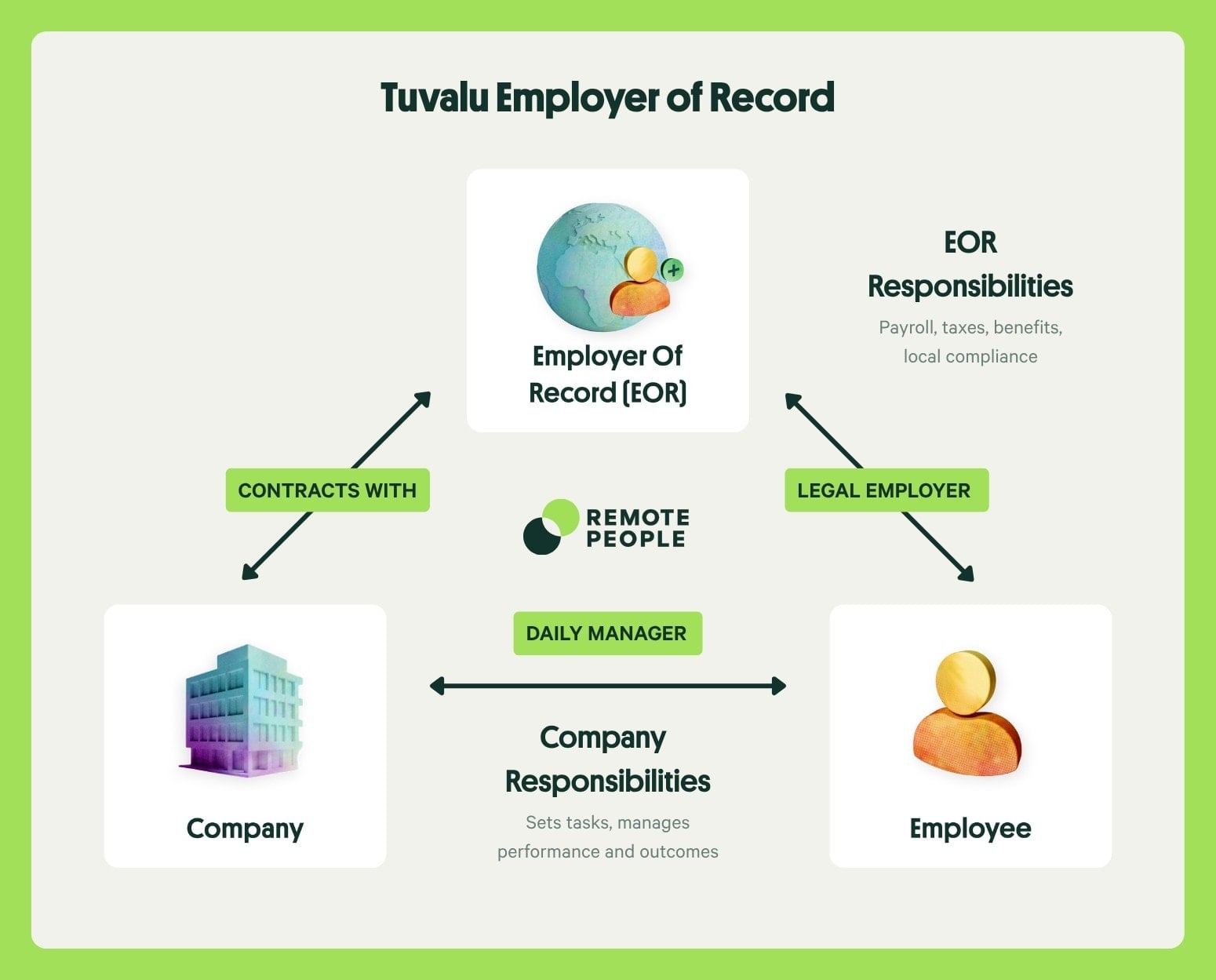
The sort of tasks that an EOR in Tuvalu would typically handle include:
- Employment contracts: An EOR would draft employment contracts, ensuring that salaries, duties, benefits, and termination rules are clearly outlined.
- Payroll processing: Salaries and payroll processing would be handled by an EOR, ensuring that necessary deductions for tax and social insurance are removed.
- Tax and social contributions: An EOR would register with the tax authorities in Tuvalu, making sure that all relevant contributions are paid correctly and on time.
- Compliance with labor regulations: With an EOR onboard, all labor regulations would be strictly adhered to, from ensuring benefits are provided to maintaining a safe working environment.
- Benefits administration: Ensuring workers receive all benefits is a key role for an EOR, making sure that annual leave, set working hours, and pension contributions are maintained.
If you’d like to learn more about how Employer of Record (EOR) services work, read our What Is an Employer of Record (EOR)? guide for a complete overview of the model, its benefits, and when to use it.
If you’re comparing providers, our Best Employer of Record (EOR) Providers guide reviews the leading platforms to help you choose the right solution for your business.
How Much Does a Tuvalu EOR Cost?
The cost of an EOR in Tuvalu varies depending on the level of support your business requires.
On average, an EOR in Tuvalu costs between $400 – $800 per employee each month, with an onboarding fee usually costing between $300 – $1,000.
EOR costs are similar to nearby islands in the Pacific, with specialized compliance needed to ensure local labor laws are always abided by.
Even when taking these fees into account, hiring an EOR can be significantly cheaper than establishing a legal entity, particularly if you’re looking to hire a small team in a short time frame.
Employment and Labor Laws in Tuvalu
There are key rules set out by local labor legislation in Tuvalu that outline the rights and obligations of employees and businesses.
Below, we’ve provided an overview of what rules employers need to follow and what they should be aware of when hiring in Tuvalu.
Key Contract Requirements
Employers must comply with the following requirements when hiring in Tuvalu:
- Issuing formal job offers: Employers must issue new workers a formal job offer, detailing the role, start date, and employment terms. The worker must formally accept the offer before commencing work.
- Written contracts: Under the Labour and Employment Relations Act 2017, any employment lasting more than 90 days requires a written contract. The contract must be signed by both parties in the presence of the Commissioner of Labour, who attests the document. It should include the job title, description of responsibilities, remuneration, employee benefits, and working hours.
- Registering with local authorities: Employers need to register with the Tuvalu National Provident Fund (TNPF) to contribute to the social security system and ensure that payroll systems are fully set up.
- Ensuring workers have the right to work verification: Non-citizens of Tuvalu must have a valid work permit and visa to work in this country, as granted by the Tuvalu Ministry of Labour.
- Notifying employees of their rights: Companies must inform all workers of their legal rights and entitlements, in line with the Labour and Employment Relations Act of 2017.
- Maintaining workplace safety: A safe working environment must be maintained at all times under Tuvalu’s occupational safety laws, with hygiene and equality being of utmost importance.
- Non-discrimination: Tuvalu’s equality laws must be adhered to when hiring new staff members, ensuring that workers aren’t prejudiced against race, gender, religion, or political viewpoint.
- Welcoming new employees: Employers must onboard their new workers by ensuring they have access to a company handbook detailing workplace procedures/policies, and ensuring all expectations of the job are explained in full.
Working Hours
Standard working hours in Tuvalu are 40 hours a week, spread over 5 work days of 8 hours each (usually between Monday – Friday).
Regular breaks must be issued, and employees are entitled to a minimum of 1 day off per week, which is typically provided on a Sunday.
Overtime
Employees must be paid a compensatory rate for working overtime hours that exceed the normal 40-hour week.
There is no specific rate mentioned in the Labour and Employment Relations Act – only that it must be paid at a higher rate than their normal salary.
Probation Periods
Probation periods of three to six months are common practice in Tuvalu and are typically set out in the employment contract. During the probationary period, either party may terminate the contract without serving a notice period, though the employer must communicate the decision to the employee in writing.
Standard statutory entitlements, including TNPF contributions and minimum wage protections, apply from the first day of employment regardless of probationary status.
Payroll and Employment Taxes in Tuvalu
Employers must follow Tuvalu’s financial regulations when hiring in this country, particularly in terms of payroll, minimum wage, and employer/employee contributions.
Below is a summary of the key rules regarding payroll and employment taxes in Tuvalu.
Payroll Cycle
There is no set payroll cycle that employers must follow in Tuvalu, with employers usually paying workers either monthly or weekly.
Minimum Wage
Tuvalu does not have a statutory national minimum wage for the private sector. Wages are determined by individual employment agreements or collective arrangements between employers and employees.
The government is the largest employer in the country, and public sector pay scales serve as the primary reference point for private sector wage expectations. The government introduced a revised salary structure in its 2024-2025 budget, though detailed pay band figures are not publicly available in accessible form. Historically, entry-level public sector positions have paid in the range of AUD 3,000 to AUD 4,000 per year, though this figure may not reflect the most recent adjustments. Private employers generally use government pay levels as an informal benchmark when setting wages.
Employer and Employee Payroll Contributions
Employers and employees are both required to contribute to the Tuvalu National Provident Fund (TNPF), the country’s compulsory social security scheme established under the Provident Fund Act 1984. Contributions are mandatory for Tuvaluan citizens aged 15 to 55 who are employed and paid for work in Tuvalu.
The employer contribution rate is 10% of gross salary and the employee contribution is 13%, bringing the combined total to 23% of gross monthly payroll. Both contributions must be submitted to the TNPF by the 15th of the following month. Late payments may result in surcharges.
Of the combined contribution, 73.91% is allocated to each member’s Retirement and General Account, with the remaining 26.09% directed to the MEDU (Medical and Educational) savings account. Funds in the MEDU account can be accessed by members to cover qualifying medical and educational expenses, making TNPF contributions serve both long-term retirement and shorter-term welfare purposes. Note that the TNPF website shows slightly different split percentages across different pages. Employers should confirm the current allocation directly with the Fund.
Income Tax
Tuvalu levies income tax on individuals under the Income Tax Act (originally enacted 1992, 2022 Revised Edition). The Act applies to all persons deriving taxable income in Tuvalu. Employers are required to withhold income tax at source from employment income and remit it to the tax authority.
The top income tax rate is 30%, with lower rates applying to lower income bands. The precise bracket thresholds are set out in Schedule 6 of the Act, which is administered by the Secretary of Finance. Some sources cite a flat 30% on income above approximately USD 1,900, while others describe a progressive structure reaching 30% at higher income levels.
Employers should confirm the current withholding tables directly with the Tuvalu tax authority or a local adviser, as the published Schedule 6 figures are not readily accessible in current public sources.
Pension System
The TNPF provides members with retirement benefits from age 45. Members can choose between a lump-sum retirement benefit paid upon retirement, or a regular retirement pension. Beyond retirement, members may access partial withdrawals for a range of approved purposes, including housing construction or renovation (for members aged 45 and above with account balances exceeding AUD 20,000), emigration, incapacity, and pledging funds as loan security.
The TNPF is currently undergoing reforms to its minimum retirement age and benefit structure. Employers and employees should verify current thresholds directly with the TNPF, as the age 45 eligibility may be subject to change.
Bonus Payments
Bonus payments, or 13-month pay, are not a statutory right for employees in Tuvalu.
Some employers do offer bonuses based on performance, but this is offered at the discretion of the employer.
Tax Compliance and Payroll Reporting
Employers in Tuvalu must be compliant with tax regulations, including social insurance contributions, income tax deductions, and regular tax reporting. They must file corporate income tax returns annually, and within 3 months of the fiscal year end.
Records must be maintained for a minimum of 5 years.
Work Permits and Visas in Tuvalu
Foreign nationals must obtain a work permit and entry/residence permit before commencing employment in Tuvalu. Work permits are tied to a specific employer, who is responsible for submitting the application to the Department of Immigration on behalf of the employee. Employers must demonstrate that no suitable local candidate is available for the role before a work permit will be approved.
Required documents include a valid passport, completed application form, signed employment contract, and a police clearance certificate for positions lasting more than one year. Medical clearance may also be required. Permits are valid for up to 12 months and may be renewed up to three times over a five-year period. If an employee changes employer, a new work permit must be obtained.
Working without a valid permit is illegal and may result in fines, deportation, and a ban on re-entry.
| Type of Visa/Permit | Validity |
|---|---|
| Visa-free / Visa on Arrival | 1-month duration |
| Work Permit / Employment Visa | Up to 12 months |
| Temporary Residence Permit | Linked to an employment visa |
| Business / Study Visa | Valid for up to 1 year |
Time Off and Leave in Tuvalu
Mandatory Leave Entitlements
Employees in Tuvalu are entitled to a minimum of 15 days of paid annual leave per year at full pay, upon completing one year of continuous service with the same employer. The specific entitlement may be further defined by the employment contract or applicable industry standards.
Any accrued but untaken annual leave must be paid out to the employee within 14 days of termination. Some employers offer additional leave as a supplementary benefit.
Public Holidays
Tuvalu celebrates various public holidays each year, which provide workers with a paid day off. The public holidays in Tuvalu are as follows:
- New Year’s Day (January 1)
- Commonwealth Day (second Monday in March)
- Good Friday (varies)
- Easter Monday (varies)
- Gospel Day / Te Aso o te Tala Lei (second Monday in May)
- King’s Official Birthday (second Saturday in June, or as appointed)
- National Children’s Day (first Monday in August)
- Tuvalu Day (October 1, continuing October 2)
- Heir to the Throne’s Birthday (second Monday in November)
- Christmas Day (December 25)
- Boxing Day (December 26)
Sick Leave
Full-time employees in Tuvalu are entitled to a minimum of 10 days of sick leave per year. Part-time employees are eligible for sick leave on a pro-rata basis.
Workers must provide their employer with a medical certificate to qualify for sick leave.
Maternity Leave
Female employees are entitled to 12 weeks of fully paid maternity leave in Tuvalu. This is usually taken as 6 weeks before birth and 6 weeks after birth.
Paid leave is provided to employees who have contributed to social security for at least 1 year.
Paternity Leave
Male employees are entitled to paternity leave in Tuvalu. This is offered to both biological and adoptive parents.
Paternity leave in Tuvalu consists of 10 days of fully paid leave, which must be taken within 4 months of the birth/adoption.
Parental Leave
There is no statutory parental leave entitlement in Tuvalu beyond the standard maternity and paternity provisions. Female employees may request additional unpaid leave following the end of their statutory maternity leave period under the Labour and Employment Relations Act 2017. Any such arrangement is subject to agreement between the employer and employee and should be documented in writing.
Bereavement and Jury Duty
Employees who have completed a minimum of three months of continuous service are entitled to three days of paid compassionate leave in the event of the death or critical illness of a close family member. This entitlement is not explicitly codified in widely accessible public sources and may be subject to employer policy or the terms of the employment contract. Employers should confirm the applicable provisions with a local adviser.
Employee Benefits in Tuvalu
Employers are advised to provide their workers with supplementary benefits to retain staff and increase the number of job applications for new roles.
These may include flexible working, performance bonuses, or private health insurance options.
The mandatory employee benefits in Tuvalu are:
- Maternity leave
- Paternity leave
- Sick leave
- Social security contributions
Some examples of supplementary employee benefits companies could provide include:
- Performance bonuses
- Flexible working
- Transport, food, or housing expenses
- Company car
- Private health insurance
- Advanced training opportunities
Terminations and Severance in Tuvalu
Ending an Employment Contract
Under the Labour and Employment Relations Act 2017, fixed-term and project-based contracts terminate automatically upon expiry. Indefinite contracts require a lawful reason for termination, which includes redundancy, employee misconduct, or unsatisfactory performance. In the absence of a notice period specified in the employment contract, a minimum of one week’s notice applies.
Employees dismissed due to redundancy may be entitled to severance pay calculated on length of service, though specific terms are generally set out in the employment contract or determined by the Labour Commissioner.
Notice Periods
Notice requirements under the Labour and Employment Relations Act 2017 depend on the circumstances of termination and what is specified in the employment contract.
Where no notice period is stated in the contract, the statutory minimum is one week. Employment contracts may specify longer notice periods, and these are enforceable provided they apply equally to both parties. Either party may substitute payment in lieu of notice.
No notice is required during a probationary period, though the decision to terminate must be communicated to the employee in writing. Termination for serious misconduct also carries no notice entitlement.
On termination, regardless of the reason, all outstanding wages, notice period pay, and accrued but untaken annual leave must be settled and paid to the employee within 14 days.
Severance Pay
If an employer terminated an employee’s contract due to redundancy or an employer-initiated reason (excluding misconduct), they may be eligible for severance pay.
The exact amounts are not stipulated by law; however, this is usually calculated based on years of service and experience.
Expand into Tuvalu Easily with RemotePeople’s Employer of Record (EOR) Solution
There are many advantages to hiring in Tuvalu, particularly for companies looking to expand into the Pacific region in key industries such as fishing, agriculture, and the public sector.
An Employer of Record (EOR) helps streamline hiring by managing payroll, benefits, and labor law compliance—removing the burden of local administration. At RemotePeople, we provide EOR services tailored to Tuvalu’s unique legal and cultural landscape, making it easier for your business to build a compliant local team.
Working with an EOR can significantly improve the efficiency and compliance of expanding your business abroad, allowing you and your team to focus on other areas of your business.
Contact RemotePeople today to see how we can help your business hire in Tuvalu.
Where companies hiring in Tuvalu expand next
Companies operating in Tuvalu often extend across the Asia-Pacific, drawing on English-speaking talent and aligned business culture. After building a team in Tuvalu, employers often look to a team in Fiji for the regional Pacific talent footprint, then operations in Papua New Guinea for Pacific-region proximity and English-first hiring. Australia follows with aligned Pacific workforce norms, and hiring in New Zealand typically closes the regional footprint via shared Pacific business rhythm.
Frequently Asked Questions
Yes. Under the Labour and Employment Relations Act 2017, disputes are handled through the Commissioner of Labour, who may appoint a conciliator to attempt resolution. If conciliation fails, the matter is referred to the Trade Disputes Tribunal, where an adjudicator must issue a binding award within three months of receiving the submission.
Yes. Non-citizens require both a valid work permit and visa before commencing employment. Given the government's preference for local employment and the very small size of the formal labour market, foreign hires are typically limited to roles where local talent is unavailable, such as technical, specialist, or development-sector positions.
Employees have the right to join a trade union, though union activity in Tuvalu is extremely limited. The only established trade union is the Tuvalu Seamen's Union, affiliated with the International Transport Workers Federation. Government workers may belong to associations with some union-like features, but formal collective bargaining is not widespread.
Members who leave Tuvalu permanently may be eligible for the TNPF emigration benefit. Those who have obtained citizenship or permanent residency in another country can withdraw 100% of their account balance. Members without permanent residency status abroad can access up to 50% of their balance, provided it exceeds AUD 1,000, and may apply for the remainder after 12 months of absence.
Employment contracts in Tuvalu commonly include a probationary period of three to six months. During this period, employers may terminate the contract without notice, though the decision must be communicated to the employee in writing. Standard statutory entitlements such as TNPF contributions apply from the first day of employment regardless of probationary status.
Employers who fail to register themselves or their employees with the TNPF, or who fail to remit contributions by the 15th of the following month, are subject to surcharges imposed by the Fund. Non-compliance can also result in penalties, reputational risks, and complications with government contracts or business licensing, particularly given Tuvalu's small and closely networked business environment.
Yes. Tuvalu applies a standard consumption tax rate of 7% under the Consumption Tax Act 2008, levied on taxable supplies by registered businesses and on taxable imports. This is separate from income tax obligations and is relevant for employers operating as trading entities within the country.
Employer of Record in
Employer of Record in
Employer of Record in
Employer of Record in
Employer of Record in
Employer of Record in
Employer of Record in
Employer of Record in




