
 Recruit
Employer of Record in Nevada
-
 Drew Donnelly
- Published
- September 22, 2026
Nevada’s employment law includes mandatory paid leave, no state income tax, and labor rules, and a Nevada EOR handles payroll and full state compliance with no local entity needed.
Hire in Nevada — book a free 30-minute demo
Tell us what you need. You'll get a tailored, transparent proposal within 24 hours, plus a free call to walk through it.
Tell us about your company
So we can match you with a specialist who knows your market — and unlock volume pricing tiers.
* All fields are required.
Where and when are you hiring?
Tell us the geography and timing and we'll quote each country line by line, with onboarding timelines.
* All fields are required.
Help us beat your current setup
We'll benchmark your current deal and send a line-by-line proposal in 24 hours — showing exactly where we cut cost, time, or risk. After you submit, you can book a call to walk through it together.
* All fields are required.
Thanks! Your proposal is on its way.
Expect a tailored, line-by-line proposal in your inbox within 24 hours. In the meantime…
Want to walk through it together?
Book a free 30-minute call with one of our specialists. We'll explain every line, answer your questions, and tailor the proposal further if you need.
No obligation. Pick a time that works for you.








- Hire in Nevada — book a free 30-minute demo
- Tell us about your company
- Where and when are you hiring?
- Help us beat your current setup
- Thanks! Your proposal is on its way.
- Nevada Employer of Record
- What Is the Difference Between a Nevada Employer of Record and a Nevada PEO?
- How Does a Nevada Employer of Record Work?
- How Labor Laws Affect Hiring in Nevada?
- Payroll Taxes and Employer Cost in Nevada
- Employee Classification Rules in Nevada
- What Makes Hiring in Nevada Unique?
- What Are the Benefits of a Nevada Employer of Record?
- What Are the Downsides of a Nevada EOR?
- How to Choose a Nevada Employer of Record?
- Engage a Nevada Employer of Record with RemotePeople
- Related EOR Destinations

Let RemotePeople handle payroll, compliance, and HR admin worldwide so you can focus on building your team.
Key Takeaways
- Nevada offers strong business opportunities with low taxes, global market access, and thriving tourism and agriculture sectors.
- An EOR handles employment responsibilities entirely, while a PEO shares legal duties with the employer.
- Nevada’s labor laws require compliance with wages, taxes, and benefits, but EOR services can be expensive.
- Choosing an EOR requires evaluating pricing, legal expertise, responsiveness, and support for Nevada’s diverse workforce.
The numbers tell an interesting story in Nevada, which shows why it’s worthwhile to hire in the state. Las Vegas now leads the nation in projected tech hiring growth at 4.7%, while Reno has transformed into one of the world’s largest data center markets. It hosts Google, Switch, Microsoft, and Apple in an industrial park larger than the city of Detroit. The total valuation of Las Vegas-area startups has ballooned from $1.9 billion in 2014 to $19 billion in 2024.
Furthermore, Nevada offers a business climate that is ranked seventh in the Tax Foundation’s 2023 State Business Climate Index. Also, there is no corporate or personal income tax here, so the regulatory system leans pro-business.
Also, the cost environment is more forgiving than coastal alternatives, though the state grapples with its own challenges. That includes water scarcity and federal land ownership that constrains development.
We’ll provide more context for the best practices when hiring in Nevada, and you’ll learn how an Employer of Record is the right partner.
Nevada Employer of Record
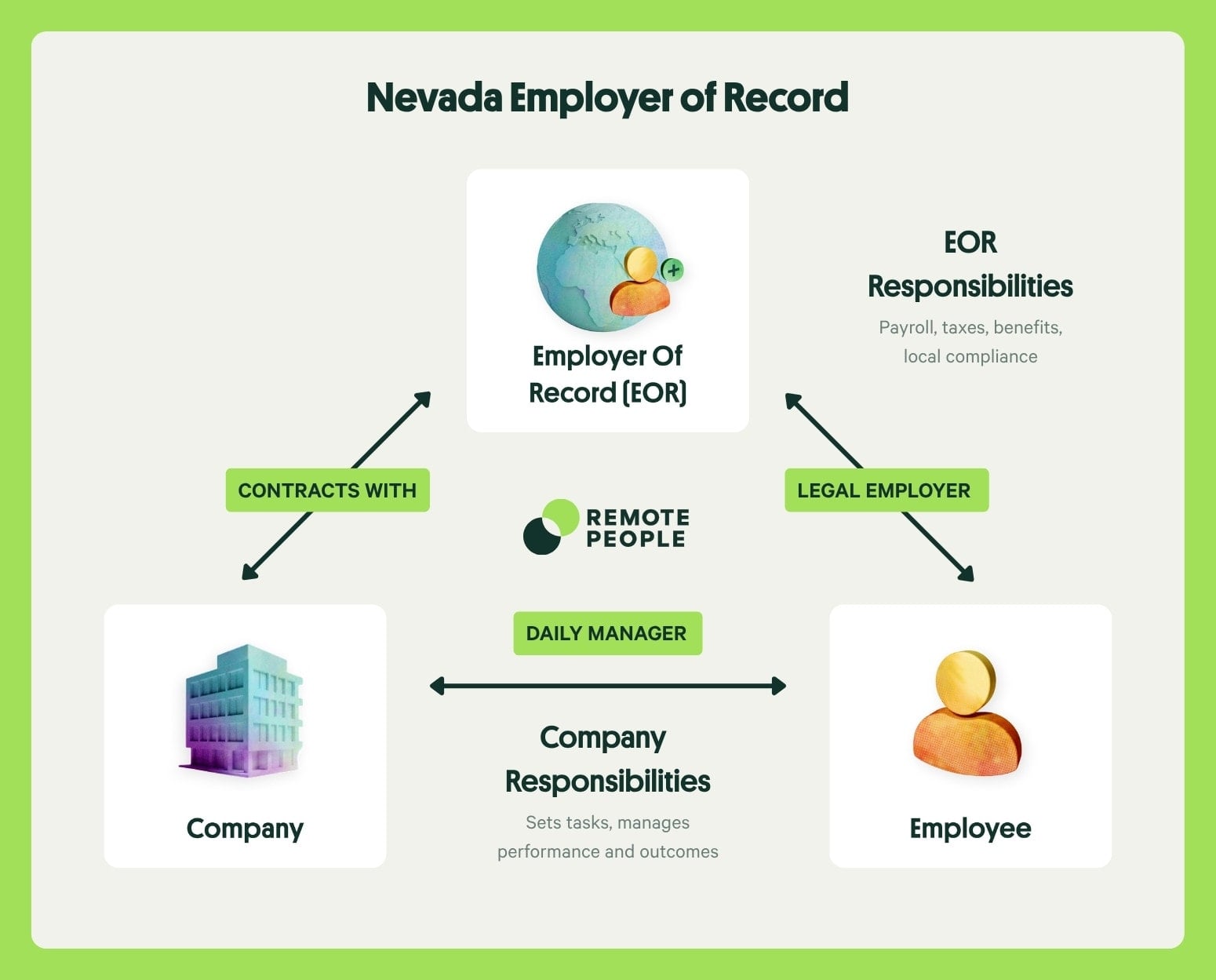
A Nevada Employer of Record is a third-party organization that becomes the legal employer for your workers in the state. The EOR handles all the bureaucratic heavy lifting while your company directs what gets done.
What is an EOR can help explain how this employment model works in more detail.
Here are the key tasks that an EOR can perform:
- State tax registration since the EOR registers your business with the Nevada Department of Taxation for the Modified Business Tax. It also establishes accounts with the Department of Employment & Training and Rehabilitation for unemployment insurance contributions before any payroll runs.
- Employment contract generation because the EOR prepares legally compliant offer letters and employment agreements. These address Nevada-specific provisions, including the two-tier minimum wage classification based on health benefits and the state’s at-will employment disclaimers.
- Payroll processing and tax withholding since they calculate gross wages, withhold federal income tax, and FICA contributions. They also remit the employer’s share of Social Security and Medicare taxes while ensuring no state income tax withholding is erroneously taken.
- Quarterly MBT filings since the EOR prepares and submits the Modified Business Tax returns every quarter. This ensures payments reach the Nevada Department of Taxation before filing deadlines.
- Worker compensation administration because the EOR secures worker compensation coverage for all Nevada employees. They also manage any workplace injury claims and handle the required reporting to the state’s insurance regulators and the injured worker’s medical providers.
What Is the Difference Between a Nevada Employer of Record and a Nevada PEO?
Understanding the differences between an EOR and a PEO service will help you choose the right one for your business.
PEO
A Professional Employer Organization, or PEO, operates through what the industry calls co-employment. When you partner with a PEO in Nevada, your company must already have a registered legal entity in the state.
Hence, you remain the Employer of Record on paper, and the PEO simply handles HR functions as an outsourced service. Also, you share employment responsibilities, but the legal liability ultimately traces back to your entity.
This arrangement works for domestic companies that have already established a presence in Nevada and want to streamline HR operations. Small to midsize businesses particularly benefit from the enterprise-grade benefits packages that PEOs can negotiate.
However, the model assumes you have already done the hard work of entity formation. If you are not yet registered in Nevada, a PEO cannot help you hire there.
EOR
An Employer of Record is the service provider that becomes the legal employer, not just an administrative helper. Therefore, your company does not need an entity in Nevada. The EOR assumes full legal responsibility for employment compliance, tax withholding, and all the regulatory obligations that come with having workers in the state.
This distinction becomes critical when things go wrong. With a PEO, if a classification error triggers a state audit or a wage dispute escalates to litigation, your company remains on the hook.
With an EOR, the service provider bears that risk. Hence, the model is particularly suited to international companies hiring their first American employees, or out-of-state businesses testing the Nevada market.
Here’s a table showcasing the main differences at a glance:
Aspect | PEO | EOR |
|---|---|---|
Legal Entity Required | Yes, your company must be registered in Nevada. | No, EOR uses its own entity. |
Employment Liability | Shared (co-employment). | Assumed entirely by EOR. |
Best For | Domestic companies with existing Nevada presence | International companies or out-of-state businesses testing market. |
Compliance Responsibility | Your company retains ultimate liability. | EOR bears compliance risk. |
Speed to Hire | Slower (requires entity first). | Immediate. |
Start hiring with a Nevada EOR
Let us handle the complexities of hiring, compliance, and payroll in Nevada while you focus on growing your team.
- Hire employees in Nevada with a Nevada EOR
- No local entity is needed
- Pricing starts at USD 199 per employee
- RemotePeople can also help you find the best talent in Nevada
How Does a Nevada Employer of Record Work?
Compliant Employment Contract
It begins with documentation. When you identify a candidate in Nevada, the EOR generates an employment contract that complies with both state and federal requirements. This is not boilerplate lifted from a legal website.
The contract must address Nevada-specific provisions:
- The at-will nature of employment.
- The particular wage tier applicable based on whether your company offers health benefits.
- The state’s rules around rest breaks and meal periods.
The candidate signs with the EOR as the legal employer, establishing a clean and compliant
paper trail from day one.
Payroll Setup with Correct State Registrations
Before any money changes hands, the EOR ensures proper registration with Nevada’s taxing authorities. This means establishing accounts with the Nevada Department of Taxation for the Modified Business Tax and registering with the Department of Employment. Also, Training and Rehabilitation (DETR) for unemployment insurance contributions.
For a company going it alone, this registration process involves paperwork, waiting periods, and the risk of missteps. For the EOR, it is routine since they maintain active registrations that can be deployed instantly for new clients.
Tax Withholding and Remittance
Nevada offers one simplification for employers, which is that there is no state income tax. Your employees keep more of what they earn, and you avoid the administrative headache of calculating state-level withholdings.
However, other obligations remain. The EOR withholds federal income tax, Social Security, and Medicare contributions from each paycheck. They also calculate and remit the employer’s share of these taxes, along with the Modified Business Tax.
Benefits Administration
Talented workers expect more than just a paycheck. Through an EOR, your Nevada employees gain access to benefits packages that might otherwise be unavailable to a standalone small business.
Health insurance, dental and vision coverage, and retirement plans are what the EOR handles. They aggregated workforces to negotiate rates and plan designs competitive with Fortune 500 companies. This administrative layer also handles COBRA notifications, benefit elections, and the endless questions employees have about their coverage.
Ongoing Compliance Management
Employment laws do not sit still, and Nevada’s regulatory system has its own rhythms. The EOR monitors changes to minimum wage rates, unemployment insurance tax rates, and reporting requirements.
Furthermore, they track the quarterly filing deadlines for the Modified Business Tax and unemployment reports. If a workplace injury occurs, they manage the worker compensation claim.
How Labor Laws Affect Hiring in Nevada?
Minimum Wage & Overtime
Nevada operates one of the more unusual minimum wage systems in the country, featuring two distinct tiers that hinge on health benefits. As of mid-2024, employers who offer qualified health insurance may pay $11.25 per hour. Employers who do not offer such benefits must pay $12.00 per hour.
Overtime rules add another layer of complexity. The state follows federal law in requiring time-and-a-half for hours beyond 40 in a workweek. However, Nevada also imposes daily overtime for certain workers. Employees earning less than one and a half times the minimum wage must receive overtime for any day exceeding eight hours.
Income Tax
The headline that draws so many businesses and individuals to Nevada is that the state imposes no personal income tax. For employees, this means larger paychecks and simpler tax filing.
For employers, it means one less withholding calculation to manage. You remit federal taxes only. You’ll find that there is no state income tax withholding and no annual reconciliation with a state revenue department.
This advantage extends to the corporate side as well. That’s because Nevada also lacks a corporate income tax, though the Modified Business Tax functions as a payroll-based levy on employers.
State Unemployment Insurance (SUI)
Nevada’s unemployment insurance system requires employer contributions to fund benefits for workers who lose their jobs through no fault of their own. New employers entering the state pay a standard rate of 2.95% on wages up to the taxable wage base.
That base adjusts annually based on the state’s average annual wage. For 2026, it stands at $43,700, up from $41,800 in 2025. Furthermore, experienced employers receive rates ranging from 0.3% to 5.4% based on their history of layoffs.
Paid Leave
Nevada’s paid leave law applies to employers with 50 or more employees. Covered workers accrue leave at a rate of one hour for every 52 hours worked, capping at 40 hours per year.
Additionally, employees may use this leave for their own illness or injury, or to care for a family member. Smaller employers face no mandate, though many choose to offer voluntary paid leave to remain competitive.
Beyond sick leave, Nevada grants specific protected absences. This includes time for school activities, witness duty, leave related to domestic violence, and volunteer emergency responder leave.
Workers' Compensation
Nevada law mandates that every employer carry worker compensation insurance to cover medical expenses and lost wages for employees injured on the job. This coverage must be in place from the moment you hire your first employee.
Some exemptions exist for independent contractors meeting strict criteria and for certain licensed professionals like real estate agents. Employers may obtain coverage through private insurers or the state fund. It depends on their industry and risk profile.
Termination and Final Pay
Nevada’s rules governing termination and final compensation contain specific requirements that, if missed, can turn an already difficult situation into an expensive legal matter.
Nevada follows the at-will employment doctrine, meaning either party may terminate the relationship at any time for any reason not prohibited by law. This flexibility benefits employers, allowing swift responses to performance issues or changing business needs.
However, at-will does not mean consequence-free. Discrimination, retaliation, and breach of contract claims remain viable regardless of at-will status.
The Final Paycheck
When termination occurs, final paycheck timing depends on who initiated the separation. If the employer terminates the employee, all wages earned must be paid immediately.
If the employee resigns, the employer has until the next scheduled payday or within seven days, whichever comes first. These deadlines apply to all earned wages.
Possible Penalties
Failure to comply with final pay deadlines triggers wage penalties. Employees may file claims with Nevada’s Labor Commissioner, and employers face potential liability for the unpaid wages plus additional damages.
For layoffs affecting multiple employees, federal WARN Act obligations may apply based on company size and the scope of the reduction.
Payroll Taxes and Employer Cost in Nevada
Understanding the true cost of a Nevada employee requires looking beyond the base salary to other taxes and required contributions. These costs accumulate predictably, and smart budgeting accounts for them from the start.
Federal payroll taxes apply uniformly across the country. Social Security takes 6.2% of wages up to the annual cap ($176,100 in 2026), while Medicare adds 1.45% with no wage limit.
Furthermore, Federal Unemployment Tax (FUTA) applies at 6% on the first $7,000 of wages, though credits for state unemployment tax payments typically reduce this to 0.6% for compliant employers.
Other Costs
State-level obligations in Nevada include the unemployment insurance contributions discussed above, plus the Modified Business Tax (MBT). The MBT applies at 1.4% to taxable wages for employers paying more than $50,000 per quarter.
Finally, worker compensation premiums vary dramatically by industry but typically range from 0.5% to 5% of payroll.
Example Cost Breakdown
Consider a Nevada employee earning $75,000 annually. The employer’s costs above salary might look something like this:
Category | Cost |
|---|---|
Social Security (Employer share) | $4,650 (6.2%) |
Medicare (Employer share) | $1,087.50 (1.45%) |
Federal Unemployment (FUTA) | $42 (0.6% after credits on the first $7,000) |
State Unemployment (SUI) | $1,289.15 (2.95% new employer rate on $43,700 wage base) |
MBT | $1,033.50 (1.378% on total wages) |
Workers Comp | $375 to $1,500 (0.5% to 2%, industry-dependent) |
The total employer burden ranges from around 10% to 15% above base salary, or $7,500 to $11,250 annually on a $75,000 wage. This range accounts for the variability in worker compensation rates and the new employer SUI rate.
Employee Classification Rules in Nevada
The distinction between employee and independent contractor carries consequences for tax obligations, benefit eligibility, and legal liability. Nevada approaches this question with particular rigor, and missteps invite serious penalties.
The state uses what is commonly known as the ABC test for unemployment insurance purposes. Under this framework, a worker qualifies as an independent contractor only if all three conditions are met:
- A is where the worker is free from control and direction in performing the service, both under contract.
- B means the service is performed outside the usual course of the employer’s business or outside all places of the employer’s business.
- C is the worker customarily engaged in an independently established trade, occupation, profession, or business of the same nature as the contracted service.
Part B creates particular difficulty for companies that primarily provide services matching their core business. For instance, a construction company cannot classify its framers as independent contractors simply by signing contracts. Similarly, a marketing agency cannot treat its content creators as independent contractors if content creation is what the agency sells.
The Penalties
The penalties for misclassification reflect the seriousness with which Nevada treats this issue. Late filing charges begin at $5 and escalate to 0.1% of taxable wages per month. Note that interest accrues at 1 % monthly on unpaid amounts.
Also, civil penalties can reach $5,000 or 10% of underreported wages. For intentional evasion, the state considers a category C felony, punishable by one to five years in prison. Beyond state penalties, misclassification invites IRS scrutiny.
This is where an Employer of Relationship provides substantial protection. Because the EOR serves as the legal employer, classification decisions fall under its purview and liability. If a worker is misclassified, the EOR bears the consequences, not your company.
What Makes Hiring in Nevada Unique?
Nevada is pivoting from a tourism-only past to a diversified future powered by advanced manufacturing, logistics, and healthcare. This evolution means the state maintains a genuinely business-friendly regulatory system with low corporate taxes.
Wage trends reflect that employers must offer competitive compensation to attract skilled workers, though the absence of state income tax effectively boosts take-home pay by 5-13% compared to high-tax states. This makes offers more attractive without increasing salary costs.
Furthermore, workforce availability is strong, as around 45,000 young Nevadans ages 16 to 24 remain disconnected from school or employment.
What Are the Benefits of a Nevada Employer of Record?
The case for using an EOR in Nevada rests on a foundation of practical advantages that compound over time:
- No entity setup because you avoid the weeks or months required to register with the state, obtain necessary licenses, and establish banking relationships. Your Nevada hire starts working now, not when the paperwork clears.
- Faster onboarding since from signed offer to first paycheck, the timeline compresses dramatically. EORs maintain a ready infrastructure that deploys immediately for new clients.
- Centralized compliance as one provider handles payroll, tax filings, benefits administration, and regulatory reporting across all states where you operate. No juggling multiple vendors or internal specialists.
- Reduced legal risk because employment lawsuits and agency audits target the Employer of Record. With an EOR, that target is not your company.
- Scalable across multiple states as Nevada is likely not your only expansion target. An EOR relationship extends seamlessly to other jurisdictions, creating uniform processes nationwide.
What Are the Downsides of a Nevada EOR?
Balance requires acknowledging that no solution is perfect for every situation. The EOR model carries trade-offs worth considering:
- Service fee since the convenience and risk transfer come at a cost. EOR fees typically range from a monthly per-employee charge to a percentage of payroll. This represents an ongoing expense that self-administered employment does not incur.
- Less direct payroll control because your employees receive paychecks from the EOR, not your company. For some organizations, this distance feels uncomfortable or dilutes their employer brand.
- Shared data access as payroll and HR information resides with the EOR, requiring trust in their systems and security protocols.
How to Choose a Nevada Employer of Record?
Here’s a table to help you figure out what matters most when selecting an EOR in Nevada.
Transparent Pricing
Clear upfront fees with no hidden charges for setup or termination, preventing budget surprises and maintaining trust in the partnership. Transparent pricing also makes it easier to compare providers and forecast long-term costs.
Direct EOR Structure
A provider that serves as the actual legal employer, not a broker, eliminating liability gaps and ensuring direct compliance accountability. This structure can provide greater clarity and consistency in employment management.
US Multi-State Expertise
Proven experience across multiple states, including Nevada regulations, enabling seamless expansion without requalifying vendors. Multi-state expertise is especially valuable for businesses planning to scale across the US.
Dedicated Support
A named contact in US time zones rather than an anonymous ticket system, guaranteeing a human response when payroll emergencies arise. Personalized support can also improve communication and speed up issue resolution.
Compliance Track Record
Verifiable audit history, proper insurance, and client references, as your compliance safety depends entirely on their track record. A strong compliance history can help reduce legal risks and provide peace of mind.
Engage a Nevada Employer of Record with RemotePeople
The complexities of Nevada hiring should slow down your momentum. Whether you are drawn by the tax advantages, the growing tech ecosystem, or the state’s position at the center of America’s battery future, the path to compliant employment runs through the right partnership.
RemotePeople stands ready as your Nevada Employer of Record, bringing deep expertise in the state’s particular requirements. Also, we handle the compliance burden so you can focus on what matters. That’s building your team, serving your customers, and seizing the opportunities that brought you to Nevada in the first place.
Do you want to hire the best Employer of Record in Nevada? Then contact us to get started with a proposal.
Employer of Record in
Employer of Record in
Employer of Record in
Employer of Record in
Employer of Record in
Employer of Record in
Employer of Record in
Employer of Record in