
 Recruit
Employer of Record (EOR) in Bali
-
 Drew Donnelly
- Published
- September 27, 2026
Bali follows Indonesia’s Omnibus Law, including BPJS insurance and THR allowances, and a Bali-based EOR handles payroll and full local compliance with no local entity needed.
Hire in Bali — book a free 30-minute demo
Tell us what you need. You'll get a tailored, transparent proposal within 24 hours, plus a free call to walk through it.
Tell us about your company
So we can match you with a specialist who knows your market — and unlock volume pricing tiers.
* All fields are required.
Where and when are you hiring?
Tell us the geography and timing and we'll quote each country line by line, with onboarding timelines.
* All fields are required.
Help us beat your current setup
We'll benchmark your current deal and send a line-by-line proposal in 24 hours — showing exactly where we cut cost, time, or risk. After you submit, you can book a call to walk through it together.
* All fields are required.
Thanks! Your proposal is on its way.
Expect a tailored, line-by-line proposal in your inbox within 24 hours. In the meantime…
Want to walk through it together?
Book a free 30-minute call with one of our specialists. We'll explain every line, answer your questions, and tailor the proposal further if you need.
No obligation. Pick a time that works for you.








- Hire in Bali — book a free 30-minute demo
- Tell us about your company
- Where and when are you hiring?
- Help us beat your current setup
- Thanks! Your proposal is on its way.
- How an Employer of Record Works in Bali
- Employment Laws and Regulations in Bali
- Work Permits and Visas in Bali
- Payroll, Taxes, and Social Security in Bali
- Cost of Hiring Through an EOR in Bali
- Benefits of Using an EOR in Bali
- Termination and Offboarding in Bali
- EOR vs. Other Hiring Models in Bali
- Public Holidays in Bali
- How to Get Started with an EOR in Bali
- Where companies hiring in Bali expand next
- Frequently Asked Questions
- Related EOR Destinations
Start hiring in Bali
Let RemotePeople handle payroll, compliance, and HR admin worldwide so you can focus on building your team.

Bali offers one of Southeast Asia’s most attractive talent pools for companies hiring remote professionals, blending a large English-speaking workforce, lower wage floors than Jakarta, and a mature digital economy anchored in Denpasar and Badung. For companies looking to hire employees in Bali, the challenge is that employment is fully governed by Indonesian national law, including the Cipta Kerja Omnibus Law, five separate BPJS social security programs, progressive PPh 21 income tax, and a mandatory THR religious holiday bonus. Setting up a local PT PMA entity to run payroll on your own can take four to six months and tie up significant capital.
An employer of record in Bali removes that friction. RemotePeople acts as the legal employer through our Indonesian entity, handles every statutory obligation under Indonesian labour law, and lets you onboard staff in Denpasar, Ubud, Canggu, or anywhere else on the island within one to two weeks. This guide explains exactly how it works, what it costs in 2026, and how to stay compliant with both national Indonesian rules and Bali’s unique provincial wage and holiday calendar.
How an Employer of Record Works in Bali
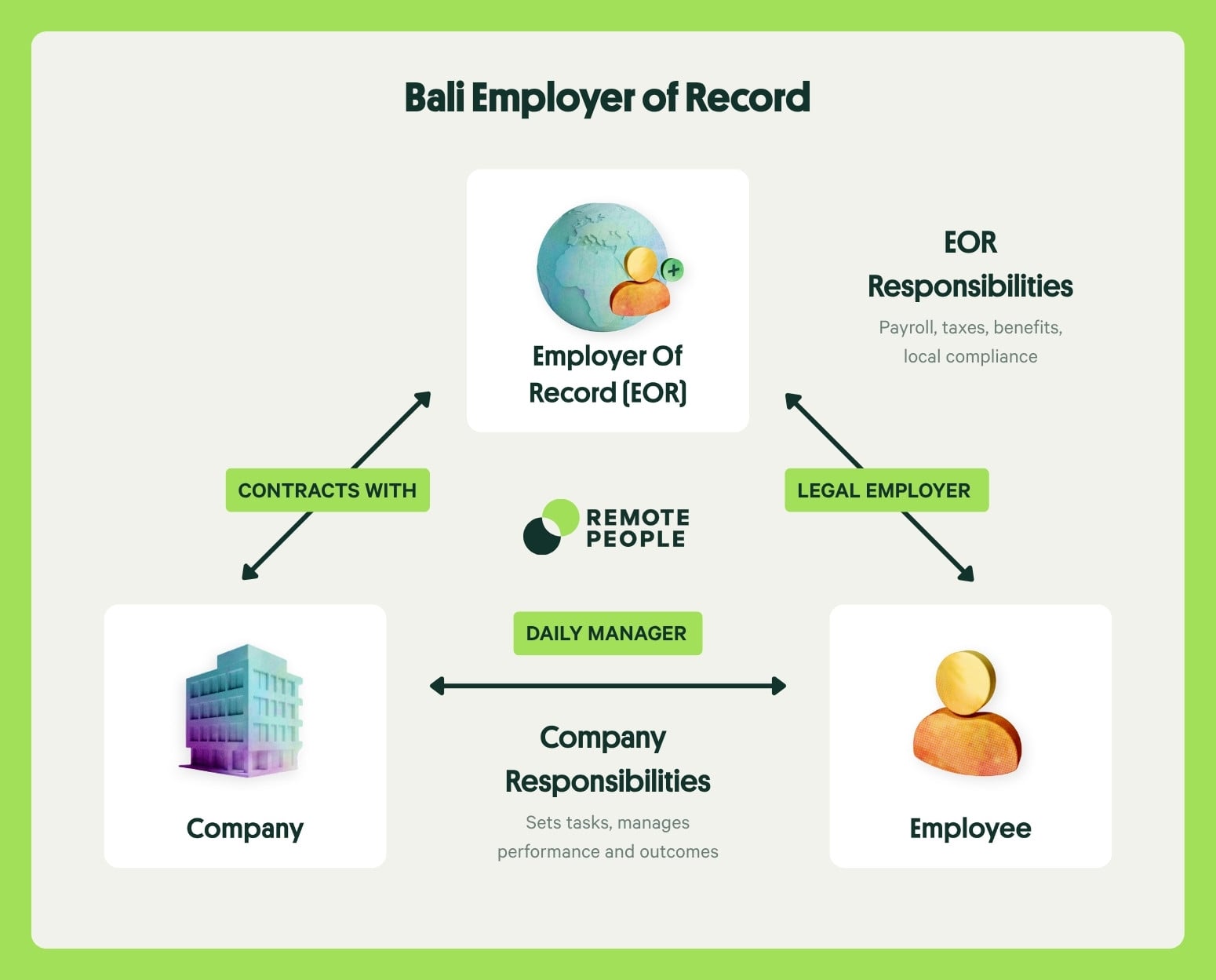
If you’d like to learn more about how Employer of Record (EOR) services work, read our What Is an Employer of Record (EOR)? guide for a complete overview of the model, its benefits, and when to use it.
If you’re comparing providers, our Best Employer of Record (EOR) Providers guide reviews the leading platforms to help you choose the right solution for your business.
Who Uses an EOR in Bali?
An employer of record in Bali is the fastest route to market for companies that want a small team on the island without committing to a local entity. The typical use cases include testing the Bali market with one to ten hires before deciding whether to invest in a PT PMA, onboarding a single senior leader ahead of a larger rollout, hiring local designers and developers for product teams headquartered in Singapore or Sydney, and absorbing staff from an acquired Bali operation while the integration is still in progress.
EOR is also the default choice for companies that need to hire quickly. An Indonesian PT PMA typically takes four to six months to incorporate, capitalise, and register with BPJS and the tax authority. An EOR can put a compliant employee on payroll in Bali in under two weeks.
Typical Onboarding Timeline
Most EOR providers can onboard an employee in Bali within 1 to 2 weeks, assuming the candidate is an Indonesian national. The timeline extends by three to eight weeks if a KITAS work permit is required for a foreign hire.
- First, sign the EOR service agreement and share employee details (1-2 days).
- Second, the EOR drafts a Bahasa Indonesia employment contract that meets Law No. 13 of 2003 requirements and sends it for signature (2-3 days).
- Third, BPJS Kesehatan and BPJS Ketenagakerjaan registration runs in parallel with the tax NPWP setup (3-5 days).
- Fourth, payroll is configured for the correct UMK wage floor and the employee completes onboarding (2-3 days).
- Fifth, the employee’s first working day and first monthly payroll cycle begin.
Hire in Bali
Skip the months-long entity setup and complex Indonesian compliance requirements. RemotePeople handles employment contracts, BPJS registration, payroll, and tax filing, so you can start building your Bali team in days, not months.
Employment Laws and Regulations in Bali
Employment Contracts
The governing framework for all employment in Bali is Indonesia’s Law No. 13 of 2003 on Manpower (Undang-Undang Ketenagakerjaan), as amended by Law No. 11 of 2020 on Job Creation (Cipta Kerja) and implemented by Government Regulation No. 35 of 2021. The Ministry of Manpower (Kementerian Ketenagakerjaan) is the primary regulatory authority.
Indonesian law recognises two contract types. An indefinite-term contract (PKWTT, or Perjanjian Kerja Waktu Tidak Tertentu) is the default permanent employment relationship. A fixed-term contract (PKWT) is allowed only for specific project-based, seasonal, or temporary work and is capped at a maximum cumulative duration of five years under Article 8 of PP 35/2021. All employment contracts must be written in Bahasa Indonesia to be legally binding; a bilingual English-Indonesian version is common in Bali’s international workplaces, but the Indonesian text controls in any dispute.
Working Hours and Overtime
The standard workweek in Bali is 40 hours under Article 77 of Law No. 13 of 2003. Employers can structure this as either 8 hours per day over 5 days or 7 hours per day over 6 days. Overtime is capped at 4 hours per day and 18 hours per week under Article 28 of PP 35/2021 (full regulation text).
Overtime on regular working days is paid at 1.5 times the hourly wage for the first hour and 2.0 times for each subsequent hour. Weekly rest day overtime pays 2.0 times for the first 7 or 8 hours (depending on schedule), 3.0 times for the next hour, and 4.0 times for any additional hours. Public holiday work is paid at 2.0 times for the first 8 hours, 3.0 times for the 9th hour, and 4.0 times beyond that. The hourly wage base is calculated as monthly salary divided by 173 hours.
Overtime in Bali is regulated by Law No. 13 of 2003 as amended by Law No. 11 of 2020 (Cipta Kerja) and implemented through Government Regulation No. 35 of 2021, which sets the standard workweek at 40 hours (either 7 hours for 6 days or 8 hours for 5 days). Any hour beyond that counts as overtime and is capped at 4 hours per day and 18 hours per week. Managerial staff whose duties, schedule, and responsibilities place them outside the 40-hour framework may be exempted, provided this is stated explicitly in the employment contract.
Bali overtime and premium pay rates · Per PP No. 35 of 2021 · 2026 | |||
Hour Type | Rate Multiplier | Weekly or Daily Cap | Notes |
|---|---|---|---|
Weekday overtime, first hour | 1.5× hourly wage | 4 hours per day, 18 hours per week | Employee written consent required. Food allowance or meal must be provided for overtime of 3 hours or more. |
Weekday overtime, each subsequent hour | 2.0× hourly wage | Counts toward the 4/18 hour cap | Hourly wage is calculated as 1/173 of monthly gross salary. |
Weekly rest day, first 7 or 8 hours | 2.0× hourly wage | 7 hours for 6-day week, 8 hours for 5-day week | Applies to work performed on the scheduled weekly rest day (typically Sunday). |
Weekly rest day, next hour | 3.0× hourly wage | 8th or 9th hour | Applies to the hour immediately following the standard rest-day allotment. |
Weekly rest day, hours beyond the above | 4.0× hourly wage | 9th and 10th hour on 6-day week, 10th and 11th on 5-day week | Any further hours are also paid at the 4.0× rate. |
Public holiday work (shortest workday) | 2.0× for first 5 hours, 3.0× for hour 6, 4.0× for hours 7 and 8 | Applies when the holiday falls on the employee’s shortest scheduled workday | Holiday rates replace normal pay for the day, not add to it. |
Public holiday work (standard workday) | 2.0× for first 7 or 8 hours, 3.0× for hour 8 or 9, 4.0× for hours 9–10 or 10–11 | 6-day week uses 7-hour base, 5-day week uses 8-hour base | Applies to any of Indonesia’s 16 national public holidays listed in Section 9. |
Minimum Wage
The 2026 provincial minimum wage in Bali (UMP Bali) is approximately $188 per employee per month (based on an exchange rate of roughly 17,100 rupiah per US dollar). This represents a 7.04% increase over the 2025 figure and was set by Bali Governor’s Decree No. 1011/03-M/HK/2025 issued in December 2025 (Bali provincial government).
Bali is divided into eight regencies and one city, each with its own regency-level minimum wage (UMK) that can sit above the provincial floor. Employers in Bali must pay the UMK of the regency where the employee actually works, not the provincial floor. The tourism-heavy regency of Badung has the highest UMK in 2026, and Bali also publishes a separate sectoral minimum wage (UMSP) of $191 per month for workers in accommodation and food and beverage services.
- Badung Regency UMK 2026: approximately $222 per month
- Denpasar City UMK 2026: approximately $205 per month
- Gianyar Regency UMK 2026: approximately $194 per month
- Tabanan, Buleleng, Karangasem, Bangli, Klungkung, and Jembrana: the $188 provincial UMP applies
For a full breakdown, RemotePeople maintains a dedicated minimum wage in Indonesia reference that covers every province. For Bali-specific pay benchmarks, see our Bali payroll and tax page.
Probation Period
The maximum probation period in Bali is 3 months under Article 60 of Law No. 13 of 2003. Probation is only allowed for PKWTT permanent contracts; it is legally void for fixed-term PKWT contracts. During probation, the employee must be paid at least the applicable regency UMK, and termination during probation still requires a written notice under PP 35/2021. The probation clause must appear in the signed employment contract to be enforceable.
Leave Entitlements
Bali follows Indonesia’s national statutory leave framework, which combines annual leave, sick leave, a significantly expanded maternity and paternity regime under Law No. 4 of 2024, and several short personal leave categories under Article 93 of the Manpower Law.
Annual Leave
Employees in Bali are entitled to a minimum of 12 paid working days of annual leave after 12 months of continuous service, under Article 79 of Law No. 13 of 2003 as amended by the Cipta Kerja Law. Leave accrues pro-rata before the 12-month threshold, and unused days must be paid out at the employee’s final salary rate on termination. At least six of the 12 days must be taken consecutively under the original statutory language, though in practice this is often waived by agreement.
Sick Leave
Sick leave in Bali is paid on a descending scale under Article 93 of Law No. 13 of 2003, using the employee’s regular salary as the base. The first 4 months of verified illness are paid at 100% of salary, the next 4 months at 75%, the following 4 months at 50%, and any period beyond 12 months at 25% until the employer can lawfully terminate for long-term incapacity. A medical certificate from a licensed doctor is required after the first few days of absence.
Maternity Leave
Maternity leave in Bali was significantly expanded by Law No. 4 of 2024 on Mother and Child Welfare in the First 1,000 Days of Life (UU KIA), which came into force in July 2024. The new entitlement is a mandatory 3 months of paid maternity leave at 100% of salary, with up to an additional 3 months available on medical grounds in cases of postpartum complications, miscarriage recovery, or newborn health issues. Pay for the optional extended months 4 through 6 is set at 75% of salary. The previous 1.5-month pre-birth and 1.5-month post-birth split under Law No. 13 of 2003 has been superseded.
Paternity Leave
Paternity leave in Bali was also expanded by Law No. 4 of 2024. Fathers now receive up to 5 days of paid leave for a normal birth (previously 2 days), with extensions of up to 10 days available for complications such as a high-risk pregnancy, miscarriage, or the death of the mother during childbirth. Paternity leave is paid at 100% of salary by the employer.
Other Statutory Leave
Article 93 of Law No. 13 of 2003 grants several short personal leave categories, all paid at 100% of salary. These include 3 days for the employee’s own marriage, 2 days for the marriage of the employee’s child, 2 days for a circumcision or baptism, 2 days for the death of a spouse, parent, parent-in-law, or child, and 1 day for the death of another household member. Female employees also have a statutory right to 2 days of menstrual leave per month under Article 81 where they experience significant pain, though this provision is rarely invoked in practice.
Bali statutory leave entitlements · Per Law No. 13 of 2003 and Law No. 4 of 2024 | ||
Leave Type | Duration | Eligibility and Notes |
|---|---|---|
Annual Leave | 12 working days | Paid at 100%. Accrues after 12 months service. Unused days paid out on termination. |
Sick Leave | Up to 12 months | 100% for months 1-4, 75% for months 5-8, 50% for months 9-12, 25% thereafter. Medical certificate required. |
Maternity Leave | 3 months (up to 6 months) | Mandatory 3 months at 100%. Optional months 4-6 at 75% with medical justification under UU 4/2024. |
Paternity Leave | Up to 5 days | 100% pay. Extendable to 10 days for childbirth complications under UU 4/2024. |
Menstrual Leave | 2 days per month | Available to female employees experiencing significant pain under Article 81. |
Marriage and Family Leave | 1-3 days | 3 days for own marriage, 2 days for child’s marriage, 2 days for circumcision or baptism. |
Bereavement Leave | 1-2 days | 2 days for death of spouse, parent, in-law, or child. 1 day for other household members. |
Source: Law No. 13 of 2003 on Manpower and Law No. 4 of 2024 on Mother and Child Welfare | ||
Statutory Employee Benefits
Beyond leave, Indonesian law requires employers in Bali to enrol every employee in two separate statutory social insurance systems that together cover health, pensions, and work injury. The first is BPJS Kesehatan, the national health insurance program, which is funded by a 4% employer contribution and a 1% employee deduction on gross salary (capped at a salary base of approximately $702 per month) and automatically covers the employee’s spouse and up to three children. The second is BPJS Ketenagakerjaan, which bundles five separate programs: old-age savings (JHT), mandatory pension (JP), work accident insurance (JKK), death benefit (JKM), and job loss insurance (JKP).
Bali employers must also pay a mandatory THR religious holiday bonus equivalent to one month’s salary before the employee’s main religious holiday, which for Bali’s Hindu majority is Nyepi, for Muslim staff is Idul Fitri, and for Christian staff is Christmas. For the exact contribution rates and ceilings, see Section 4 below on payroll and taxes. Our dedicated Bali employee benefits guide covers the full statutory package.
Recent Regulatory Updates (2026)
Three recent regulatory changes affect every Bali employer in 2026. First, Law No. 4 of 2024 (the KIA Law) came into force in July 2024 and permanently extended maternity leave to up to 6 months and paternity leave to up to 10 days, as described in the leave section above. Second, the Directorate General of Taxes introduced the TER (Tarif Efektif Rata-rata) effective-rate monthly withholding system for PPh 21 in January 2024, which simplifies monthly payroll calculations but still requires a progressive-bracket reconciliation each December.
Third, BPJS Ketenagakerjaan raised the JP pension contribution ceiling for 2026 to approximately $648 per month, up from roughly $617, effective March 2026. The annual ceiling adjustment is triggered by national GDP growth (5.11% in 2025) under PP 45/2015. Bali’s own 2026 minimum wage increase of 7.04% was set by Governor’s Decree No. 1011/03-M/HK/2025 using the updated PP 51/2023 formula, which weighs regional economic growth alongside inflation.
Work Permits and Visas in Bali
Work Permit Requirements
Who Needs a Work Permit
Any foreign national who intends to work for an Indonesian-registered employer in Bali requires a work permit under Indonesian immigration law. This includes foreigners hired through an EOR in Bali, since the EOR is itself an Indonesian entity acting as the legal employer. Indonesian nationals, including Bali-born Indonesians and returnees, do not need any work permit. A small number of ASEAN nationals can enter on short-term business visas for visits under two weeks, but any active employment relationship requires the full RPTKA and KITAS pathway.
Eligibility and Required Documents
To qualify for a work permit in Bali, a foreign candidate generally needs a bachelor’s degree, at least five years of relevant experience, and a signed employment contract with an Indonesian-registered employer. The typical document checklist includes a valid passport with at least 18 months remaining, the signed job offer and RPTKA approval, a diploma or degree certificate that has been apostilled in the home country, proof of work experience, a clean criminal record certificate, a recent medical examination, and a curriculum vitae in English or Bahasa Indonesia.
Processing Time and Validity
A typical KITAS work permit for Bali takes 4 to 8 weeks from the moment the RPTKA application is filed with the Ministry of Manpower to the moment the employee receives their card at the local immigration office. KITAS is usually issued for 6, 12, or 24 months depending on the contract and employer category. Delays usually come from apostille or document legalisation in the home country, not from the Indonesian side.
Renewal Process
KITAS renewal must be started at least 30 days before the current permit expires. The employer submits a fresh RPTKA notification and updated supporting documents, and the employee continues to work legally during the renewal window provided the application was filed on time. Since 2025, Indonesian Immigration has moved most KITAS applications onto a fully digital e-ITAS portal, which has cut typical renewal turnaround to 2 to 3 weeks.
Common Visa Types for Foreign Workers
Indonesia has several visa categories relevant to companies hiring into Bali. The E23 skilled professional visa is the standard route for foreign employees of an Indonesian company and leads directly into a KITAS work permit. The E28A investor KITAS is available to foreigners who personally invest in an Indonesian PT PMA, but it is not relevant for EOR hires. The E33G remote worker visa (often called the Bali digital nomad visa) allows foreign nationals to live in Bali while working exclusively for foreign-registered employers, which means it cannot be used by staff employed through an Indonesian EOR. The E33F second home visa is a 10-year residence permit for retirees and is not work-eligible. For most EOR use cases, the E23 visa feeding into a KITAS is the only compliant path.
Indonesia runs every foreign-hire visa category through the Directorate General of Immigration and requires the employer to hold a Foreign Manpower Utilisation Plan (RPTKA) approved by the Ministry of Manpower before any employment visa can be issued. The table below covers every category relevant to an EOR, investor, or remote working arrangement, plus the permanent residence pathway. ITAP (Izin Tinggal Tetap) is Indonesia’s permanent residence permit and the equivalent of a long-term settlement right.
Bali work visa types for foreign workers · 2026 | ||||
Visa Type | Duration | Best For | Leads to ITAP? | Processing |
|---|---|---|---|---|
E23 Skilled Worker KITAS | 6, 12, or 24 months, renewable | Standard EOR and local hire pathway for foreign employees of an Indonesian-registered employer. Requires RPTKA approval and the $100 per month DKPTKA levy. | Yes, after 3–5 years continuous KITAS | 4–8 weeks from RPTKA filing |
E28A Investor KITAS | 1 or 2 years, renewable | Foreign nationals who personally hold equity in an Indonesian PT PMA with roughly $585,000 paid-in capital. Not available through an EOR. | Yes, after 2 years continuous | 3–6 weeks |
E33G Remote Worker Visa | 1 year, renewable once | Foreign nationals working remotely for an employer registered outside Indonesia. Requires $60,000 annual income plus savings. Cannot be used for EOR employment. | No | 2–4 weeks |
E33F Second Home Visa | 5 or 10 years | Retirees and high-net-worth individuals. Requires a bank deposit of roughly $130,000. Does not confer the right to work in Indonesia. | Converts directly, but with no work rights | 4–8 weeks |
B211A Single-Entry Visit Visa | 60 days, extendable up to 180 days | Business visits, training, conferences, and meetings. Holders cannot engage in paid employment, so not a substitute for a KITAS. | No | 3–7 business days |
How an EOR Handles Work Permits
A Bali EOR can sponsor the full RPTKA and KITAS process on behalf of a foreign hire, which removes the single biggest barrier for companies that do not yet have an Indonesian entity. The EOR files the RPTKA with the Ministry of Manpower, coordinates the e-Visa application through the employee’s local Indonesian embassy, and arranges KITAS issuance at the Denpasar immigration office once the employee arrives. The employee’s role is to provide personal documents, attend any in-person biometric appointments, and complete a brief orientation. Sponsoring a work permit typically extends the standard 1 to 2 week onboarding timeline described in Section 1.4 by 4 to 8 weeks. For an end-to-end breakdown, see our Bali work visa guide.
Payroll, Taxes, and Social Security in Bali
Employer Contributions
Employers in Bali pay five separate social security contributions across the two BPJS systems, plus the work accident rate varies by industry risk category. The figures below use the medium-risk rate (0.89%) that applies to most professional services, hospitality, and tourism roles in Bali; lower-risk office-only roles may qualify for a 0.24% or 0.54% JKK rate.
Bali employer social security contributions · 2026 rates | ||
Contribution | Rate | Notes |
|---|---|---|
BPJS Kesehatan (health) | 4.00% | Capped on a salary base of approximately $702/month. Covers spouse and 3 children. |
JHT (old-age savings) | 3.70% | No salary ceiling. Employee receives lump sum on retirement or exit. |
JP (mandatory pension) | 2.00% | Capped on a salary base of approximately $648/month (increased March 2026). |
JKK (work accident, medium risk) | 0.89% | Varies 0.24%-1.74% by industry risk level. No salary ceiling. |
JKM (death benefit) | 0.30% | No salary ceiling. Lump-sum benefit paid to beneficiaries. |
JKP (job loss insurance) | 0.00% | Funded by government and recomposition from JKK/JKM, no employer cost. |
Total employer BPJS | 10.89% | Nominal rate before ceilings. Effective rate is lower for employees above the JP and Kesehatan caps. |
Employee Contributions
Employees in Bali pay a combined 4% of gross salary toward the same two BPJS systems. JHT old-age savings takes 2.0%, JP mandatory pension takes 1.0% (capped on the same $648 salary base as the employer portion), and BPJS Kesehatan takes 1.0% (capped at the same $702 salary base). Employees pay nothing toward JKK, JKM, or JKP, which are fully employer-funded or government-funded.
Bali employee payroll deductions · 2026 monthly withholdings | ||
Deduction | Rate | Notes |
|---|---|---|
JHT (old-age savings) | 2.00% | No salary ceiling. Withdrawable on retirement, resignation, or permanent departure. |
JP (mandatory pension) | 1.00% | Capped at an approximate $648 monthly salary base. |
BPJS Kesehatan (health) | 1.00% | Capped at an approximate $702 monthly salary base. |
Total employee BPJS | 4.00% | Deducted monthly via payroll, separate from PPh 21 income tax. |
Income Tax
Income tax in Bali follows Indonesia’s national PPh 21 progressive scale, set by Law No. 7 of 2021 on the Harmonisation of Tax Regulations. Every resident employee is entitled to a personal allowance (PTKP) before tax applies; the standard single-filer PTKP is roughly $3,158 per year with additional allowances for a spouse and up to three dependents. Since January 2024, employers withhold PPh 21 each month using the TER effective-rate system, then reconcile the final annual liability against the progressive brackets at year-end.
Bali income tax brackets · 2026 | |
Annual Taxable Income (USD) | Tax Calculation |
|---|---|
Up to $3,509 | 5% of taxable income |
$3,509 – $14,620 | $175 plus 15% of the amount above $3,509 |
$14,620 – $29,240 | $1,842 plus 25% of the amount above $14,620 |
$29,240 – $292,400 | $5,497 plus 30% of the amount above $29,240 |
Above $292,400 | $84,445 plus 35% of the amount above $292,400 |
Payroll Cycle
Payroll in Bali runs monthly, typically paid on the 25th or the last working day of the month by bank transfer to the employee’s Indonesian bank account. Cash payment is legal but almost never used in the formal economy. Pay slips must show the gross salary, all BPJS deductions, PPh 21 withholding, and net pay in Indonesian rupiah. Employers must remit PPh 21 income tax to the Directorate General of Taxes (DJP) by the 10th of the following month, file the SPT Masa PPh 21 monthly report by the 20th, and remit all five BPJS contributions by the 15th.
13th Month Salary and Bonus Pay
The 13th month salary in Bali is mandatory. Known as THR (Tunjangan Hari Raya), it is set by Ministerial Regulation No. 6 of 2016 (Permenaker 6/2016) and equals one full month of salary for any employee with 12 or more months of continuous service. Employees with between 1 and 12 months of service receive a pro-rata THR calculated as (months worked ÷ 12) × one month’s salary. Payment must arrive at least 7 days before the employee’s religious holiday: Idul Fitri for Muslim employees, Christmas for Christian employees, Nyepi for Bali’s Hindu majority, and Waisak for Buddhist employees. Late payment triggers a 5% fine plus the full backpay obligation, and repeat violations can be escalated to criminal penalties.
Cost of Hiring Through an EOR in Bali
EOR Service Fees
EOR service fees in Bali typically range from $300 to $600 per employee per month depending on provider, contract length, and role complexity. This flat USD fee covers the legal entity, employment contract drafting, monthly payroll processing, PPh 21 and BPJS remittance, THR administration, compliance monitoring, and HR support. RemotePeople’s standard pricing for Bali sits within this range, with volume discounts for teams of five or more.
Total Employment Cost Breakdown
The worked example below uses a gross monthly salary of $1,200, which is a realistic figure for a mid-level developer, designer, or operations lead in the Bali market. Because two BPJS contributions (JP and Kesehatan) are capped at ceilings below this salary, the effective employer BPJS load at $1,200 comes in below the 10.89% nominal rate shown in the contributions table.
Bali employer cost example · $1,200/month gross · 2026 | ||
Employer Cost | Amount (USD) | % of Gross |
|---|---|---|
Gross salary | $1,200.00 | 100.00% |
BPJS Kesehatan 4% (capped) | $28.07 | 2.34% |
JHT 3.70% | $44.40 | 3.70% |
JP 2.00% (capped) | $12.97 | 1.08% |
JKK 0.89% | $10.68 | 0.89% |
JKM 0.30% | $3.60 | 0.30% |
RemotePeople EOR fee | $400.00 | 33.33% |
Total employer cost | $1,699.72 | 141.64% |
Total employer cost in this example is $1,699.72 per month, roughly 41.6% above the gross salary. Employer BPJS contributions account for 8.3% of gross at this pay level (versus the 10.89% nominal rate), and the $400 RemotePeople EOR fee is the largest single component. You should also budget separately for the THR 13th-month bonus (one extra month’s salary each year) and for accrued annual leave payout on termination. All USD amounts are approximate conversions at an exchange rate of roughly 17,100 rupiah per US dollar (April 2026).
Ready to hire in Bali? Contact our team for a formal quote and we will handle employment contracts, payroll, tax withholding, and full Indonesian compliance. No local entity needed.
Benefits of Using an EOR in Bali
Using an EOR is the fastest way to put a compliant employee on payroll in Bali. Setting up a PT PMA from scratch takes four to six months, requires minimum paid-in capital of roughly $585,000, and pulls your leadership into tax registrations, BPJS enrolment, and gubernatorial licensing that have nothing to do with your actual business. An EOR can onboard the same employee in 1 to 2 weeks, using an entity that is already fully compliant with every national and Bali-provincial rule.
The compliance burden is the second reason companies choose an EOR over direct hiring. Indonesian labour law is dense, uses a three-component severance formula that changes multipliers depending on the termination ground, and still requires contracts in Bahasa Indonesia. Bali adds its own regency-level UMK floor and the Nyepi shutdown. Getting any of this wrong can trigger disputes at the Bali Industrial Relations Court, which almost always sides with employees. A specialist EOR absorbs that risk entirely.
Cost efficiency, local HR expertise, and the ability to scale down without dissolving an entity round out the business case. Using an EOR means no capital tied up in a dormant PT, no ongoing accounting and audit fees in rupiah, access to a local HR team that already speaks Bahasa Indonesia and understands Bali’s tourism-sector wage dynamics, and the flexibility to end a contract cleanly when a project wraps or a role disappears. For companies testing the Bali market, experimenting with distributed teams, or hiring a handful of senior specialists, the EOR model is almost always the right starting point.
Termination and Offboarding in Bali
Notice Periods
The employer must give at least 14 working days of written notice before the intended termination date under Article 37 of PP 35/2021, though this minimum is frequently extended by contract to 30 days for mid-level and senior roles. Employees who resign voluntarily typically provide 30 days of notice as set out in their individual contract. If the employer wants the employee to stop work immediately, the employer must still pay out the notice period in lieu. Probation-period terminations can use a shorter 7-day notice window.
Indonesian notice requirements are set by Article 151 of Law No. 13 of 2003 as amended by the Job Creation Law, and elaborated in Articles 37 and 40 of PP No. 35 of 2021. Unlike many jurisdictions, Indonesia uses a single statutory floor that does not scale with seniority or tenure. The variation below reflects contract type, the termination ground, and whether the employee is still in probation.
Bali statutory notice periods by position level · Per PP No. 35 of 2021 · 2026 | |||
Position Level or Contract Type | Notice Period | During Probation | Notes |
|---|---|---|---|
PKWTT (permanent indefinite contract), all seniority levels | 14 working days (minimum) | 7 working days (first 3 months) | Employer must submit a written termination notice that states the reason. Pay in lieu of notice is not expressly permitted; statutory severance is paid in addition to any notice period. |
PKWTT, senior management and directors | 14 working days (statutory floor) | 7 working days | Indonesian law does not set a longer statutory notice for executives. Longer contractual notice (30, 60, or 90 days) is common and enforceable if agreed in writing. |
PKWT (fixed-term contract) | No advance notice required at natural expiry | Probation is prohibited on PKWT contracts | Early termination before the contract end triggers compensation equal to the wages remaining through the contract expiry, plus any accrued UPH (compensation of rights). |
Dismissal for gross misconduct | No notice required | No notice required | Employer must still issue a termination letter and may need to present evidence in the Industrial Relations Court if the employee contests the grounds. |
Severance Pay
Calculation Method
Severance in Bali follows Indonesia’s three-component formula under Articles 40 through 58 of PP 35/2021. The first component is pesangon (severance pay proper), which scales from 1 month of salary for employees with less than 1 year of service up to 9 months of salary at 8 or more years of service. The second is uang penghargaan masa kerja (long-service reward), which starts at 2 months of salary after 3 years of service and rises to 10 months after 24 years. The third is uang penggantian hak (compensation of rights), which covers accrued unused annual leave and any other contractually accrued benefits. The base for all three is the employee’s most recent monthly wage including fixed allowances.
Each termination ground applies a different multiplier to pesangon and long-service reward. Termination for redundancy, company closure, retirement, or long-term illness applies a 1.0 multiplier to both components. Termination by mutual agreement applies a 0.5 multiplier to both. Voluntary resignation applies a 0.5 multiplier to pesangon and no long-service reward at all.
Caps and Exceptions
Indonesian severance has no statutory dollar cap, but the maximum achievable benefit is capped by the table itself: 9 months of pesangon and 10 months of long-service reward, for a total of 19 months of salary on a 1.0 multiplier ground after 24+ years of service. Fixed-term PKWT contracts that end on their scheduled expiry date do not trigger severance at all. Termination for gross misconduct under Article 52 of PP 35/2021 (criminal conviction, theft, or similar) triggers only the compensation of rights, with no pesangon and no long-service reward.
Indonesian severance pay is set by Articles 40–57 of PP No. 35 of 2021, implementing Articles 156 and 157 of Law No. 13 of 2003 as amended by the Job Creation Law. The total payout combines three components: Uang Pesangon (severance pay, tiered by years of service), Uang Penghargaan Masa Kerja (long-service reward, available from 3 years of service), and Uang Penggantian Hak (compensation of rights, covering unused leave and repatriation). The multiplier depends on the termination ground. The worked examples below assume redundancy dismissal by a profitable employer (1× pesangon + 1× UPMK), which is the most common EOR exit scenario.
Bali severance pay schedule by years of service · Per PP No. 35 of 2021 · 2026 | |||
Years of Service | Severance Amount | Base Salary | Notes |
|---|---|---|---|
1 year | 2 months pesangon + 0 UPMK = 2 months total | Last gross monthly salary plus fixed allowances | UPMK does not apply below 3 years of service. Uang Penggantian Hak (UPH) is paid in addition. |
3 years | 4 months pesangon + 2 months UPMK = 6 months total | Last gross monthly salary plus fixed allowances | UPMK tier 1 begins at exactly 3 years. THR (13th-month) is not included in the severance base. |
5 years | 6 months pesangon + 2 months UPMK = 8 months total | Last gross monthly salary plus fixed allowances | Pesangon is capped at 9 months; UPMK is capped at 10 months after 24 years of service. |
10 years | 9 months pesangon + 4 months UPMK = 13 months total | Last gross monthly salary plus fixed allowances | Pesangon reaches its statutory maximum at 8 years. UPMK tier 3 (9–12 years) applies here. |
Probation dismissal | Zero severance; only UPH (unused leave, repatriation) | Not applicable | Article 154A of PP 35/2021 exempts probation dismissals from pesangon and UPMK. |
Dismissal for gross misconduct | Zero pesangon; UPMK and UPH only if earned | Not applicable | Grounds are enumerated in Article 52 of PP 35/2021. Employer must document the misconduct and may need Industrial Relations Court approval. |
Grounds for Termination
PP 35/2021 lists 15 specific grounds for termination in Bali, grouped into three categories. Just-cause grounds include criminal conviction, gross insubordination, repeated violation of company rules after formal warnings, and disclosure of company trade secrets. No-cause grounds include redundancy, bankruptcy, business restructuring, automation, and force majeure. Non-disciplinary grounds include retirement, employee death, long-term incapacity beyond 12 months, and mutual agreement. Each ground has its own severance multiplier under Articles 40 and 41 of PP 35/2021, which is why accurate payroll data and a well-documented termination process matter so much when ending an employment relationship in Bali.
EOR vs. Other Hiring Models in Bali
EOR vs. Setting Up a Local Entity
The decision between using an EOR and setting up a PT PMA in Bali comes down to speed, capital, and long-term intent. A PT PMA is the standard foreign investment vehicle in Indonesia, but it requires minimum paid-in capital of roughly $585,000, takes 4 to 6 months to register, and exposes your leadership to ongoing Indonesian corporate tax, audit, and reporting obligations. An EOR in Bali uses an existing Indonesian entity, requires zero capital commitment, and can onboard an employee in 1 to 2 weeks.
Bali EOR vs local entity comparison · Setup time, cost, risk and best-fit | ||
Comparison | Employer of Record | Own Entity (PT PMA) |
|---|---|---|
Setup time | 1-2 weeks | 4-6 months |
Upfront cost | $0 | $20,000-$40,000 plus ~$585,000 paid-in capital |
Ongoing cost | $300-$600/employee/month | $15,000-$30,000/year in accounting, tax, and maintenance |
Local partner required | No (EOR is the local entity) | Not required for most sectors, but local director often needed |
BPJS and tax registration | Handled by EOR | You manage it |
Payroll and tax filing | Handled by EOR | You manage it (or outsource) |
Best for team size | 1-15 employees | 15+ employees |
Scale down or exit | Easy, no entity to unwind | Costly, legal dissolution required |
Government contracts | Not eligible | Eligible (requires local entity) |
For most companies with fewer than 15 employees in Bali, the EOR model wins on every dimension except one: eligibility for Indonesian government contracts, which require a locally-owned PT or PT PMA. If your business plan depends on selling directly to Indonesian ministries or state-owned enterprises, you eventually need an entity. Until then, an EOR gives you the same compliant employment relationship without any of the incorporation overhead.
The capital threshold is the second major factor. Indonesia’s BKPM requires roughly $585,000 in paid-in capital to register a PT PMA, which is a significant commitment for a company still testing the Bali market. EOR has no capital requirement.
EOR vs. Hiring Independent Contractors
Hiring independent contractors in Bali looks attractive on paper because it avoids BPJS, THR, and severance obligations entirely. The risk is misclassification: if a contractor relationship looks and functions like employment, Indonesian labour inspectors and courts can reclassify the relationship retroactively and impose back taxes, unpaid BPJS contributions, and the full severance formula. Misclassification risk means hiring independent contractors is only appropriate in some cases, typically short-term project work, specialised consulting, and roles where the worker has genuine autonomy over how and when they deliver.
Bali EOR vs independent contractors · Compliance, cost, and risk | ||
Comparison | EOR (Full-Time Employee) | Independent Contractor |
|---|---|---|
Legal relationship | Employee of the EOR under PKWTT or PKWT | Self-employed, no employment relationship |
Compliance risk | Low, EOR ensures Indonesian labour law compliance | Higher, misclassification risk if relationship resembles employment |
Payroll and tax | EOR handles PPh 21, BPJS, and filings | Contractor invoices you, handles their own PPh |
Benefits and leave | BPJS, paid leave, THR bonus, and severance | No entitlement to employee benefits |
IP protection | Stronger, employment contract assigns IP by default | Weaker, requires explicit IP assignment clause |
Termination | Subject to 14-day notice and PP 35/2021 severance | Contract can be ended per agreement terms |
Best for | Long-term, core team roles | Short-term projects, specialised tasks |
Cost structure | Salary plus 10.89% BPJS plus EOR fee | Contractor fee (typically higher gross, lower total cost) |
Source: Government Regulation 35 of 2021 and PwC Indonesia | ||
Indonesian courts apply a functional test to distinguish employees from contractors, looking at whether the worker uses company tools, follows fixed hours, reports to a supervisor, and receives regular fixed payments. If three or more of those factors apply, the relationship is almost certainly employment under Law No. 13 of 2003, and the tax authority can backdate BPJS and PPh 21 obligations up to five years.
If your role is genuinely project-based and requires contractor flexibility rather than employment protections, RemotePeople also offers a dedicated contractor management solution that handles compliant contractor agreements, IP assignment, PPh remittance, and payment processing. For more detail, see our global contractor management page or the contractors in Bali guide.
EOR vs. PEO (Professional Employer Organization)
Indonesia does not have a formal PEO legal framework. The co-employment model that defines a US-style PEO, where a client and the PEO share employer liability, does not exist under Indonesian labour law. Every employment relationship in Indonesia must have a single direct legal employer, which means any solution marketed as a Bali PEO is in practice either an EOR (if you do not have your own entity) or an outsourced HR and payroll service layered on top of your existing PT PMA.
Bali EOR vs PEO comparison · Legal employer, liability, and setup | ||
Comparison | Employer of Record (EOR) | PEO / HR Outsourcing |
|---|---|---|
Legal employer | EOR’s Indonesian entity is the sole employer | Your own PT PMA remains the legal employer |
Local entity required | No, the EOR is the local entity | Yes, you must already have a PT or PT PMA in Indonesia |
Best for | Companies without a local entity | Companies that already have a PT PMA |
Compliance liability | EOR assumes all employer compliance responsibility | Liability stays with your Indonesian entity |
Setup time | 1-2 weeks | Depends on your PT PMA setup (4-6 months) |
Control over HR policies | EOR manages within Indonesian law framework | You retain direct control, provider advises |
Typical use case | Market entry, small remote teams, testing Bali | Established Bali operations needing payroll outsourcing |
Source: Law No. 13 of 2003 on Manpower and BKPM Indonesia | ||
The practical difference is straightforward. If you do not yet have a PT PMA in Indonesia, an EOR is the only compliant route to put staff on payroll in Bali. If you already have a registered PT PMA, an HR outsourcing provider can take payroll, BPJS, and tax filing off your plate while your entity remains the legal employer. Most companies starting their first Bali hire should choose an EOR; companies with an existing entity that is scaling headcount should evaluate an outsourced HR and payroll provider.
A handful of Bali service providers market themselves as PEOs, but under Indonesian law they are almost always operating as either a licensed outsourcing company (under the PP 35/2021 outsourcing framework) or a straight EOR. Before signing any agreement, confirm in writing which entity will appear on the employment contract, since that is the only test that matters for compliance purposes.
Public Holidays in Bali
Bali observes Indonesia’s national public holiday calendar plus the Hindu holiday of Nyepi, which is unique to Bali and shuts down the entire island for 24 hours. All employees working in Bali are entitled to paid leave on each of these dates, and any work performed is payable at the public holiday overtime rate of 2.0 times to 4.0 times the regular hourly wage under PP 35/2021.
Bali public holidays · 2026 calendar year | ||
Date | Holiday | Type |
|---|---|---|
January 1 | New Year’s Day | Secular |
January 16 | Isra Mi’raj | Islamic |
February 17 | Chinese New Year (Imlek) | Cultural |
March 19 | Nyepi (Bali Day of Silence) | Hindu, Bali-wide shutdown |
April 3 | Good Friday | Christian |
April 21-22 | Idul Fitri (Eid al-Fitr) | Islamic |
May 1 | International Labour Day | Secular |
May 14 | Ascension Day | Christian |
May 21 | Waisak (Vesak) | Buddhist |
June 1 | Pancasila Day | Secular |
June 28 | Idul Adha (Eid al-Adha) | Islamic |
July 18 | Islamic New Year (Tahun Baru Hijriah) | Islamic |
August 17 | Independence Day | Secular |
September 26 | Maulid Nabi (Prophet’s Birthday) | Islamic |
December 25 | Christmas Day | Christian |
Nyepi on March 19, 2026 is the single most important holiday for any Bali-based payroll. The entire island shuts down for 24 hours, including the airport, seaports, hotels, and all businesses. No work of any kind is permitted. Employees must be paid in full, and no exceptions apply even to remote or work-from-home roles. The Indonesian government also publishes several collective leave days (cuti bersama) around major holidays each year through a joint ministerial decree, which often extend the effective break around Idul Fitri by an additional two to four days.
How to Get Started with an EOR in Bali
Launching a compliant Bali hire through RemotePeople’s employer of record is a short, predictable process that plugs into your existing recruitment workflow.
- First, scope the role, salary, location, and start date with RemotePeople, and share the candidate’s personal details (1-2 days).
- Second, sign the master EOR service agreement and approve the individual employment contract that RemotePeople drafts in Bahasa Indonesia (2-3 days).
- Third, the candidate signs the employment contract and provides onboarding documents, while RemotePeople handles BPJS, NPWP tax ID registration, and payroll setup (3-5 days).
- Fourth, the employee’s first day begins and the first monthly payroll runs on the agreed cycle.
- Fifth, RemotePeople manages ongoing payroll, statutory filings, leave tracking, and year-end tax reconciliation.
Ready to hire in Bali? Contact our team to get a custom quote, and we will onboard your first employee within two weeks. For a general overview of our service, see the employer of record page, and for transparent pricing across all markets, see RemotePeople pricing.
Where companies hiring in Bali expand next
Teams hiring in Bali typically expand across ASEAN, where cross-border mobility and diverse multilingual talent make regional coverage natural. After building a team in Bali, employers often look to a team in Malaysia for the ASEAN single-market trade framework, then operations in Singapore for overlapping ASEAN labor and mobility rules. Thailand follows with ASEAN-wide talent flows and shared hiring norms, and hiring in Indonesia typically closes the regional footprint via the parent jurisdiction’s framework extending to this market.
Frequently Asked Questions
Beyond the employee's gross salary and employer BPJS contributions (a nominal 10.89%, with an effective rate closer to 8-9% once the JP and Kesehatan ceilings kick in), you will pay an EOR service fee of $300 to $600 per employee per month. The exact fee depends on the provider, the length of your contract, and the complexity of the role. You should also budget separately for the mandatory THR 13th-month bonus each year.
RemotePeople can onboard an Indonesian national in 1 to 2 weeks, assuming the contract and candidate details are ready on day one. Onboarding a foreign national adds 4 to 8 weeks for the RPTKA filing and KITAS work permit issuance. Rushing either step creates compliance risk, so the EOR will not cut corners on statutory timelines.
You can, but only for genuinely project-based work where the contractor controls their own tools, hours, and methods. Indonesian labour inspectors apply a strict functional test, and long-term contractors who look like employees can be reclassified retroactively, triggering back taxes, unpaid BPJS contributions, and full severance under PP 35/2021. If you need contractor flexibility, RemotePeople offers a dedicated contractor management solution that handles compliant contracts, IP assignment, and payment processing for Bali.
The employment contract assigns all intellectual property to the client company (you), not the EOR. RemotePeople drafts every Bali employment contract with an explicit IP assignment clause so that work product, code, designs, and any other output flow directly to your business. The EOR is the legal employer for compliance purposes only; it has no ownership claim on anything the employee produces.
JHT and JP balances stay with the employee in their BPJS Ketenagakerjaan account and are withdrawable on retirement or permanent departure from Indonesia. Accrued but unused annual leave must be paid out at the final salary rate. If the employee has at least one month of service at the time of the religious holiday, they receive a pro-rata THR calculated as months worked divided by twelve times one month of salary.
Yes. RemotePeople's Indonesian entity can sponsor the RPTKA foreign worker plan with the Ministry of Manpower and coordinate KITAS issuance through Indonesian Immigration. This is one of the main reasons companies choose an EOR for Bali hires rather than spinning up their own PT PMA, which is also capable of sponsorship but takes 4 to 6 months to register.
Yes. Nyepi falls on March 19, 2026 and is a mandatory paid holiday for every employee in Bali. RemotePeople handles the pay calculation automatically and makes sure no work is scheduled for that day. Companies headquartered outside Indonesia often forget Nyepi because it does not appear on national Indonesia holiday lists, which is a common compliance pitfall.
The 2026 provincial minimum wage (UMP Bali) is approximately $188 per month. The regency-level minimum wage (UMK) where the employee actually works may be higher: Badung is about $222, Denpasar about $205, and Gianyar about $194. See our dedicated Bali minimum wage page for the full breakdown and historical figures.
Employer of Record in
Employer of Record in
Employer of Record in
Employer of Record in
Employer of Record in
Employer of Record in
Employer of Record in
Employer of Record in