
 Recruit
Employer of Record (EOR) in Comoros
-
 Drew Donnelly
- Published
- September 27, 2026
Hire employees in Comoros without setting up a local entity. RemotePeople handles payroll, employment contracts, social security registration, tax compliance, and benefits, so you can build your Comoros team in days, not months.
Hire in Comoros — book a free 30-minute demo
Tell us what you need. You'll get a tailored, transparent proposal within 24 hours, plus a free call to walk through it.
Tell us about your company
So we can match you with a specialist who knows your market — and unlock volume pricing tiers.
* All fields are required.
Where and when are you hiring?
Tell us the geography and timing and we'll quote each country line by line, with onboarding timelines.
* All fields are required.
Help us beat your current setup
We'll benchmark your current deal and send a line-by-line proposal in 24 hours — showing exactly where we cut cost, time, or risk. After you submit, you can book a call to walk through it together.
* All fields are required.
Thanks! Your proposal is on its way.
Expect a tailored, line-by-line proposal in your inbox within 24 hours. In the meantime…
Want to walk through it together?
Book a free 30-minute call with one of our specialists. We'll explain every line, answer your questions, and tailor the proposal further if you need.
No obligation. Pick a time that works for you.








- Hire in Comoros — book a free 30-minute demo
- Tell us about your company
- Where and when are you hiring?
- Help us beat your current setup
- Thanks! Your proposal is on its way.
- How an Employer of Record Works in Comoros
- Hire in Comoros Without a Local Entity
- Employment Laws and Regulations in Comoros
- Work Permits and Visas in Comoros
- Payroll, Taxes, and Social Security in Comoros
- Cost of Hiring Through an EOR in Comoros
- Benefits of Using an EOR in Comoros
- Termination and Offboarding in Comoros
- EOR vs. Other Hiring Models in Comoros
- Public Holidays in Comoros
- How to Get Started with an EOR in Comoros
- Where companies hiring in Comoros expand next
- Frequently Asked Questions
- Related EOR Destinations
Start hiring in Comoros
Let RemotePeople handle payroll, compliance, and HR admin worldwide so you can focus on building your team.

An employer of record in Comoros is the fastest compliant route to hire local and expatriate staff without incorporating a subsidiary in Moroni. The Union of the Comoros is a three-island francophone archipelago in the Indian Ocean with a labour force of roughly 350,000, a French-based legal system, and strategic access to the COMESA and Indian Ocean Commission regional markets. The trade-off for foreign employers is administrative complexity. The 1984 Labour Code as amended in 2012, registration with the Comorian retirement and social security fund, personal income tax administered by the Direction Générale des Impôts, and work authorization procedures run by the Ministry of Labour all apply from the first hire. An employer of record in Comoros removes that setup burden by becoming the legal employer of your staff, handling payroll, social contributions, tax withholding, and compliance, while you direct day-to-day work.
This guide explains how an EOR works in Comoros, the statutory framework employers must follow, payroll and tax contributions for 2026, the total cost of hiring, work permit rules for expatriates, termination procedures, and a full comparison with setting up your own entity or engaging independent contractors. All monetary amounts are shown in USD for easier comparison across markets, using the April 2026 reference rate of approximately KMF 427 per USD.
How an Employer of Record Works in Comoros
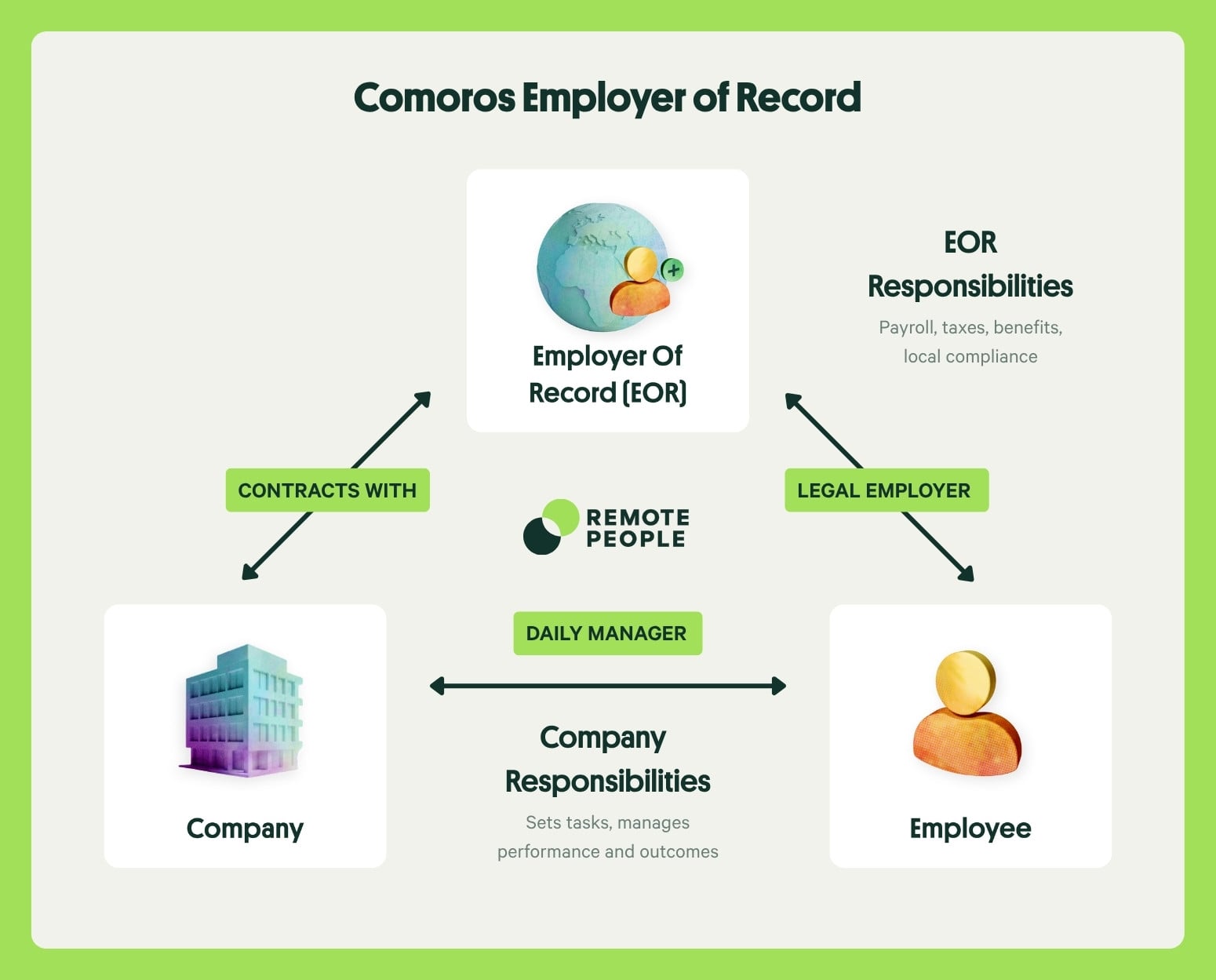
If you’d like to learn more about how Employer of Record (EOR) services work, read our What Is an Employer of Record (EOR)? guide for a complete overview of the model, its benefits, and when to use it.
If you’re comparing providers, our Best Employer of Record (EOR) Providers guide reviews the leading platforms to help you choose the right solution for your business.
Who Uses an EOR in Comoros?
Any company that wants to place a small team in Comoros without the lead time and capital commitment of local incorporation is a candidate for an EOR. The typical use cases include testing the Comorian market before committing to a subsidiary, hiring one to fifteen employees where incorporation does not justify the cost, retaining a Comorian national who would otherwise have to be misclassified as a contractor, and bringing in a regional coordinator for an Indian Ocean or East African project. Organisations with existing operations in Madagascar, Mauritius, or mainland East Africa also use a Comoros EOR as a lightweight staging point for cross-border hires.
Typical Onboarding Timeline
Most EOR providers can onboard a Comorian citizen within one to two weeks. Expatriate hires take longer because the long-stay visa and work permit must be issued before the employee can legally begin work.
- First, sign the EOR service agreement and provide employee details, salary, and job description. This takes 1 to 2 business days.
- Second, the EOR drafts a compliant French-language employment contract and sends it to the employee for signature. This takes 2 to 3 business days.
- Third, the EOR registers the employee with the Comorian retirement and social security fund and sets up the tax file with the Direction Générale des Impôts. Registration takes 3 to 7 business days in Moroni.
- Fourth, payroll is configured, the social security number is issued, and the employee begins work with full first-month coverage.
- Fifth, for expatriates, the long-stay visa and work permit are filed in parallel. Expect an additional 4 to 8 weeks before the work permit is issued, followed by 1 to 2 weeks for the residence card.
Hire in Comoros Without a Local Entity
RemotePeople handles payroll, compliance, and benefits in Comoros so you can focus on building your team. No entity setup required.
Employment Laws and Regulations in Comoros
Employment in Comoros is governed by the Labour Code (Loi n°84-108/PR of 12 February 1984), as amended by the Law of 28 June 2012, together with its implementing decrees and the collective bargaining agreements that apply to specific sectors. The Ministry of Labour, Employment, Vocational Training and Women’s Entrepreneurship is the primary regulator. Islamic law also influences personal status matters, but employment and payroll remain under the civil law framework inherited from the French legal tradition.
Employment Contracts
Every employment relationship in Comoros should be documented in a written contract, particularly where duration exceeds three months or where the employee is required to live away from their usual residence. The contract must specify the parties, job title, workplace, basic salary, working hours, probationary period, and duration, and it is typically drafted in French. Fixed-term contracts are permitted but tightly regulated, with renewal limits designed to prevent circumvention of indefinite-term protections. Indefinite-term contracts remain the default form of employment for open-ended roles and carry full statutory dismissal protections after probation.
Working Hours and Overtime
The standard workweek in Comoros is 40 hours for non-agricultural workers, arranged as 8 hours per day across 5 days. Agricultural work follows an annual cap rather than a weekly one. Any hours worked above the weekly ceiling count as overtime and must be authorized in advance by the employer.
Overtime is compensated at a premium over the regular hourly rate. Standard overtime hours are typically paid at 125% to 150% of the base rate under the general provisions of the Labour Code and the sector-specific collective agreements in force. Work performed on the weekly rest day attracts a higher premium, usually 150% to 200%, and night work between 9 p.m. and 5 a.m. carries additional compensation. Young workers under 18 cannot be assigned night shifts or hazardous tasks and have a lower weekly hours cap.
Minimum Wage
The minimum wage in Comoros is KMF 55,000 per month, which is approximately $129 at the April 2026 exchange rate. The current level is the Salaire Minimum Interprofessionnel Garanti (SMIG) for non-agricultural workers and has not been revised by decree since 2020, according to WageIndicator’s minimum wage tracker. Sector-specific collective agreements frequently set higher floors, particularly in banking, telecommunications, the vanilla and ylang-ylang export trade, and international NGO roles. Enforcement of the statutory SMIG is uneven in the informal sector, which remains by far the largest share of Comorian employment, but EOR arrangements always operate inside the formal framework.
Probation Period
Probation in Comoros is capped at 6 months for executive and managerial staff, 3 months for technicians and supervisors, and 1 month for ordinary workers. The probation clause must be in writing and signed before the contract takes effect. Either party may terminate the employment during probation without severance, provided reasonable written notice is given. After probation ends, full statutory dismissal protections apply, and a fixed-term contract cannot be renewed again under a probation label.
Leave Entitlements
Comorian employees accrue paid leave under the general principles of the 1984 Labour Code, which sets a minimum of 2.5 working days of paid leave per month of actual service. That produces 30 working days per year after twelve months of continuous service. Seniority, collective agreements, and Ministry of Labour orders can expand these entitlements, and young workers accrue leave at a higher rate. The sections below summarise each statutory leave category, followed by a comparison table.
Annual Leave
Employees accrue 2.5 working days of paid leave per month of actual service, producing a minimum of 30 working days after a full year. Collective agreements in the banking, telecommunications, and public-service sectors frequently add seniority increments of 1 to 2 days per five-year period. Annual leave must normally be taken within the reference year, with limited carryover at the employer’s discretion. Leave pay is calculated on the employee’s full salary including fixed allowances, and unused accrued days must be paid out on termination.
Sick Leave
Employees unable to work because of illness must provide a medical certificate from an approved practitioner, typically within 48 hours of the first missed day. Short-service workers are entitled to up to 6 months of paid sick leave at their normal rate, and employees with longer service receive extended protection under the Labour Code. The employer carries the first weeks of sick pay directly, and long-duration illness is then taken up by the social security scheme where the employee meets the contribution history requirement. A protected return-to-work right applies, and the employer cannot terminate a sick employee except on narrowly defined grounds of serious misconduct.
Maternity Leave
Female employees are entitled to 14 weeks of maternity leave, split into 6 weeks before and 8 weeks after the expected delivery date. The leave is fully paid, with costs shared between the employer and the social security authority under the retirement and welfare fund’s maternity benefits branch. During maternity leave and for up to 15 months after the birth, the employer cannot terminate the employee except for serious misconduct unrelated to the pregnancy. Nursing mothers are entitled to one hour per day of paid break time during the first year after returning to work.
Paternity Leave
Comorian labour law does not create a dedicated statutory paternity leave entitlement. New fathers may take paid family-event leave of 1 to 3 days under the special leave provisions of the Labour Code, depending on the applicable collective agreement. Private-sector employers in Moroni and the banking sector frequently add 5 to 10 days of paternity leave as a voluntary benefit, and most EORs follow the higher standard to stay competitive with regional Indian Ocean practice.
Other Statutory Leave
Beyond annual, sick, and maternity leave, Comorian workers are entitled to several additional statutory categories. Special family-event leave of 1 to 4 paid days applies to births, marriages, deaths of close relatives, and similar events. Paid public holidays cover the 13 days listed in the public holidays section below. Trade union leave allows worker representatives to attend official training sessions. Pilgrimage leave to Mecca is commonly granted once per employee under collective agreement, reflecting the country’s Muslim majority.
Comoros statutory leave entitlements · Per Labour Code Loi n°84-108/PR |
||
Leave Type |
Duration |
Eligibility & Notes |
|---|---|---|
Annual leave |
30 working days/year |
Accrues at 2.5 days per month of service; full salary; limited carryover at employer discretion. |
Sick leave |
Up to 6 months |
Medical certificate required; employer pays initial period, social security covers longer illness. |
Maternity leave |
14 weeks |
6 weeks pre-natal + 8 weeks post-natal; fully paid; shared employer / social security funding. |
Paternity leave |
1 to 3 days |
Family-event leave; many private employers add 5 to 10 days voluntarily. |
Family-event leave |
1 to 4 days |
Marriage, birth, death of close relative; fully paid under the Labour Code. |
Public holidays |
13 days/year |
Fixed secular dates plus Islamic holidays based on lunar calendar; 150% premium if worked. |
Pilgrimage leave (Hajj) |
Up to 30 days |
Commonly granted once per employee under collective agreement; usually unpaid. |
Statutory Employee Benefits
Beyond paid leave, Comorian employers must register every employee with the national retirement and welfare fund and contribute to the public social security scheme, which funds pension, family allowances, and occupational risk insurance. There is no universal statutory health insurance scheme in Comoros, so most private-sector employers offering competitive packages also buy supplementary private health cover, either locally or through regional Indian Ocean insurers. Life and disability insurance are not statutory but are commonly offered by banks, telecommunications operators, and international NGOs.
Transport allowances and meal vouchers are not mandated by the Labour Code but are frequently included in employment contracts in Moroni, where commuting costs are a meaningful share of a monthly wage. A housing allowance is customary for expatriate employees and for Comorian staff relocated between islands. EOR providers typically offer a standard benefits package that bundles supplementary health insurance, transport allowance, and an optional 13th month bonus, which keeps your offer competitive with Comoros banking and telecoms roles. For the exact employer and employee contribution percentages, see the tables in the payroll and taxes section below, and review our guide to employee benefits in Comoros.
Recent Regulatory Updates (2026)
As of April 2026, Comoros has not enacted a new comprehensive labour code and the 1984 statute remains the core text, as last amended in 2012. The current SMIG of KMF 55,000 per month has been in force since 2020 and no fresh indexation decree has been published. The Direction Générale des Impôts ran a transfer pricing capacity-building programme with OECD and UNDP support in late 2025, signalling a tighter focus on cross-border arrangements that may affect EOR and contractor structures in the coming years.
The International Monetary Fund published a March 2026 selected issues paper on tax and expenditure policies in Comoros, which flagged the narrow personal income tax base and recommended gradual reform. No amendments to the income tax brackets had taken effect as of April 2026, and the 2023 Code Général des Impôts remains the current tax framework. Employers should watch the Journal Officiel de l’Union des Comores for any 2026 amendments to social security rates or the IRPP schedule.
Work Permits and Visas in Comoros
Work Permit Requirements
Who Needs a Work Permit
All foreign nationals, including citizens of neighbouring African countries, require a work permit and a long-stay visa to be employed in Comoros. There are no visa-exempt employment regimes, and the 30-day entry visa available on arrival cannot be converted into work authorization. Nationals of France and other Schengen states still require a full work permit if they intend to earn income from a Comorian employer.
Eligibility and Required Documents
The employer submits the work authorization file to the Ministry of Labour. The employee provides a valid passport with at least six months of remaining validity, a signed employment contract, proof of qualifications and professional experience, a police clearance certificate from their country of residence, a medical certificate, and passport photographs. The Ministry of Labour assesses whether the position can be filled by a Comorian national before issuing the authorization, a standard labour market test in francophone Africa.
Processing Time and Validity
Work permit processing typically takes 4 to 8 weeks once the complete file has been submitted, depending on administrative capacity. The initial permit is usually valid for 1 year and is tied to the employer and the specific role. A matching long-stay visa is issued by the Direction Générale de la Sûreté du Territoire, followed by a residence card once the employee has landed. Processing is slower during the Ramadan period and in the weeks around major public holidays.
Renewal Process
Renewal must begin at least 60 days before expiry and requires an updated employment contract, proof of continued employment, social security contribution receipts, and a fresh medical certificate. Renewals are usually issued for 1 to 2 years. Provided the renewal file is submitted on time, the employee can continue working during processing, but the EOR keeps proof of the renewal receipt in case of inspection.
Common Visa Types for Foreign Workers
- Long-stay work visa, for employment contracts longer than 3 months, issued after the Ministry of Labour grants work authorization.
- Short-stay business visa, valid for 30 days and extendable to 60, intended for meetings and training but not for salaried work.
- Investor and company-founder visa, available to foreign nationals registering a local entity and used where a full subsidiary is being set up.
- Dependent and family reunification visa, granted to spouses and minor children of work permit holders on proof of relationship.
The table below sets out the four visa pathways most commonly used by foreign workers entering Comoros, based on the Loi n°88-025 on foreigners’ conditions of stay and Article 33 of the Code du Travail on foreign contracts.
Comoros work visa types for foreign workers · 2026 | ||||
Visa Type | Duration | Best For | Leads to Residence? | Notes |
|---|---|---|---|---|
Long-stay work visa | 1 year, renewable | Employment contracts longer than 3 months | Yes — paired with residence card | Issued after Ministry of Labour grants work authorization |
Short-stay business visa | 30 days, extendable to 60 | Meetings and training | No | Not valid for salaried or paid work |
Investor / company-founder visa | Tied to entity registration | Foreign nationals registering a local entity | Yes — long-term residence | Used where a full subsidiary is being set up |
Dependent / family reunification visa | Matches sponsor visa | Spouses and minor children of work permit holders | Yes — derived from sponsor | Proof of relationship required |
Source: Comoros Loi n°88-025 on the conditions of stay of foreigners and Code du Travail Article 33. | ||||
How an EOR Handles Work Permits
An EOR in Comoros sponsors the work permit on its local licence and acts as the legal employer for immigration purposes. The EOR prepares the work authorization file, submits it to the Ministry of Labour, coordinates the long-stay visa and work permit with the Direction Générale de la Sûreté du Territoire, and manages the residence card and any renewals. The employee focuses on collecting personal documents such as passport, police clearance, and medical certificate. Because a local employer licence is required to sponsor foreign hires in Comoros, an EOR is often the fastest compliant route for companies without a subsidiary. As noted in the onboarding timeline above, expatriate hires typically add 4 to 8 weeks to the timeline before the employee can legally start.
Payroll, Taxes, and Social Security in Comoros
Employer Contributions
Employers in Comoros must register every employee with the national retirement and welfare fund and remit monthly contributions covering old-age pension, family allowances, and occupational risk insurance, plus a small vocational training levy. Exact rate breakdowns are not consistently published by the Comorian authorities, and individual line items should be confirmed with the retirement fund at payroll setup. Total employer social contributions fall in the approximate range of 9 to 10 percent of gross salary, placing Comoros among the lower-burden jurisdictions in francophone Africa.
Comoros employer social security contributions · 2026 rates |
||
Contribution |
Rate |
Notes |
|---|---|---|
Old-age pension (retraite) |
5.0% |
Administered by the Comorian retirement fund; funds pension and survivor benefits. |
Family allowances |
2.5% |
Funds family and maternity benefits for registered employees. |
Occupational risk insurance |
1.0% |
Covers workplace accidents and occupational disease compensation. |
Vocational training levy |
1.0% |
Earmarked for national vocational training programmes; remitted with social security. |
Total employer contributions |
9.5% |
Applied to gross monthly salary; confirm exact line items with the retirement fund at registration. |
Employee Contributions
Employees in Comoros contribute a single line item to the national retirement fund, which funds their future pension and survivor benefits. There is no separate employee line for health insurance or unemployment, because Comoros does not operate a universal statutory health insurance scheme or a contributory unemployment fund. The employee pension contribution is withheld from gross salary and remitted monthly by the employer alongside the employer contributions and personal income tax.
Comoros employee payroll deductions · 2026 monthly withholdings |
||
Deduction |
Rate |
Notes |
|---|---|---|
Old-age pension (retraite) |
4.0% |
Withheld monthly and remitted to the Comorian retirement fund with employer contributions. |
Personal income tax (IRPP) |
0% to 30% |
Progressive brackets; withheld at source under PAYE. See the IRPP table below. |
Total employee deductions |
4.0% + IRPP |
Pension is a flat rate; personal income tax is progressive and depends on annual salary. |
Income Tax
Personal income tax in Comoros is progressive, with seven brackets ranging from 0 percent on the first tranche of annual income up to 30 percent on the highest incomes. The IRPP is administered by the Direction Générale des Impôts and collected through employer withholding (prélèvement à la source) each month. The brackets below are expressed in USD for international comparison, using the April 2026 reference rate of KMF 427 per USD. The Comorian franc thresholds remain the legal reference for filing.
Comoros income tax brackets · 2026 |
|
Annual Taxable Income (USD) |
Tax Calculation |
|---|---|
$0 to $351 |
0% (tax-free allowance) |
$352 to $1,171 |
5% of income above $351 |
$1,172 to $2,342 |
$41 + 10% of income above $1,171 |
$2,343 to $3,513 |
$158 + 15% of income above $2,342 |
$3,514 to $5,855 |
$334 + 20% of income above $3,513 |
$5,856 to $8,197 |
$802 + 25% of income above $5,855 |
Above $8,197 |
$1,388 + 30% of income above $8,197 |
Payroll Cycle
Payroll in Comoros runs on a monthly cycle, with salaries paid by bank transfer or, more commonly outside Moroni, by cash against a signed pay slip. Employers must issue a pay slip every month showing gross pay, each social security line item, the IRPP withholding, and the net amount. Personal income tax withholding is remitted to the Direction Générale des Impôts by the 15th of the following month, and social security contributions are due on the same cycle to the retirement fund. Late filing attracts interest and penalties, and the tax office is increasingly digitising its filing workflows.
13th Month Salary and Bonus Pay
A 13th month salary is not mandatory under Comorian labour law, and there is no statutory requirement for an annual bonus. Many banks, telecommunications operators, and international NGO employers voluntarily pay a 13th month equal to one month’s basic salary, usually in December before the end-of-year holidays. Some collective agreements also provide a small end-of-year productivity bonus, and public-sector rules can differ. For private EOR hires, a 13th month is usually negotiated into the offer package as a voluntary benefit to stay competitive with local Moroni salaries.
Cost of Hiring Through an EOR in Comoros
EOR Service Fees
EOR service fees in Comoros typically range from $300 to $600 per employee per month, invoiced in USD. The fee covers employment contract drafting, monthly payroll processing, social security and IRPP withholding, work permit sponsorship, benefits administration, and ongoing compliance support. It is separate from the employee’s gross salary and the employer social contributions, which are passed through to the retirement fund at cost.
Total Employment Cost Breakdown
The table below shows an illustrative full employment cost for a mid-level Comoros hire on a $1,200 per month gross salary. All amounts are in USD. Exchange rate conversions use the April 2026 reference rate of KMF 427 per USD.
Comoros employer cost example · $1,200/month gross · 2026 |
||
Employer Cost |
Amount (USD) |
% of Gross |
|---|---|---|
Gross monthly salary |
$1,200 |
100.0% |
Old-age pension (retraite) |
$60 |
5.0% |
Family allowances |
$30 |
2.5% |
Occupational risk insurance |
$12 |
1.0% |
Vocational training levy |
$12 |
1.0% |
EOR service fee (est.) |
$400 |
33.3% |
Total monthly employer cost |
$1,714 |
142.8% |
Total employer cost in this example is approximately 43 percent above the employee’s gross salary, of which roughly 9.5 percentage points are social security and the balance is the EOR service fee. The EOR fee’s share of total cost is larger in Comoros than in higher-wage markets because gross salaries are comparatively low. All USD amounts above are approximate conversions at $1 = KMF 427 (April 2026 rate).
Ready to hire in Comoros? Get started with RemotePeople. We handle employment contracts, payroll, social security, IRPP withholding, and full Comoros compliance. No local entity needed.
Benefits of Using an EOR in Comoros
Using an employer of record in Comoros turns a difficult market-entry project into a predictable weekly operation. Instead of spending three to six months incorporating a local company, opening bank accounts, registering with the tax office and the retirement fund, and recruiting a local HR lead, you sign an EOR agreement and start hiring within days. The legal, payroll, and immigration burden sits with the EOR, which lets you focus on what the employee actually does rather than how to keep them compliant.
The compliance upside is significant. Comoros has a French-inflected labour code that is unfamiliar to many international HR teams, along with local enforcement practices and filing deadlines that rarely appear in English-language guides. A local EOR brings direct relationships with the retirement fund, the Direction Générale des Impôts, and the Ministry of Labour, which prevents late-filing penalties and shortens the time needed to respond to inspections. It also manages the growing set of supplementary health, life, and pension products that private-sector employers are expected to offer in Moroni.
The financial and strategic benefits compound from there. EOR pricing is a flat monthly fee per employee, which is easier to budget than the lumpy costs of a subsidiary, and it lets you scale down as quickly as you scaled up. You keep the option to hire one employee as a pilot, test demand for six months, and either commit to full incorporation or exit without unwinding a legal entity. That optionality is particularly valuable in a small market like Comoros, where headcount decisions are usually modest and demand conditions can change fast.
Termination and Offboarding in Comoros
Notice Periods
Statutory notice periods in Comoros are tiered by employee category. Ordinary workers are typically entitled to 1 month of notice, technicians and supervisors to 2 months, and executive or managerial staff to 3 months. Fixed-term contracts usually run to their contractual end date, with early termination allowed only for serious misconduct or force majeure. During the notice period the employee continues to receive full salary and benefits, and the employer must allow paid time off for the employee to search for a new job.
Severance Pay
Calculation Method
Severance pay (indemnité de licenciement) is owed in Comoros when an employer terminates an indefinite-term contract for reasons other than serious misconduct. The statutory baseline is approximately one month of salary per year of completed service, calculated on the employee’s average gross monthly salary over the last 12 months including fixed allowances. Collective bargaining agreements in banking, telecommunications, and the Moroni port can push the multiplier higher for long-tenured staff, and the final amount is agreed after consultation with the workplace consultative committee where one exists.
Caps and Exceptions
There is no hard statutory cap on severance pay in Comoros, but collective agreements often include a maximum number of months of salary for very long tenures. Severance is not owed where the contract ends during probation, where the employee resigns voluntarily, where a fixed-term contract reaches its natural end date, or where the employer dismisses the employee for serious misconduct (faute lourde) supported by evidence. A separate pay-in-lieu-of-notice indemnity applies if the employer waives the statutory notice period.
Grounds for Termination
A Comorian employer can terminate an indefinite contract for economic reasons, personal reasons (performance or conduct), or serious misconduct. Each path has its own procedural requirements. Economic dismissals require consultation with the workforce and, where thresholds are met, notification to the Ministry of Labour. Personal dismissals require a warning, a hearing, and a written termination letter setting out the reasons. Serious misconduct allows immediate dismissal without notice or severance, provided the evidence is documented and the procedure is followed. Pregnant employees, employees on maternity leave, and worker representatives enjoy enhanced protection, and dismissing them usually requires prior authorization from the labour inspectorate.
EOR vs. Other Hiring Models in Comoros
EOR vs. Setting Up a Local Entity
Choosing between an Employer of Record and setting up your own legal entity in Comoros comes down to timeline, upfront cost, ongoing administrative burden, and how quickly you can scale up or wind down. The table below lays out both paths side by side across setup time, cost, compliance risk, and flexibility so you can match the right model to the size and duration of your Comoros hiring plan.
Comoros EOR vs local entity comparison · Setup time, cost, risk and best-fit |
||
Comparison |
Employer of Record |
Own Entity |
|---|---|---|
Setup time |
1 to 2 weeks |
3 to 6 months |
Upfront cost |
$0 |
$8,000 to $20,000 |
Ongoing cost |
$300 to $600/employee/month |
$10,000 to $25,000/year maintenance |
Local partner required |
No (EOR is the local entity) |
Not mandatory, but strongly recommended |
Social insurance registration |
Handled by EOR |
You manage it |
Payroll & tax filing |
Handled by EOR |
You manage it (or outsource) |
Best for team size |
1 to 15 employees |
15+ employees |
Scale down / exit |
Easy, no entity to unwind |
Costly, legal dissolution required |
Government contracts |
Not eligible |
Eligible (requires local entity) |
Setting up a Comorian subsidiary makes sense once headcount is consistently above fifteen employees or when the business needs to bid on government and donor-funded contracts, which are only open to locally incorporated entities. Below that threshold, an EOR is faster, cheaper, and more flexible. You avoid the capital requirement, the bank account opening delays in Moroni, and the fixed cost of a local finance and HR function that a small team cannot absorb.
The hidden cost of a subsidiary in Comoros is ongoing compliance. Annual financial statements, tax returns, social security reconciliations, and labour inspectorate filings all have to be produced in French, on local paper, to local deadlines. A missed filing usually means a visit from an inspector and a penalty. An EOR bundles all of that into the monthly fee, so you pay a predictable amount and the provider absorbs the operational risk.
For most international hires in Comoros, the practical choice is to start with an EOR and revisit the decision once the local team is stable, growing past ten people, or moving into regulated sectors such as banking or telecommunications where a local licence is mandatory. That staged approach keeps market-entry risk low and preserves the option to scale up if the business case holds.
EOR vs. Hiring Independent Contractors
Classifying a Comoros-based worker as an independent contractor rather than an employee can expose you to back-taxes, unpaid social contributions, and reclassification penalties if the working relationship looks like employment in practice. The table below contrasts EOR employment with contractor engagement across legal relationship, tax and benefits treatment, IP ownership, and misclassification risk so you can pick the right model role by role.
Comoros EOR vs independent contractors · Compliance, cost, and risk |
||
Comparison |
EOR (Full-Time Employee) |
Independent Contractor |
|---|---|---|
Legal relationship |
Employee of the EOR |
Self-employed, no employment relationship |
Compliance risk |
Low, EOR ensures local labour law compliance |
Higher, misclassification risk if the relationship resembles employment |
Payroll & tax |
EOR handles withholding, contributions, filings |
Contractor invoices you; they handle their own taxes |
Benefits & leave |
Statutory benefits, paid leave, social security |
No entitlement to employee benefits |
IP protection |
Stronger, employment contract assigns IP by default |
Weaker, requires explicit IP assignment clause |
Termination |
Subject to local notice periods and severance |
Contract can be ended per agreement terms |
Best for |
Long-term, core team roles |
Short-term projects, specialized tasks |
Cost structure |
Salary + employer contributions + EOR fee |
Contractor fee (typically higher gross, lower total cost) |
Hiring an independent contractor in Comoros is appropriate for short-term project work, specialized consulting, and roles with genuine autonomy over how and when the work is performed. A well-drafted consultancy agreement, clear deliverables, and regular invoices create a clean independent relationship that the Direction Générale des Impôts and the labour inspectorate will usually respect.
The risk is misclassification. If the Comorian contractor works full time on your core operations, uses your tools, follows your schedule, and reports to your managers, the labour inspectorate can reclassify the arrangement as employment. The consequences are back social security contributions to the retirement fund, back personal income tax, late-filing penalties, and a forced employment relationship that you cannot easily unwind. Misclassification risk is only appropriate to accept in some cases, such as short-term project work, specialized consulting, or roles with genuine autonomy.
For core team roles, an EOR gives you a compliant full-employee relationship from day one, avoids misclassification entirely, and still keeps the flexibility of a monthly service contract. For short projects where the risk is low, RemotePeople also offers a managed contractor solution, which handles compliant contractor payments, contracts, and classification checks. See our Comoros contractor hiring guide for details.
EOR vs. PEO (Professional Employer Organization)
EORs and PEOs both simplify international hiring, but only an EOR becomes the legal employer of record in Comoros — a critical distinction when you don’t have a local entity of your own. The table below maps the practical differences across legal employer status, entity requirement, liability allocation, and scope of coverage.
Comoros EOR vs PEO comparison · Legal employer, liability, and setup |
||
Comparison |
Employer of Record (EOR) |
PEO |
|---|---|---|
Legal employer |
EOR is the legal employer |
You remain the legal employer (co-employment) |
Local entity required |
No, the EOR is the local entity |
Yes, you must have your own entity in Comoros |
Best for |
Companies without a local entity |
Companies that already have a local entity |
Compliance liability |
EOR assumes compliance responsibility |
Shared liability between you and the PEO |
Setup time |
1 to 2 weeks |
Depends on your entity setup (weeks to months) |
Control over HR policies |
EOR manages within local law framework |
More direct control, PEO advises |
Typical use case |
Market entry, small remote teams, testing new markets |
Established local operations needing HR outsourcing |
Comoros does not have a formal regulatory framework for Professional Employer Organisations, and the co-employment concept that underpins PEOs in the United States does not exist under Comorian law. In practice, providers marketed as PEOs in Comoros either operate as full employers of record (where they hire the staff directly) or as HR and payroll outsourcing firms that rely on the client’s own local entity.
The key difference for international companies is simple. An EOR means you do not need your own Comorian entity. A PEO assumes you already have one and wants to manage HR on your behalf. If you are entering Comoros for the first time, an EOR is almost always the right starting point. If you already have a Moroni-registered subsidiary and want to outsource HR, payroll, and labour compliance, a local HR outsourcing provider is the closer equivalent of a PEO arrangement.
Either way, the EOR model is faster and lower risk at the market-entry stage. You preserve the option to set up an entity later once the business case has been proven, and you avoid the upfront cost and dissolution risk of a subsidiary you may not need in the long term.
Public Holidays in Comoros
Comoros observes a defined set of official public holidays on which most private-sector employers must give staff a paid day off (TimeAndDate Comoros 2026 holidays). The table below lists the statutory holidays employers need to build into payroll calendars and leave planning for the year, along with the date rule for each.
Comoros public holidays · 2026 calendar year |
||
Date |
Holiday |
Type |
|---|---|---|
January 1 (Thu) |
New Year’s Day |
Secular |
January 17 (Sat) |
Isra and Mi’raj |
Islamic |
March 18 (Wed) |
Cheikh Al Maarouf Day |
National |
March 19 (Thu) |
Eid al-Fitr (Day 1) |
Islamic |
March 20 (Fri) |
Eid al-Fitr (Day 2) |
Islamic |
May 1 (Fri) |
Labour Day |
Secular |
May 27 (Wed) |
Eid al-Adha (Day 1) |
Islamic |
May 28 (Thu) |
Eid al-Adha (Day 2) |
Islamic |
June 17 (Wed) |
Islamic New Year (Muharram) |
Islamic |
July 6 (Mon) |
Independence Day |
Secular |
August 26 (Wed) |
Mawlid (Prophet’s Birthday) |
Islamic |
November 12 (Thu) |
Maore Day |
National |
Comoros observes 12 official public holidays in 2026, combining secular national dates, Independence Day on 6 July, and the major Islamic festivals. Islamic holiday dates are set by lunar calendar and can shift by one or two days depending on local moon sightings, so employers should confirm dates with the Ministry of the Interior each year. Work performed on a public holiday is compensated at a premium of 150 percent or more, and most businesses in Moroni observe a half-day on the eve of Eid al-Fitr and Eid al-Adha.
How to Get Started with an EOR in Comoros
- First, identify the role and target salary. Benchmark against local Moroni pay bands, including the sector-specific collective agreements that apply in banking, telecommunications, and the public sector.
- Second, decide on benefits. Confirm whether the package includes a 13th month, supplementary private health insurance, a transport allowance, and any performance-linked bonuses.
- Third, sign the EOR service agreement. A standard Comoros EOR agreement covers contract drafting, payroll, social security, IRPP withholding, and work permit sponsorship where needed.
- Fourth, onboard the employee. The EOR collects personal documents, issues a French-language employment contract, registers the employee with the retirement fund and the tax office, and processes the first-month payroll.
- Fifth, manage the relationship. Monthly invoices bundle gross salary, employer contributions, and the EOR fee in USD, and the EOR files all returns on your behalf.
Ready to hire in Comoros? Contact RemotePeople. Our Comoros EOR service handles employment contracts, payroll, social security, IRPP withholding, work permits, and full compliance. Build your Comoros team in days, not months.
Where companies hiring in Comoros expand next
Hiring in Comoros frequently leads to recruitment across East Africa’s English-speaking cluster and the wider Indian Ocean corridor. Many companies add an EOR partner in Uganda first, drawing on the regional East African talent pool. Tanzania follows as aligned East African English-first hiring profile, while a team in Rwanda offers shared East African workforce norms. Operations in Kenya is often the fourth step, valued for overlapping East African talent profile.
Frequently Asked Questions
Beyond the employer social security contributions (approximately 9.5% of gross salary), you pay an EOR service fee of $300 to $600 per employee per month. The exact amount depends on the provider and the complexity of the role. For a $1,200 per month gross salary, the fully loaded monthly cost is approximately $1,714 including the EOR fee.
A Comorian citizen can be onboarded in 1 to 2 weeks once the employment details are confirmed. Expatriate hires add 4 to 8 weeks for the long-stay visa and work permit issued by the Ministry of Labour and the Direction Générale de la Sûreté du Territoire.
You can, but only for short-term project work, specialized consulting, and roles with genuine autonomy. For core team roles, misclassification risk is real and the Direction Générale des Impôts and the labour inspectorate can reclassify the relationship as employment, which triggers back contributions and penalties. RemotePeople also offers a managed contractor hiring solution that handles compliant contractor payments, contracts, and classification checks, so you can use contractors where they fit without absorbing the risk yourself.
The employment contract assigns intellectual property to the client company (you), not the EOR. RemotePeople makes sure the contract has proper IP assignment language under Comorian law so that all work product, code, designs, and inventions flow directly to your business and can be enforced in Comoros and abroad.
No. A 13th month salary is not required by Comorian law, but many banks, telecommunications operators, and international NGO employers voluntarily pay one, usually in December. For competitive EOR offers, a 13th month is often built into the package.
The statutory minimum wage in Comoros is KMF 55,000 per month, which is approximately $129 at the April 2026 exchange rate. It has not been revised since 2020, and sector-specific collective agreements frequently set higher floors. See our Comoros minimum wage guide for full details.
Yes. The EOR uses its local employer licence to sponsor the work permit, coordinates the application with the Ministry of Labour, secures the long-stay visa and residence card, and manages renewals. Because a local entity is required to sponsor foreign employees, the EOR route is often the fastest compliant way to place an expatriate hire. See our full Comoros work visa and permit guide.
Notice periods range from 1 to 3 months depending on the employee's category, and statutory severance is approximately 1 month of salary per year of completed service for indefinite-term contracts terminated by the employer for reasons other than serious misconduct. No severance is owed during probation, on voluntary resignation, or for serious misconduct supported by evidence.
Employer of Record in
Employer of Record in
Employer of Record in
Employer of Record in
Employer of Record in
Employer of Record in
Employer of Record in
Employer of Record in




