
 Recruit
Employer of Record (EOR) in Djibouti
-
 Drew Donnelly
- Published
- September 21, 2026
RemotePeople’s employer of record in Djibouti lets you hire employees in Djibouti with CNSS registration. We handle employer contributions of 15.7% including family allowance at 5.5%, health and professional injuries at 6.2%, retirement pension at 4%, and health insurance at 2%.
Hire in Djibouti — book a free 30-minute demo
Tell us what you need. You'll get a tailored, transparent proposal within 24 hours, plus a free call to walk through it.
Tell us about your company
So we can match you with a specialist who knows your market — and unlock volume pricing tiers.
* All fields are required.
Where and when are you hiring?
Tell us the geography and timing and we'll quote each country line by line, with onboarding timelines.
* All fields are required.
Help us beat your current setup
We'll benchmark your current deal and send a line-by-line proposal in 24 hours — showing exactly where we cut cost, time, or risk. After you submit, you can book a call to walk through it together.
* All fields are required.
Thanks! Your proposal is on its way.
Expect a tailored, line-by-line proposal in your inbox within 24 hours. In the meantime…
Want to walk through it together?
Book a free 30-minute call with one of our specialists. We'll explain every line, answer your questions, and tailor the proposal further if you need.
No obligation. Pick a time that works for you.








- Hire in Djibouti — book a free 30-minute demo
- Tell us about your company
- Where and when are you hiring?
- Help us beat your current setup
- Thanks! Your proposal is on its way.
- How an Employer of Record Works in Djibouti
- Employment Laws and Regulations in Djibouti
- Work Permits and Visas in Djibouti
- Payroll, Taxes, and Social Security in Djibouti
- Cost of Hiring Through an EOR in Djibouti
- Benefits of Using an EOR in Djibouti
- Termination and Offboarding in Djibouti
- EOR vs. Other Hiring Models in Djibouti
- Public Holidays in Djibouti
- How to Get Started with an EOR in Djibouti
- Where companies hiring in Djibouti expand next
- Related EOR Destinations
Start hiring in Djibouti
Let RemotePeople handle payroll, compliance, and HR admin worldwide so you can focus on building your team.

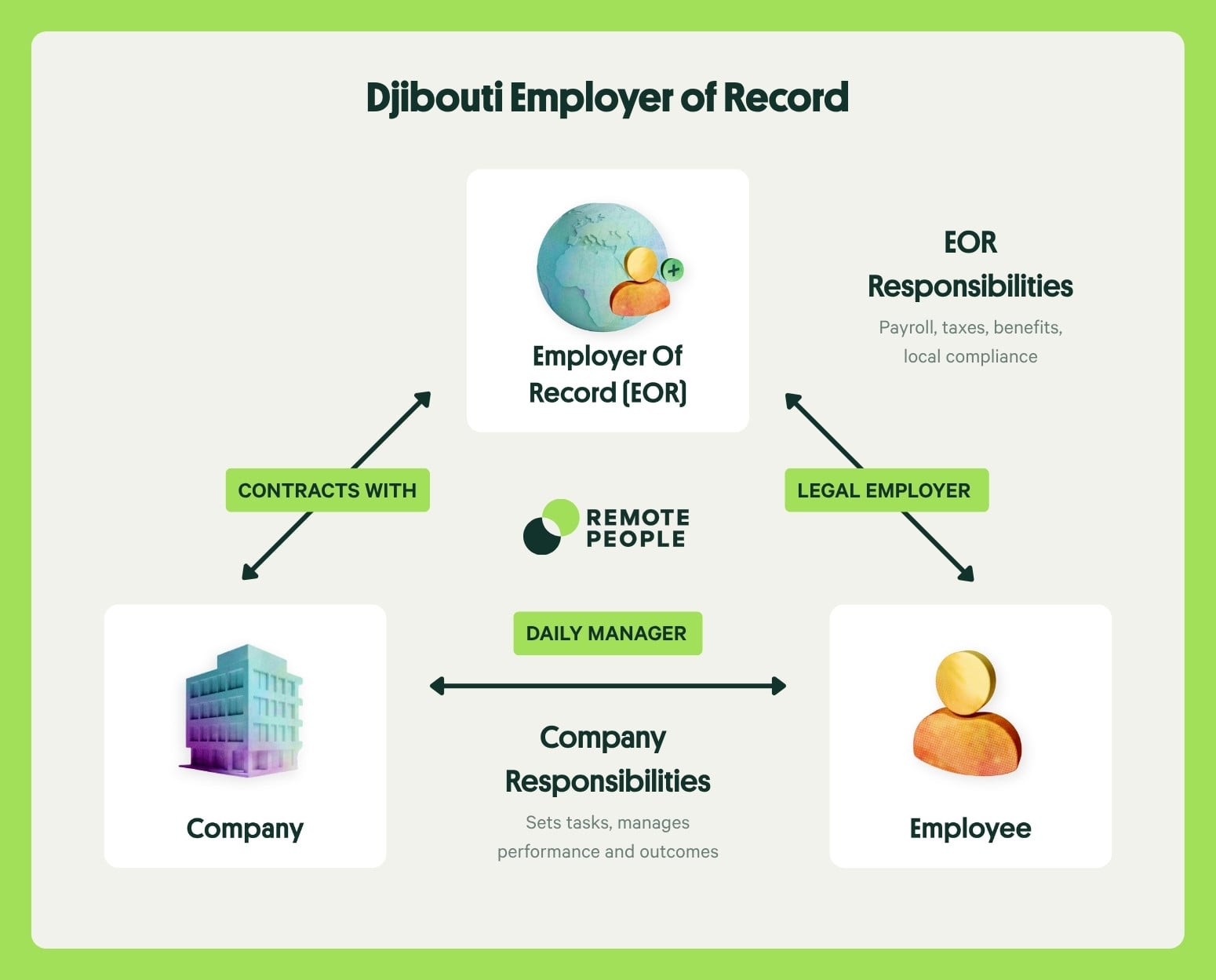
An employer of record in Djibouti is the fastest compliant way to hire local or expatriate staff without registering a subsidiary in Djibouti City. Djibouti sits at the mouth of the Red Sea and the entry point to the Bab el-Mandeb strait, hosting the Port of Djibouti, six free zones, the Doraleh Container Terminal, and the foreign military bases of the United States, France, China, Japan, and Italy. The country is a dollar-linked economy (the Djiboutian franc has been pegged at DJF 177.721 per USD since 1949) and a logistics, finance, and digital infrastructure hub for the Horn of Africa. The trade-off is regulatory complexity: the 2006 Labour Code, Caisse Nationale de Sécurité Sociale (CNSS) registration, progressive personal income tax (Impôt sur les Traitements et Salaires, or ITS) administered by the Direction Générale des Impôts, and Ministry of Labour work permit procedures all apply from the first hire. An employer of record in Djibouti removes that setup burden by becoming the legal employer of your staff, handling payroll, social contributions, tax withholding, and compliance, while you direct the day-to-day work.
This guide covers how an EOR works in Djibouti, the statutory framework employers must follow, tax and social security contributions for 2026, the total cost of hiring, work permit rules for expatriates, termination procedures, and a comparison with setting up your own entity or hiring contractors. All monetary amounts are shown in USD for easy comparison with other markets, using the April 2026 reference rate of DJF 178 per USD.
How an Employer of Record Works in Djibouti
If you’d like to learn more about how Employer of Record (EOR) services work, read our What Is an Employer of Record (EOR)? guide for a complete overview of the model, its benefits, and when to use it.
If you’re comparing providers, our Best Employer of Record (EOR) Providers guide reviews the leading platforms to help you choose the right solution for your business.
Who Uses an EOR in Djibouti?
Any company that wants to place a small team in Djibouti without the cost and lead time of setting up a local entity is a candidate for an EOR. The typical use cases include logistics and shipping companies staffing the Port of Djibouti and the Doraleh Container Terminal, telecommunications and fintech firms hiring into the free zones, NGOs running Horn of Africa programs out of Djibouti City, defence contractors supporting the foreign military bases at Camp Lemonnier and Chabelley, and consulting firms building regional teams for East African projects. Organizations expanding across the COMESA bloc also use an EOR in Djibouti as a beachhead, since the country’s dollar-linked currency and strategic location make it a natural base for Horn of Africa operations.
Typical Onboarding Timeline
Most EOR providers can onboard a Djiboutian citizen within one to two weeks. Expatriate hires take longer because the work authorization must clear the Ministry of Labour before the employee can legally start.
- First, sign the EOR service agreement and provide employee details, salary, and job description. This takes 1 to 2 business days.
- Second, the EOR drafts a compliant French-language employment contract and sends it to the employee for signature. This takes 2 to 3 business days.
- Third, the EOR registers the employee with CNSS and the Direction Générale des Impôts and sets up the payroll file. Registration takes 3 to 7 business days in Djibouti City.
- Fourth, payroll is configured, the CNSS number is issued, and the employee begins work with their first full month of coverage.
- Fifth, for expatriates, the work authorization is filed with the Ministry of Labour in parallel. Expect an additional 3 to 6 weeks before the authorization is issued, followed by 1 to 2 weeks for the visa and residence permit.
Hire in Djibouti
A strategic Red Sea location, French and Arabic-speaking workforce, and a growing logistics and port sector make Djibouti a notable option for companies expanding into the Horn of Africa.
We handle employment contracts, payroll, tax withholding, and full Djiboutian compliance.
No local entity needed. Your team can start in days.
Employment Laws and Regulations in Djibouti
Employment in Djibouti is governed by the Labour Code, Loi n° 133/AN/05/5ème L of 28 January 2006, as amended by Loi n° 221/AN/17/8ème L of 25 June 2018, together with its implementing decrees, the collective bargaining agreements that apply to specific sectors, and the Social Security Code administered by CNSS. The Ministry of Labour is the primary regulator, and the Inspection du Travail enforces compliance on the ground.
Employment Contracts
Every employment relationship in Djibouti must be documented in a written contract when the duration exceeds three months or when the employee is required to live away from their usual residence. Under Article 17 of Loi n° 133/AN/05, the contract must specify the parties, job title, workplace, basic salary, working hours, probationary period, and duration. Contracts are typically drafted in French, the official language of legal proceedings in Djibouti. Fixed-term contracts are permitted but tightly regulated, with a two-year cap including renewals under the 2018 amendment. Indefinite-term contracts (contrat à durée indéterminée) are the default form of employment for open-ended roles.
Working Hours and Overtime
The standard workweek in Djibouti is 48 hours for private-sector workers under Article 83 of Loi n° 133/AN/05, typically arranged as 8 hours per day across 6 days. Public-sector employees follow a 40-hour week. Any work above the weekly ceiling counts as overtime and must be authorized in advance by the employer.
Overtime is compensated at a premium set by the Labour Code and applicable collective agreements. The first eight overtime hours each week are typically paid at a 25% premium over the regular hourly rate, and hours beyond that threshold attract a 50% premium. Work performed on a Sunday, a public holiday, or at night (between 9 p.m. and 5 a.m.) carries a 50% to 100% premium depending on the category of work. Young workers under 18 may not exceed 40 hours per week and cannot be assigned night shifts.
Djibouti overtime and premium pay rates · Per Labour Code Loi 133/AN/05 | |||
Category | Threshold | Pay rate | Notes |
|---|---|---|---|
Standard workweek | Up to 48 h / week (8 h × 6 days) | 100% base hourly | Private sector under Article 83 |
First 8 overtime hours | Hours 49–56 / week | 125% of hourly rate (+25%) | Employer authorization required |
Overtime beyond 8 / week | 57+ hours / week | 150% of hourly rate (+50%) | Subject to labour inspector oversight |
Night work | Any hour 21:00–05:00 | 150% to 200% of hourly rate | Workers under 18 prohibited at night |
Sunday or public holiday | Any hour on rest day | 150% to 200% of hourly rate | 24-hour weekly rest mandatory |
Sources: Djibouti Labour Code Loi n° 133/AN/05, Articles 83 and 92; Ministère du Travail. | |||
Minimum Wage
Djibouti does not impose a national statutory minimum wage in Djibouti on the private sector. The Salaire Minimum Interprofessionnel Garanti (SMIG) was abolished by the 2006 Labour Code, and private-sector pay is now negotiated through collective bargaining agreements that set sector-specific floors. In practice, white-collar entry salaries in Djibouti City cluster between $300 and $500 per month, and skilled port, logistics, and banking roles run substantially higher. The public sector has its own minimum wage, set at DJF 35,000 per month (approximately $197) for civil servants effective 1 January 2025, but this figure does not apply to private employers.
Probation Period
Probation in Djibouti is tiered by employee category under Article 22 of Loi n° 133/AN/05. Ordinary workers may be placed on probation for up to 15 days, technicians and supervisors for up to 3 months, and executive or managerial staff (cadres) for up to 6 months. The probation clause must be in writing and signed before the employment contract takes effect. Either party may terminate the contract during probation without severance, provided written notice of at least 8 days is given. After probation ends, full statutory protections apply.
Leave Entitlements
Djiboutian employees accrue paid leave at the rate of 2.5 working days per month of continuous service under Article 115 of Loi n° 133/AN/05, producing a minimum of 30 working days per year after twelve months of employment. The Labour Code and collective agreements expand this entitlement for seniority, young workers, and mothers. The sections below summarize each statutory leave category, followed by a comparison table.
Annual Leave
Employees accrue 2.5 working days of paid leave per month of actual service, producing 30 working days after a full year. Seniority increments apply in many collective agreements, typically adding 1 to 2 days per five-year period of service. Mothers of children under 14 receive additional days under Article 115, and workers under 18 accrue leave at an accelerated rate. Annual leave must be taken within the reference year and is paid at the employee’s full salary, including fixed allowances.
Sick Leave
Employees unable to work because of illness must provide a medical certificate from an approved practitioner within 72 hours. Under Article 116 of the Labour Code, workers are entitled to up to 6 months of paid sick leave, with the first month at full salary and the remainder at half salary, paid jointly by the employer and the CNSS health branch. CNSS provides invalidity benefits when illness extends beyond six months and the employee meets the contribution history requirement of at least 60 months of prior contributions.
Maternity Leave
Female employees are entitled to 14 weeks of maternity leave under Article 112 of Loi n° 133/AN/05, split into 8 weeks before and 6 weeks after the expected delivery date. An additional 3 weeks of extended leave are granted in cases of medically certified complications or multiple births. The leave is fully paid at 100% of salary, funded jointly by the employer and the CNSS maternity branch. During maternity leave and the first 12 months after return, the employer cannot terminate the employee except in narrowly defined cases of serious misconduct unrelated to the pregnancy. Nursing mothers are entitled to one hour per day of paid break time during the first year after returning to work.
Paternity Leave
Djiboutian labour law does not create a dedicated statutory paternity leave entitlement. New fathers may take paid family-event leave of 3 days under the special leave provisions of Article 120 of the Labour Code, and many private-sector employers in Djibouti City voluntarily add 5 to 10 days of paternity leave as a recruitment benefit. Most EORs follow the higher voluntary standard to align with regional practice.
Other Statutory Leave
Beyond annual, sick, and maternity leave, Djiboutian workers are entitled to several additional statutory categories. Special family-event leave of 1 to 5 paid days applies to births, marriages, deaths of close relatives, and similar events under Article 120. Paid public holidays cover the days listed in the public holidays section below. Trade union leave allows worker representatives to attend official training sessions. Pilgrimage leave (Hajj) is available once in a career for Muslim employees, typically as unpaid leave of up to 30 days.
Djibouti statutory leave entitlements · Per Labour Code Loi n° 133/AN/05 |
||
Leave Type |
Duration |
Eligibility & Notes |
|---|---|---|
Annual leave |
2.5 days/month (30 days/year) |
Full pay; collective agreements add seniority increments |
Sick leave |
Up to 6 months |
First month at full pay, remainder at half pay; medical certificate required within 72 hours |
Maternity leave |
14 weeks (8 pre + 6 post) |
Full pay; +3 weeks for complications; jointly funded by employer and CNSS |
Paternity leave |
3 days (family-event leave) |
No dedicated statutory entitlement; collective agreements may add days |
Special family leave |
1 to 5 days per event |
Paid leave for births, marriages, deaths, and similar events |
Pilgrimage (Hajj) leave |
Up to 30 days |
Once per career; typically unpaid |
Public holidays |
10 days in 2026 |
Paid; work on a public holiday attracts premium pay |
Source: Djibouti Labour Code Loi n° 133/AN/05 and CNSS Djibouti |
||
Statutory Employee Benefits
Employees in Djibouti are entitled to a package of mandatory benefits funded primarily through CNSS. Every employer must register new hires with CNSS within eight days of the start date and pay monthly contributions that cover four benefit branches: old-age pension, health and maternity, family benefits, and occupational risk. Workers receive healthcare access through the public CNSS scheme, and many employers add a private health insurance plan in Djibouti because public hospital coverage outside Djibouti City is limited and expatriate staff typically expect international cover.
In addition to CNSS, employers fund a basic work-accident insurance through the occupational risk branch. Employees are subject to progressive income tax (ITS) withheld at source alongside the CNSS employee share. Most white-collar collective agreements require transport, meal, or housing allowances on top of base pay, particularly in Djibouti City where the cost of living (driven by a USD-pegged currency and heavy import dependence) is significantly higher than in regional towns. The contribution rate details are broken down in the payroll section below.
Recent Regulatory Updates (2026)
The 2018 amendment to the Labour Code (Loi n° 221/AN/17/8ème L of 25 June 2018) remains the most recent substantive update to Djiboutian employment law and continues to govern fixed-term contracts, working hours, and dispute resolution in 2026. No new minimum wage has been decreed for the private sector, and CNSS contribution rates remain unchanged since the 2012 reform that introduced the current 21.7% total rate. The 2025 public-sector minimum wage increase to DJF 35,000 per month did not extend to private employers. Employers should monitor the Journal Officiel de la République de Djibouti and Ministry of Finance circulars for any year-end adjustments to tax brackets or contribution thresholds.
Work Permits and Visas in Djibouti
Every non-Djiboutian national who wants to take up paid employment in Djibouti needs a work authorization before they can lawfully start work. The process involves three parallel tracks: the work authorization from the Ministry of Labour, the entry visa from a Djiboutian embassy abroad or the e-visa system, and the residence permit issued after arrival by the Direction de la Police Nationale. The EOR coordinates all three.
Work Permit Requirements
Who Needs a Work Permit
All foreign nationals require a work authorization regardless of their country of origin. Nationals of COMESA member states do not benefit from automatic labour market access, although the country has bilateral agreements with France, Ethiopia, and other partners that streamline specific categories. Djiboutian law gives preference to local candidates under Article 14 of the Labour Code, so the employer must document the recruitment effort before hiring a foreigner in a role that a qualified Djiboutian could fill.
Eligibility and Required Documents
The employer (or the EOR acting on behalf of the client) files the work permit dossier with the Ministry of Labour. Required documents typically include the signed employment contract, a copy of the employee’s passport, certified copies of academic and professional qualifications, a recent medical certificate issued by a Djiboutian approved practitioner, a criminal record extract no older than three months, a CV, and the employer’s trade register excerpt. All supporting documents must be translated into French by a certified translator if they originate from another jurisdiction.
Processing Time and Validity
The Ministry of Labour authorization is normally processed in 3 to 6 weeks once the file is complete. The initial work permit is typically issued for one year and is tied to the specific employer and position that sponsored the application. Including the consular visa step and the residence permit application after arrival, the full process from job offer to legal start date usually runs 6 to 10 weeks. Delays come from missing documents, apostille requirements, or sector-specific scrutiny in logistics, banking, and telecommunications.
Renewal Process
Work permits must be renewed before expiry, and renewal applications should be submitted at least 30 days in advance. The renewal dossier is similar to the initial application and requires an updated medical certificate, criminal record extract, and proof that the employee has been compliant with tax and CNSS obligations during the previous term. Employees may continue to work while the renewal is in progress if the application was filed before the original permit expired.
Common Visa Types for Foreign Workers
The key immigration categories for foreign hires in Djibouti include the short-stay business visa, valid for up to 30 days and available as an e-visa from the official Ministry of Interior portal, used for scoping visits and not for paid employment. A long-stay work visa is issued once the Ministry of Labour authorization is granted and allows multiple entries. Intra-company transfer permits apply when an employee of a multinational is moved to a related Djiboutian entity in a free zone or holding company. Diplomatic and mission visas support staff assigned to the foreign military bases and international organizations based in Djibouti City.
Djibouti work visa types for foreign workers · 2026 | ||||
Visa type | Purpose | Validity | Key requirements | Processing time |
|---|---|---|---|---|
Short-stay e-visa | Business visits, scoping meetings, conferences (no paid local work) | Up to 30 days | Valid passport, return ticket, proof of accommodation | About 3 business days online |
Long-stay business visa | Extended non-employment business engagements | 3 to 12 months | Invitation letter, company credentials, financial proof | 2 to 3 weeks |
Long-stay work visa | Paid employment with a Djibouti employer or EOR | 12 months, renewable | Ministry of Labour authorization, medical certificate, sponsor attestation | 4 to 6 weeks |
Residence permit (carte de séjour) | Long-term residency after arrival; links to active work visa | 1 year, renewable | Must be filed within 30 days of arrival; biometric appointment at DGPN | 2 to 4 weeks |
Sources: Djibouti Ports and Free Zones Authority (DPFZA) Immigration Services; Direction Générale de la Police Nationale (DGPN). | ||||
How an EOR Handles Work Permits
An EOR acts as the local sponsor for the work authorization because it is the legal employer of the expatriate in Djibouti. The EOR files the Ministry of Labour dossier, coordinates with the consular post abroad, and handles the residence permit after arrival. The expatriate supplies the personal documents (passport, medical, criminal record) and attends biometric appointments. Because the EOR is the employer on record, the permit is tied to the EOR’s name rather than the client’s foreign entity, which matters on exit and on permit renewals.
Using an EOR also extends the onboarding timeline shown earlier. A Djiboutian citizen can start within 1 to 2 weeks, but an expatriate hire should plan for 6 to 10 weeks from offer to first day. Clients hiring for immediate-start roles usually prioritize Djiboutian candidates and use a contractor management solution as a bridge for expatriates already in-country under another status.
Payroll, Taxes, and Social Security in Djibouti
Employer Contributions
Employers in Djibouti pay a combined statutory burden of 15.70% of gross salary, split across four CNSS branches: old-age pension, family benefits, work injury, and health and maternity. Unlike several regional neighbours, Djibouti does not levy a separate payroll tax or apprenticeship levy on top of CNSS. The full contribution applies to the gross salary without a statutory wage ceiling for most categories, which means the headline rate is the effective rate at all salary levels.
Djibouti employer social security contributions · 2026 rates |
||
Contribution |
Rate |
Notes |
|---|---|---|
CNSS old-age, invalidity, and survivors pension |
4.00% |
Employer share; funds the pension branch |
CNSS family benefits |
5.50% |
Employer share; funds family allowances and maternity |
CNSS work injury and occupational disease |
1.20% |
Employer share; rate may vary by sector risk profile |
CNSS health and sickness (AMO) |
5.00% |
Employer share; funds public health coverage |
Total employer burden |
15.70% |
Applied to gross salary; no statutory ceiling |
Source: CNSS Djibouti and Djibouti Ministry of Finance |
||
Employee Contributions
Employees pay a combined 6.00% of gross salary toward CNSS, split between the pension branch and the health branch, on top of the progressive personal income tax described in the next section. Djibouti does not levy a separate solidarity surcharge, housing fund, or audiovisual tax on employees, which keeps payroll deductions simpler than in several neighbouring markets.
Djibouti employee payroll deductions · 2026 monthly withholdings |
||
Deduction |
Rate |
Notes |
|---|---|---|
CNSS pension (employee share) |
4.00% |
Applied to gross salary; no statutory ceiling |
CNSS health and sickness (employee share) |
2.00% |
Applied to gross salary; funds AMO coverage |
Personal income tax (ITS) |
2% to 30% |
Progressive; see income tax brackets below |
Total social contribution floor |
6.00% |
Before ITS withholding |
Source: CNSS Djibouti and Djibouti Ministry of Finance ITS |
||
Income Tax
Djibouti’s personal income tax, known as the Impôt sur les Traitements et Salaires (ITS), applies on a progressive scale with five brackets under the 2026 General Tax Code. The tax is calculated on net taxable income after deducting mandatory CNSS contributions. Employers withhold ITS monthly and remit it to the Direction Générale des Impôts by the 15th of the following month. The table below shows the annual brackets in USD at the April 2026 reference rate of DJF 178 per USD.
Djibouti income tax brackets (ITS) · Annual 2026 |
|
Annual Taxable Income (USD) |
Tax Rate |
|---|---|
$0 to $2,022 |
2% |
$2,023 to $3,371 |
15% |
$3,372 to $10,112 |
18% |
$10,113 to $40,449 |
20% |
Above $40,449 |
30% |
Source: Djibouti Ministry of Finance ITS |
|
Capital income such as rental earnings and dividends is taxed separately at flat rates between 10% and 25% under the General Tax Code. All USD amounts in the bracket table are approximate conversions at $1 = DJF 178 (April 2026 reference rate) and should be treated as indicative. Because the Djiboutian franc is pegged to the US dollar, bracket thresholds in USD have remained stable year-on-year and are not subject to the exchange-rate drift seen in other African markets.
Payroll Cycle
Djiboutian payroll runs on a monthly cycle, with salaries paid in DJF by bank transfer into an account held in the employee’s name. Pay slips must be issued in French and must show gross pay, each line item deduction, and net pay. CNSS contributions and ITS withholding must be filed and paid to CNSS and the Direction Générale des Impôts by the 15th of the month following the pay period. Annual reconciliations and employee tax certificates are due at the end of the fiscal year. Employers who fail to remit on time face penalty interest and, in severe cases, criminal liability under the Social Security Code.
13th Month Salary and Bonus Pay
Djibouti does not impose a statutory 13th month salary on private-sector employers. The Labour Code is silent on the matter, and no decree mandates an annual bonus in the way seen in several Francophone markets. Some large employers in banking, logistics, telecommunications, and the port sector pay a customary end-of-year bonus, and collective bargaining agreements in those sectors may make it contractually binding. When a 13th month is paid voluntarily, it is subject to the same ITS and CNSS treatment as regular salary.
Cost of Hiring Through an EOR in Djibouti
EOR Service Fees
EOR service fees in Djibouti typically run $300 to $600 per employee per month for a standard white-collar role. The fee covers employment contract drafting, monthly payroll, CNSS and tax filings, pay slip issuance, leave tracking, insurance administration, and compliance monitoring. Work permit sponsorship for expatriates may attract additional one-off fees of $500 to $1,500 to cover the Ministry of Labour dossier and residence permit handling.
Total Employment Cost Breakdown
The table below shows the total monthly cost of hiring an employee on a gross salary of $1,200 per month through an EOR in Djibouti. At that level, the CNSS branches apply to the full salary without any ceiling adjustment, so the nominal 15.70% employer burden is fully effective. All figures are in USD.
Djibouti employer cost example · $1,200/month gross · 2026 |
||
Employer Cost |
Amount (USD) |
% of Gross |
|---|---|---|
Gross salary |
$1,200.00 |
100.00% |
CNSS old-age pension |
$48.00 |
4.00% |
CNSS family benefits |
$66.00 |
5.50% |
CNSS work injury |
$14.40 |
1.20% |
CNSS health and sickness |
$60.00 |
5.00% |
EOR service fee (est.) |
$450.00 |
37.50% |
Total monthly cost |
$1,838.40 |
153.20% |
Source: CNSS Djibouti and Djibouti Ministry of Finance |
||
The statutory employer burden on a $1,200 gross salary is $188.40, or 15.70% above gross. Adding a typical $450 EOR service fee brings the total to $1,838.40 per month, which is 53.20% above the gross salary. Because Djibouti has no CNSS wage ceiling, the 15.70% employer rate applies uniformly regardless of salary level, and the total cost scales linearly with the gross. All USD amounts are approximate conversions at $1 = DJF 178 (April 2026 reference rate).
Ready to hire in Djibouti? Contact our team for a full cost quote. RemotePeople handles employment contracts, CNSS registration, payroll, tax withholding, and full Djibouti compliance. No local entity needed.
Benefits of Using an EOR in Djibouti
The single biggest reason to use an EOR in Djibouti is speed. Incorporating a Djiboutian subsidiary usually takes 3 to 6 months and involves the Guichet Unique at the Agence Nationale pour la Promotion de l’Investissement (ANPI), the commercial register, the Direction Générale des Impôts, and CNSS registration. An EOR can onboard a Djiboutian citizen in 1 to 2 weeks because the legal entity already exists. For companies that want to pilot the market or hire a single regional lead for a logistics, shipping, or fintech project, that time saving is decisive.
Compliance risk is the second reason. Djibouti’s Labour Code is detailed and enforceable through the Inspection du Travail, and foreign employers who try to handle payroll informally often run into trouble with CNSS or the tax authority. An EOR carries that compliance responsibility on its own books, which means the client is insulated from CNSS assessments, back-tax claims, and labour court judgments that come from paperwork errors. Termination, in particular, is an area where the EOR’s local expertise pays off, because wrongful dismissal claims in Djibouti can result in significant severance awards under the tiered formula set out in the Labour Code.
Cost efficiency also matters for smaller teams. Running a Djiboutian subsidiary carries fixed costs (office, accountant, auditor, secretariat) that can exceed $25,000 per year even without any employees, especially in Djibouti City where professional services cater to the port, free-zone, and military base economy and are priced accordingly. An EOR replaces that fixed cost with a per-employee fee, so the total cost scales cleanly with headcount. Finally, the employee experience is often better under an EOR. The employee receives a proper Djiboutian contract, CNSS benefits, pay slips in French, and access to the public healthcare scheme, which is hard to match when paying a remote worker as a contractor from abroad.
Termination and Offboarding in Djibouti
Notice Periods
The Labour Code sets statutory minimum notice periods based on the employee’s category and length of service. Ordinary workers are entitled to 8 days of notice during the first year of service, with the period extending to 1 month after one year and progressively longer for longer-tenured employees. Technicians and supervisors typically receive 1 month during the first year and up to 2 months thereafter. Managerial staff (cadres) receive the longest notice periods, usually 1 to 3 months depending on tenure. Notice must be given in writing, and either party may pay in lieu of serving out the notice period.
Djibouti statutory notice periods by employee category · Per Labour Code Loi 133/AN/05 | |||
Employee category | Notice in first year | Notice after first year | Notes |
|---|---|---|---|
Ordinary workers (hourly or manual) | 8 days | 1 month | May extend with tenure per collective agreement |
Technicians and supervisors | 1 month | Up to 2 months | Progressive with length of service |
Cadres (managerial staff) | 1 month | 1 to 3 months | Longest notice reserved for senior executives |
Gross misconduct (faute lourde) | None | None | Immediate dismissal; no payment in lieu of notice |
Sources: Djibouti Labour Code Loi n° 133/AN/05; Ministère du Travail; applicable collective bargaining agreements. | |||
Severance Pay
Calculation Method
Severance pay, known as the indemnité de licenciement, is mandatory for employees dismissed for any reason other than serious misconduct, provided they have completed at least one year of continuous service under Article 51 of Loi n° 133/AN/05. The formula is tiered by tenure and expressed as a percentage of the average monthly salary over the last twelve months. Under the Labour Code, the rate is 25% of monthly salary per year of service for the first five years, 30% per year for years six through ten, and 35% per year for each year beyond ten years of service. A worker with seven years of tenure therefore accrues five years at 25% plus two years at 30%, producing 185% of monthly salary in severance.
Caps and Exceptions
Severance is not payable in cases of serious misconduct (faute lourde) that meets the threshold defined by case law and collective agreement, such as theft, gross insubordination, or violence. Fixed-term contracts that reach their natural expiry date do not attract severance, and employees dismissed during the probation period are also ineligible. The average monthly salary used in the formula includes base pay plus fixed allowances but excludes occasional bonuses. Collective agreements in banking, logistics, and the port sector sometimes set higher severance rates than the Labour Code minimum, and the EOR applies whichever is more favourable to the employee.
Grounds for Termination
An employer may terminate an indefinite-term contract for economic reasons or for a personal reason linked to the employee’s conduct or capability. Both categories require written notice, a statement of the reasons in the termination letter, and, for economic dismissals, consultation with employee representatives and notification to the Inspection du Travail. Dismissal for serious misconduct must be preceded by an internal disciplinary hearing where the employee has the right to present a defence. Protected categories, including pregnant employees, those on maternity leave, and worker representatives, enjoy additional protection and cannot be dismissed except in narrowly defined cases approved by the labour inspectorate.
EOR vs. Other Hiring Models in Djibouti
EOR vs. Setting Up a Local Entity
Choosing between an Employer of Record and setting up your own legal entity in Djibouti comes down to timeline, upfront cost, ongoing administrative burden, and how quickly you can scale up or wind down. The table below lays out both paths side by side across setup time, cost, compliance risk, and flexibility so you can match the right model to the size and duration of your Djibouti hiring plan.
Djibouti EOR vs local entity comparison · Setup time, cost, risk and best-fit |
||
Comparison |
Employer of Record |
Own Entity |
|---|---|---|
Setup time |
1 to 2 weeks |
3 to 6 months |
Upfront cost |
$0 |
$5,000 to $15,000 |
Ongoing cost |
$300 to $600 per employee per month |
$20,000 to $35,000 per year maintenance |
Local partner required |
No (EOR is the local entity) |
Not legally required, often useful for market knowledge |
Social insurance registration |
Handled by EOR |
You manage it |
Payroll and tax filing |
Handled by EOR |
You manage it (or outsource) |
Best for team size |
1 to 15 employees |
15+ employees |
Scale down or exit |
Easy, no entity to unwind |
Costly, legal dissolution required |
Government and port contracts |
Not eligible |
Eligible (requires local entity) |
Source: Djibouti Labour Code Loi n° 133/AN/05 and CNSS Djibouti |
||
Setting up a Djiboutian subsidiary makes sense when the projected headcount is large enough to absorb the fixed costs and when the business model requires a local entity, for example to operate in one of the six free zones, to hold a port concession, or to bid on public infrastructure contracts. For everyone else, the EOR route is materially faster and cheaper.
The break-even point is usually around 15 to 20 employees. Below that, the EOR’s per-employee fee is lower than the fixed overhead of running a subsidiary. Above it, the subsidiary economics start to make sense, and many companies transition from an EOR to their own entity once they hit that threshold. The EOR handover can usually be completed in 2 to 3 months.
Another factor is risk tolerance. Setting up an entity exposes the parent company to full local liability, including any historical CNSS or tax assessment against the subsidiary. The EOR model caps that risk because the EOR is the employer of record and carries the compliance obligation. For companies testing Djibouti for the first time, that insulation is valuable.
EOR vs. Hiring Independent Contractors
Classifying a Djibouti-based worker as an independent contractor rather than an employee can expose you to back-taxes, unpaid social contributions, and reclassification penalties if the working relationship looks like employment in practice. The table below contrasts EOR employment with contractor engagement across legal relationship, tax and benefits treatment, IP ownership, and misclassification risk so you can pick the right model role by role.
Djibouti EOR vs independent contractors · Compliance, cost, and risk |
||
Comparison |
EOR (Full-Time Employee) |
Independent Contractor |
|---|---|---|
Legal relationship |
Employee of the EOR |
Self-employed, no employment relationship |
Compliance risk |
Low, EOR ensures local labour law compliance |
Higher, misclassification risk if the relationship resembles employment |
Payroll and tax |
EOR handles withholding, CNSS, and filings |
Contractor invoices you; they handle their own taxes |
Benefits and leave |
Statutory benefits, paid leave, CNSS coverage |
No entitlement to employee benefits |
IP protection |
Stronger, employment contract assigns IP by default |
Weaker, requires explicit IP assignment clause |
Termination |
Subject to local notice periods and severance |
Contract can be ended per agreement terms |
Best for |
Long-term, core team roles |
Short-term projects, specialized tasks |
Cost structure |
Salary + employer contributions + EOR fee |
Contractor fee (typically higher gross, lower total cost) |
Source: Djibouti Labour Code Loi n° 133/AN/05 and CNSS Djibouti |
||
Hiring independent contractors in Djibouti is only appropriate in some cases, such as short-term project work, specialized consulting, or roles where the worker has genuine autonomy over how and when they deliver. For long-term or full-time roles, contractor classification is the wrong tool because Djiboutian labour courts can reclassify the relationship as employment if the worker is economically dependent on one client, reports to that client’s management, and follows company processes.
The consequences of misclassification in Djibouti are concrete. The client may owe back CNSS contributions, back-dated ITS withholding, penalty interest on both, plus severance if the worker was dismissed without following the Labour Code procedure. The Inspection du Travail can also open an enforcement action independently of the worker’s own claim.
For roles that truly are project-based, the cleanest option is to use a contractor management solution rather than a direct invoice arrangement. RemotePeople’s contractor hiring solution handles compliant contractor agreements, payments, and classification reviews for Djiboutian and Horn of Africa freelancers, which preserves the flexibility of a contractor relationship while managing the misclassification risk. See our guide to hiring and paying contractors in Djibouti for a detailed walkthrough.
EOR vs. PEO (Professional Employer Organization)
EORs and PEOs both simplify international hiring, but only an EOR becomes the legal employer of record in Djibouti — a critical distinction when you don’t have a local entity of your own. The table below maps the practical differences across legal employer status, entity requirement, liability allocation, and scope of coverage.
Djibouti EOR vs PEO comparison · Legal employer, liability, and setup |
||
Comparison |
Employer of Record (EOR) |
PEO |
|---|---|---|
Legal employer |
EOR is the legal employer |
You remain the legal employer (co-employment) |
Local entity required |
No, the EOR is the local entity |
Yes, you must have your own entity in Djibouti |
Best for |
Companies without a local entity |
Companies that already have a local entity |
Compliance liability |
EOR assumes compliance responsibility |
Shared liability between you and the PEO |
Setup time |
1 to 2 weeks |
Depends on your entity setup (weeks to months) |
Control over HR policies |
EOR manages within local law framework |
More direct control, PEO advises |
Typical use case |
Market entry, small remote teams, testing new markets |
Established local operations needing HR outsourcing |
Source: Djibouti Labour Code Loi n° 133/AN/05 and CNSS Djibouti |
||
Djibouti does not have a formal PEO regulatory framework comparable to the US co-employment model. The concept exists in practice because domestic HR firms offer payroll and administration outsourcing services to companies that already have a Djiboutian entity, but the legal employer remains the client company. This is the key distinction: an EOR replaces the need for a local entity, while a PEO complements one.
For foreign companies without a Djiboutian subsidiary, the EOR route is the only practical option because a PEO assumes you already have a company in-country. Once a client has incorporated and grown past the EOR break-even point, moving to a PEO-style payroll outsourcing arrangement can make sense because it lowers the per-employee overhead while keeping the entity active for tendering and regulatory purposes.
Compliance liability is the other major difference. Under an EOR, the provider is on the hook for CNSS, tax, and Labour Code compliance. Under a PEO arrangement, the client company remains on the hook and the PEO only advises and executes, which means the client must still have internal capacity to review the local advice.
Public Holidays in Djibouti
Djibouti observes a defined set of official public holidays on which most private-sector employers must give staff a paid day off (TimeAndDate Djibouti Holidays 2026). The table below lists the statutory holidays employers need to build into payroll calendars and leave planning for the year, along with the date rule for each.
Djibouti public holidays · 2026 calendar year |
||
Date |
Holiday |
Type |
|---|---|---|
1 January |
New Year’s Day |
National |
15 February |
Isra and Mi’raj |
Religious (Islamic, tentative) |
20 March |
Eid al-Fitr (end of Ramadan) |
Religious (Islamic, tentative) |
1 May |
Labour Day |
National |
27 May |
Eid al-Adha (Feast of Sacrifice) |
Religious (Islamic, tentative) |
17 June |
Islamic New Year (Hijri 1447) |
Religious (Islamic, tentative) |
27 June |
Independence Day |
National |
28 June |
Independence Day (second day) |
National |
26 August |
Mawlid (Prophet’s Birthday) |
Religious (Islamic, tentative) |
25 December |
Christmas Day |
Religious (Christian) |
Djibouti observes 10 paid public holidays in 2026, split between national days, Christian, and Islamic religious holidays. Islamic dates depend on lunar sighting and may shift by one or two days based on official confirmation from the Ministry of Muslim Affairs. Work performed on a public holiday attracts a premium of 50% to 100% over the regular rate, and payroll for the holiday month must reflect the paid day whether or not the employee worked.
How to Get Started with an EOR in Djibouti
- First, define the role, gross salary, and projected start date for your Djiboutian hire and share the brief with the EOR provider.
- Second, receive and review the full cost quote, including statutory contributions, the EOR service fee, and any work permit costs for expatriates.
- Third, sign the EOR service agreement and send the employee’s personal details, identification documents, and qualifications.
- Fourth, the EOR drafts the employment contract, sends it for signature, registers the employee with CNSS and the Direction Générale des Impôts, and sets up payroll.
- Fifth, the employee begins work. You manage their day-to-day output while the EOR handles monthly payroll, filings, leave tracking, and ongoing compliance.
Ready to get started? RemotePeople operates as your employer of record across Djibouti and the wider Horn of Africa region, with local payroll, CNSS filings, and a dedicated account team that knows the Labour Code. Check our pricing for a transparent per-employee fee and launch your Djibouti team in days. Learn more about the work visa and permit process in Djibouti, the Djibouti payroll outsourcing service, the Djibouti probation period framework, doing business in Djibouti, and employee benefits in Djibouti.
Where companies hiring in Djibouti expand next
Hiring in Djibouti frequently leads to recruitment across East Africa’s English-speaking cluster and the wider Indian Ocean corridor. Common expansion paths include Ethiopia (shared East African workforce norms) and hiring in Kenya (overlapping East African talent profile). Teams scaling further usually add an EOR partner in Uganda for the regional East African talent pool, with Tanzania extending coverage through aligned East African English-first hiring profile.
Employer of Record in
Employer of Record in
Employer of Record in
Employer of Record in
Employer of Record in
Employer of Record in
Employer of Record in
Employer of Record in




