
 Recruit
Employer of Record (EOR) in Kiribati
-
 Drew Donnelly
- Published
- September 22, 2026
RemotePeople’s employer of record in Kiribati lets you hire employees in Kiribati with KPF enrollment. We handle 7.5% Kiribati Provident Fund contributions, mandatory retirement savings, and individual account management.
Hire in Kiribati — book a free 30-minute demo
Tell us what you need. You'll get a tailored, transparent proposal within 24 hours, plus a free call to walk through it.
Tell us about your company
So we can match you with a specialist who knows your market — and unlock volume pricing tiers.
* All fields are required.
Where and when are you hiring?
Tell us the geography and timing and we'll quote each country line by line, with onboarding timelines.
* All fields are required.
Help us beat your current setup
We'll benchmark your current deal and send a line-by-line proposal in 24 hours — showing exactly where we cut cost, time, or risk. After you submit, you can book a call to walk through it together.
* All fields are required.
Thanks! Your proposal is on its way.
Expect a tailored, line-by-line proposal in your inbox within 24 hours. In the meantime…
Want to walk through it together?
Book a free 30-minute call with one of our specialists. We'll explain every line, answer your questions, and tailor the proposal further if you need.
No obligation. Pick a time that works for you.








- Hire in Kiribati — book a free 30-minute demo
- Tell us about your company
- Where and when are you hiring?
- Help us beat your current setup
- Thanks! Your proposal is on its way.
- How an Employer of Record Works in Kiribati
- Employment Laws and Regulations in Kiribati
- Work Permits and Visas in Kiribati
- Payroll, Taxes, and Social Security in Kiribati
- Cost of Hiring Through an EOR in Kiribati
- Benefits of Using an EOR in Kiribati
- Termination and Offboarding in Kiribati
- EOR vs. Other Hiring Models in Kiribati
- Public Holidays in Kiribati
- How to Get Started with an EOR in Kiribati
- Where companies hiring in Kiribati expand next
- Frequently Asked Questions
- Related EOR Destinations

Start hiring in Kiribati
Let RemotePeople handle payroll, compliance, and HR admin worldwide so you can focus on building your team.

An employer of record in Kiribati serves as the legal employer for your workforce, handling all compliance obligations while you focus on operations. Kiribati, an island nation in the central Pacific, has a compact labour market with specific regulatory requirements under the EIRC 2015. Whether you’re expanding regionally or establishing your first presence, understanding Kiribati’s employment landscape is essential.
This guide covers employment laws, tax obligations, work permit procedures, and the true cost of hiring through an EOR in 2026.
How an Employer of Record Works in Kiribati
An EOR acts as the formal employer on payroll records, contracts, and regulatory filings while you keep operational control. The arrangement lets you hire talent in Kiribati without setting up a legal subsidiary. An EOR manages all compliance risk, from contract law to tax filings, making rapid scaling possible for international businesses new to Pacific employment practices.
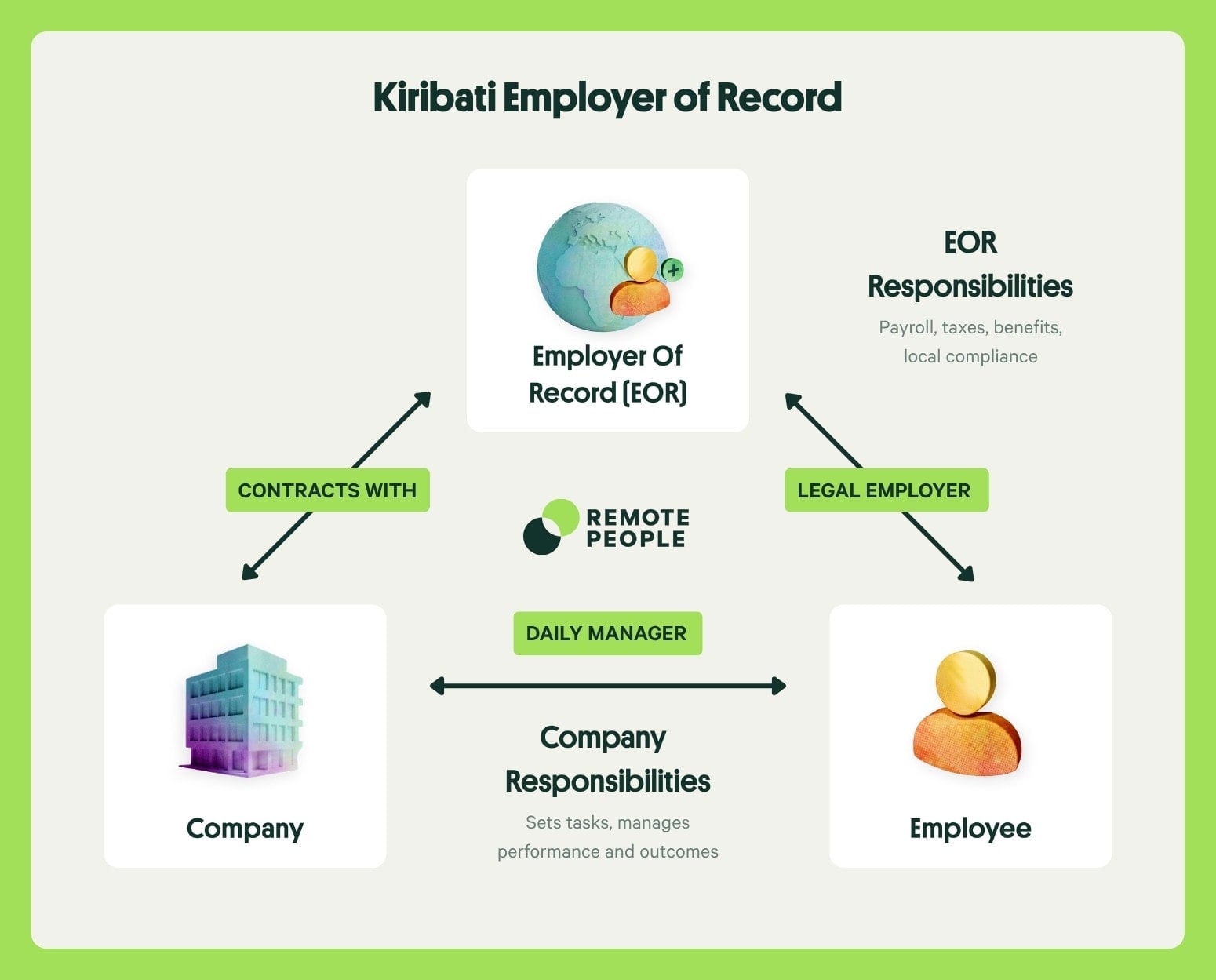
Who Uses an EOR in Kiribati?
Companies entering Kiribati for the first time are the most common EOR users because they avoid the cost and complexity of forming a local subsidiary. Teams expanding from one to ten or more employees also benefit from outsourced HR administration that scales without adding in-house headcount.
Regulatory changes and work permit rules in Kiribati shift frequently, so compliance-focused organisations hand those obligations to specialists in local law. All-in-one EOR pricing also removes hidden expenses tied to legal setup, tax filings, or permit delays, giving finance teams a single predictable monthly cost.
Typical Onboarding Timeline
Onboarding a new hire through an EOR in Kiribati typically spans 4-8 weeks, depending on work permit complexity. Initial steps include contract drafting (1-2 weeks), work permit application and medical clearance (2-6 weeks), and final payroll setup (3-5 business days). For non-expatriate hires or roles exempt from permit requirements, the timeline shortens to 2-3 weeks.
Hire in Kiribati
A transparent flat-fee pricing model, full EIRC 2015 compliance, and streamlined payroll in AUD make Kiribati expansion simple and cost-effective through an EOR.
We handle employment contracts, payroll, tax withholding, and full Kiribati compliance.
No local entity needed. Your team can start in days.
Employment Laws and Regulations in Kiribati
Kiribati’s employment framework is governed primarily by the Employment and Industrial Relations Code 2015, which sets standards for contracts, hours, leave, and termination. The country has minimal social security requirements beyond the Kiribati Provident Fund and does not have a public pension or unemployment insurance system. Understanding these statutory minimums is important for EOR compliance and cost estimation.
Employment Contracts
All employment in Kiribati should be documented in a written contract that specifies duties, remuneration, leave entitlements, and termination conditions. The Employment and Industrial Relations Code 2015 does not mandate a specific contract template, but contracts must not contradict statutory minimums. Terms may be customized by role and industry, though overseas-funded projects typically have stricter labour standards than local private sector roles.
Working Hours and Overtime
Kiribati’s standard working week is 40 hours across 5 days, or 8 hours per day. Overtime is compensated at 1.5 times the regular hourly rate, with no statutory weekly or monthly cap. Public holidays worked attract the same 1.5x multiplier.
Employers must track hours carefully; the Employment and Industrial Relations Code 2015 permits no averaging or compensatory time arrangements without explicit employee agreement.
Kiribati overtime and premium pay rates · Per Employment and Industrial Relations Code 2015 | |||
Hour Type | Rate Multiplier | Weekly/Daily Cap | Notes |
|---|---|---|---|
Regular hours (Mon-Fri, 8 hrs/day) | 1.0x | 40 hrs/week | Standard rate per contract |
Overtime (weekday, after 8 hrs/day) | 1.5x | No statutory cap | Negotiable by contract; typically voluntary |
Public holiday work | 1.5x | No statutory cap | Applies to all public holidays listed in Labour Code |
Rest day work (if scheduled) | 1.5x | No statutory cap | Subject to mutual agreement |
Source: EIRC 2015 and WIPO Lex – Kiribati | |||
Minimum Wage
Kiribati’s statutory minimum wage has remained unchanged since November 2016. The rate varies by employment category: domestic and local private sector employees earn a minimum of AUD 1.30 per hour, while employees on overseas-funded projects must receive at least AUD 3.00 per hour. These rates apply regardless of skill level or experience, and contracts cannot stipulate lower wages.
Employers should verify project funding source to confirm which minimum applies.
Probation Period
The Employment and Industrial Relations Code 2015 does not establish a statutory probation period. Probation is contractual and may be negotiated between employer and employee, typically ranging from 3 to 6 months. During probation, notice periods are often shorter or may allow immediate termination for cause; contracts should clearly define probation terms, trial outcomes, and performance expectations to avoid disputes.
Leave Entitlements
Kiribati’s employment law sets minimum leave standards covering annual, sick, maternity, and paternity entitlements. All leave accrues from the first day of employment and must be tracked by the employer. Public holidays are also statutory; unused leave cannot be forfeited and must carry over or be paid out upon termination, depending on contract terms and collective agreements.
Your employees are entitled to statutory leave benefits in accordance with Kiribati employment law. Review detailed employee benefits in Kiribati to understand all entitlements, accrual schedules, and premium pay obligations that your EOR must manage.
Annual Leave
Employees are entitled to 10 working days of annual leave per year, accruing from day one. Leave may be taken at times agreed between employer and employee; in the absence of agreement, the employer sets dates. Unused annual leave carries over to the following year and must be paid out if employment ends.
Sick Leave
Employees receive 20 working days of paid sick leave per year after completing 6 months of service. Absences in the first 6 months are unpaid unless the employee provides a medical certificate. For absences exceeding 3 consecutive days, a medical certificate issued by a registered medical practitioner is required.
Unused sick leave does not carry over and is forfeited at year end.
Maternity Leave
Mothers are entitled to 12 weeks of maternity leave – 6 weeks pre-natal and 6 weeks post-natal – paid at 25% of regular salary and funded entirely by the employer. This entitlement applies for up to 2 children during employment. Mothers may request unpaid leave beyond the 12-week period; such arrangements are negotiable.
Paternity Leave
Kiribati’s employment law does not provide a statutory paternity leave entitlement. Fathers seeking leave must negotiate arrangements with their employer; some organisations offer unpaid or short-term paid leave as a matter of policy or collective agreement.
Other Leave
Kiribati does not mandate bereavement leave, jury duty leave, or voting leave by statute. These entitlements may be offered contractually or under collective agreements. Public holidays are statutory and non-working; 23 public holidays are observed in 2026.
Kiribati statutory leave entitlements · Per Employment and Industrial Relations Code 2015 | ||||
Leave Type | Duration per Year | Pay Rate | Accrual Start | Notes |
|---|---|---|---|---|
Annual Leave | 10 working days | 100% salary | Day 1 of employment | Carries over; paid out on termination |
Sick Leave | 20 working days (after 6 months) | 100% salary | After 6-month service milestone | Medical cert required after 3 consecutive days |
Maternity Leave | 12 weeks (6 pre + 6 post) | 25% salary | Before child birth | Employer-funded; up to 2 children during employment |
Paternity Leave | Not statutory | – | – | Contractual or by collective agreement |
Public Holidays | 23 days in 2026 | 100% salary or 1.5x if worked | Calendar year | Non-working; list set annually by government |
Source: EIRC 2015 and TimeandDate Public Holidays Kiribati 2026 | ||||
Statutory Employee Benefits
Kiribati’s primary statutory benefit is the Kiribati Provident Fund (KPF), a mandatory defined-contribution pension scheme. Both employer and employee contribute 7.5% of gross salary, with employer contributions non-deductible from wages. The KPF is the only compulsory social security scheme; Kiribati has no statutory unemployment insurance, disability insurance, or public healthcare scheme funded by payroll tax.
Employers often cover healthcare costs directly through private insurance or allowances.
Recent Regulatory Updates (2026)
As of 2026, no major changes to Kiribati’s minimum wage, contribution rates, or leave entitlements have been enacted since the code’s 2015 adoption. The Kiribati government periodically reviews wage floors and benefit thresholds but has maintained current rates for over a decade. Employers should monitor announcements from the Ministry of Employment and Kiribati Tax Office for policy changes that could affect payroll.
Work Permits and Visas in Kiribati
All foreign nationals employed in Kiribati must obtain a work permit issued by the Ministry of Foreign Affairs and Immigration. The permit is separate from a visa and is required even if the individual holds a valid entry visa. Work permit processing typically takes several weeks to months, so applying early is important for on-time hiring.
An EOR manages the application process, documentation, and coordination with government agencies to reduce hiring delays.
For a comprehensive overview, see the guide on work visa requirements, which covers processing timelines, costs, and eligibility criteria for different worker categories.
Work Permit Requirements
Work permit eligibility and conditions are set by Kiribati’s immigration authority. General requirements apply to most applicants, though some roles or sectors may have exemptions or fast-track provisions.
Eligibility Criteria
Applicants must typically be between 20 and 45 years of age, though exceptions may be granted for specialised roles or senior management. Medical clearance and a police clearance certificate from the applicant’s home country are mandatory and must be current.
Required Documentation
Applications require a completed work permit form, passport copies, employment contract, employer registration, medical certificate (from approved clinic), police clearance, and proof of qualifications or training certificates. The Kiribati MFA may request additional documents for verification.
Processing Timeline
Standard work permit applications take 4-12 weeks from submission to approval. Emergency or priority processing may be available for critical roles but typically incurs additional fees. Processing time varies by completeness of documentation and current immigration workload.
Fees and Costs
Work permit fees range from AUD 200 to 500, depending on employment duration and role category. Medical examination and police clearance costs are typically borne by the applicant and may add AUD 100-300. An EOR usually includes permit coordination in service fees or charges a separate administration charge.
Common Visa Types
Kiribati offers entry visas separate from work permits, though eligibility and processing rules differ. Most foreign workers enter on a visitor visa and apply for a work permit after arrival; some employers arrange work permits before travel.
Kiribati work visa types for foreign workers · 2026 | ||||
Visa Type | Validity | Work Authorised | Typical Cost | Notes |
|---|---|---|---|---|
Visitor Visa | Up to 30 days | No (without work permit) | AUD 50-100 | Most common entry point; renewable on arrival |
Work Visa (Long-term) | 1-2 years | Yes, with work permit | AUD 150-300 | Issued concurrently with or after work permit approval |
Resident Visa | 2-5 years | Yes, if work-permitted | AUD 200-400 | May require local employment history or sponsorship |
Business/Investor Visa | 1-3 years | Yes, if business-permitted | AUD 300-600 | For business owners or significant investors |
Multiple Entry Permit | Up to 2 years | No (entry only) | AUD 100-200 | Allows re-entry without separate visa each trip |
Source: Kiribati Immigration Services and TimeandDate.com | ||||
How an EOR Handles Work Permits
An EOR simplifies the work permit process by managing all documentation, liaising with the Ministry of Foreign Affairs and Immigration, and tracking approval timelines. The EOR verifies eligibility, collects medical and police clearances, submits applications, and follows up on status. This approach cuts hiring delays and keeps you compliant with current rules.
For organisations unfamiliar with Kiribati’s bureaucracy, an EOR’s local contacts and expertise can shave several weeks off processing time.
Payroll, Taxes, and Social Security in Kiribati
Payroll and tax administration in Kiribati is simpler than many developed economies, with a single income tax regime and mandatory Kiribati Provident Fund contributions. However, non-resident employees face a flat 30% withholding rate, and employers must file monthly contributions and annual returns with the Kiribati Tax Office. An EOR handles all calculations, filings, and withholding to keep everything accurate and on time.
Learn more about payroll and tax to understand monthly withholding calculations, annual filings, and rate changes that impact your payroll budget.
Employer Contributions
Kiribati’s employer contribution obligations are limited to the Kiribati Provident Fund (KPF), a defined-contribution pension scheme. The statutory employer contribution is 7.5% of an employee’s gross monthly salary, calculated and paid directly to the KPF. No other payroll taxes, social insurance contributions, or employment levies apply.
Employer KPF contributions are not withheld from employee wages; they are a separate employer cost.
Kiribati employer social security contributions · 2026 rates | ||
Contribution Type | Rate (% of Gross Salary) | Notes |
|---|---|---|
Kiribati Provident Fund (KPF) | 7.5% | Mandatory; paid to KPF monthly; non-deductible from employee wages |
Employment Insurance | 0% | Not applicable; no statutory unemployment or disability insurance |
Healthcare Payroll Tax | 0% | Not applicable; healthcare funded separately by employer or employee |
Source: U.S. SSA – Kiribati and Kiribati Tax Office | ||
Employee Contributions
Employees contribute 7.5% of gross salary to the Kiribati Provident Fund, deducted from their monthly pay. This is the only mandatory employee payroll deduction in Kiribati. Income tax is withheld separately based on tax-bracketed rates or flat non-resident withholding.
Employees may also choose to contribute to voluntary private pension schemes, though these are not employer-facilitated and do not reduce income tax liability.
Kiribati employee payroll deductions · 2026 monthly withholdings | ||
Deduction Type | Rate (% of Gross) | Notes |
|---|---|---|
Kiribati Provident Fund (KPF) | 7.5% | Mandatory; deducted from gross salary monthly |
Income Tax (resident) | 0-35% (brackets) | Withheld based on salary and personal allowance (AUD 5,000/yr) |
Income Tax (non-resident) | 30% flat | Flat withholding on all income; no personal allowance |
Income Tax
Kiribati imposes income tax on residents and non-residents under the Income Tax Act 1990. Resident employees benefit from a personal allowance of AUD 5,000 per year, above which income is taxed at progressive rates. Non-resident employees face a flat 30% withholding on all income with no allowance.
The tax year aligns with the calendar year, and employers file annual returns and reconciliations with the Kiribati Tax Office by mid-year.
Kiribati income tax brackets · 2026 | ||
Annual Income Range (AUD) | Tax Rate | Notes |
|---|---|---|
AUD 0 – 5,000 | Nil | Personal allowance; no tax withheld |
AUD 5,001 – 15,000 | 20% on excess over AUD 5,000 | Marginal rate applies to excess only |
AUD 15,001 – 20,000 | 25% on excess over AUD 15,000 | Cumulative with previous bracket |
AUD 20,001 – 50,000 | 30% on excess over AUD 20,000 | Cumulative with previous brackets |
Above AUD 50,000 | 35% on excess over AUD 50,000 | Top marginal rate; cumulative with all previous brackets |
Source: Kiribati Tax Office and U.S. SSA – Kiribati | ||
Payroll Cycle
Most employers in Kiribati operate a monthly payroll cycle, with salary paid by the last day of each month for work performed that month. Bi-weekly or fortnightly pay cycles are less common but may be negotiated. Salary slips should itemize gross pay, KPF and income tax withholding, any deductions, and net pay.
Employers must remit KPF contributions and withholding taxes to the Kiribati Tax Office monthly; late or missed remittances incur penalties and interest.
13th Month Salary and Bonus Pay
Kiribati does not mandate a statutory 13th month salary or year-end bonus. Some employers offer voluntary bonuses or payments during the festive season, but these are not required by law. Any bonus or supplemental payments agreed in contract or collective bargaining must be taxable income and included in payroll withholding calculations.
Cost of Hiring Through an EOR in Kiribati
The total cost of hiring an employee in Kiribati through an EOR combines salary, statutory contributions, and EOR service fees. Breaking down each cost element helps with budgeting and makes pricing clear. Below is a breakdown of typical costs for a single employee earning USD 3,000 gross monthly salary, converted to AUD for statutory obligations.
EOR Service Fees
EOR service fees in Kiribati typically range from 8% to 15% of gross monthly salary, depending on service scope and provider. Basic packages (payroll, tax filing, statutory reporting) fall at the lower end; comprehensive packages including work permit coordination, benefits administration, and legal support cost more. One-time setup fees of AUD 500-1,500 may also apply.
Discuss specific pricing and included services with your EOR provider before engagement.
Total Employment Cost Breakdown
The following table illustrates the full monthly cost of employing a resident worker in Kiribati earning USD 3,000 gross salary via an EOR. Figures assume a 10% EOR service fee and current statutory contribution rates. Non-resident employees face a flat 30% tax withholding instead of progressive tax, increasing net cost proportionally.
Kiribati employer cost example · USD 3,000 gross · 2026 | ||
Employer Cost | Amount (USD) | % of Gross |
|---|---|---|
Gross Monthly Salary | 3,000.00 | 100.0% |
Employer KPF Contribution (7.5%) | 225.00 | 7.5% |
EOR Service Fee (10% of gross) | 300.00 | 10.0% |
Subtotal: Employer Cost | 3,525.00 | 117.5% |
Employee KPF Deduction (7.5% from gross) | (225.00) | (7.5%) |
Income Tax Withholding (est. 18% after allowance) | (423.00) | (14.1%) |
Net Monthly Pay to Employee | 2,352.00 | 78.4% |
Source: International Revenue Service and Kiribati Tax Office. Note: Figures are illustrative; actual costs vary by contract terms and provider fees. | ||
Hiring in Kiribati through an EOR removes the complexity of subsidiary setup, payroll compliance, and work permit processing. An experienced EOR provider manages statutory obligations, tax filings, and regulatory changes, so you can focus on growing your team. Ready to expand to Kiribati or simplify your current employment operations?
Learn more about EOR solutions or contact us to discuss your hiring needs and cost projections.
Benefits of Using an EOR in Kiribati
An Employer of Record (EOR) service removes the administrative burden of establishing a legal entity and managing ongoing compliance in Kiribati. When you partner with an EOR, you get immediate payroll processing, tax filing, and regulatory compliance without waiting months to set up a subsidiary. This means you can focus on growth while the EOR handles all employment-related tasks.
An EOR gives you rapid market entry by letting you hire in Kiribati within 1-2 weeks, without registering a local entity. The EOR immediately provides the legal employer framework you need.
EOR providers know EIRC 2015 and local tax regulations inside out, so every contract, payroll deduction, and statutory contribution meets legal requirements. You also skip setup costs ($5,000-$15,000 for a local entity) and cut monthly overhead from managing HR infrastructure, payroll software, and tax filings. EOR services work on a transparent per-employee monthly fee.
The EOR takes on liability for employment disputes, misclassification claims, and regulatory violations, protecting your organization from costly legal problems in an unfamiliar jurisdiction. You can add or remove employees without penalty or complex dissolution processes, which is especially valuable during growth phases or when testing market fit in Kiribati.
Employees receive timely salary payments in AUD, statutory superannuation contributions, and paid leave entitlements managed according to Kiribati’s social security framework, supporting retention and morale. You also get access to expert HR guidance for contract disputes, leave administration, and regulatory interpretation without hiring an in-house compliance officer.
Organizations expanding into Kiribati can use an EOR to reduce legal risk, speed up deployment, and maintain operational efficiency during the important scaling phase. This model works especially well for companies without prior experience in Pacific jurisdiction employment law.
Termination and Offboarding in Kiribati
Notice Periods
Kiribati’s EIRC 2015 sets clear notice requirements that protect both employers and employees during termination. Notice periods vary based on tenure and contractual arrangement, ensuring fair transition time for knowledge transfer and recruitment.
Kiribati statutory notice periods by position level · Per Employment and Industrial Relations Code 2015 | |||
Position Level | Notice Period | During Probation | Notes |
|---|---|---|---|
Probation (0-3 months) | Immediate or 1-2 days | Shorter notice or termination without notice | Probation terms defined in employment contract; employer and employee may agree to waive formal notice |
Short tenure (3-12 months) | 1 week | N/A | Standard notice after probation concludes; applies unless contract specifies otherwise |
Mid tenure (1-5 years) | 2 weeks | N/A | Increased protection for longer-tenured employees; allows adequate handover time |
Long tenure (5+ years) | 1 month | N/A | Extended notice reflects seniority and institutional knowledge; contract may provide greater notice |
Notice periods may be modified through individual employment contracts or collective agreements if they provide greater protections than statutory minimums. Both employer and employee are obligated to honor the agreed notice period; failure to do so may trigger claims for damages equivalent to the salary owed for the unworked notice period.
During probation, employers retain greater flexibility to terminate employment with minimal notice, provided the probationary term and its conditions were clearly communicated in writing. Once probation ends, the standard notice periods above apply, and dismissal must be justified by fair cause or valid redundancy circumstances.
Severance Pay
Severance entitlements in Kiribati apply primarily to redundancy dismissals and are calculated based on years of continuous service. Unlike some jurisdictions with statutory caps, severance amounts are generally determined by the employment contract or collective agreement, though EIRC 2015 requires that severance reflect the employee’s base salary and tenure fairly.
Kiribati severance pay schedule by years of service · Per Employment and Industrial Relations Code 2015 | |||
Years of Service | Severance Multiplier | Base for Calculation | Notes |
|---|---|---|---|
Less than 1 year | 0 (no severance) | N/A | Short-tenure employees typically receive no severance unless contract specifies; notice pay substitute applies |
1-5 years | 1-2 weeks per year | Weekly base salary (AUD) | Example: 3 years x 1.5 weeks = 4.5 weeks’ pay; contract terms may increase multiplier |
5-10 years | 2 weeks per year | Weekly base salary (AUD) | Enhanced protection for longer-tenured employees; commonly applied in redundancy contexts |
10+ years | 2 weeks per year (negotiable) | Weekly base salary (AUD) | Collective agreements or individual negotiations may provide additional multipliers for very long service |
Source: EIRC 2015 and International Labour Organization (ILO) and WIPO Lex – Kiribati and typical employment contract provisions in Kiribati | |||
Example 1 (1 year of service): An employee with 1 year of tenure earning AUD 2,000 per week is dismissed due to redundancy. Severance = 1 year x 1.5 weeks x AUD 2,000 = AUD 3,000.
Example 2 (3 years of service): An employee with 3 years of tenure earning AUD 2,500 per week receives redundancy notice. Severance = 3 years x 1.5 weeks x AUD 2,500 = AUD 11,250.
Example 3 (5 years of service): An employee with 5 years of tenure earning AUD 3,000 per week is terminated for operational reasons. Severance = 5 years x 2 weeks x AUD 3,000 = AUD 30,000.
Example 4 (10 years of service): An employee with 10 years of tenure earning AUD 4,000 per week is dismissed through redundancy. Severance = 10 years x 2 weeks x AUD 4,000 = AUD 80,000.
Calculation Method
Severance is computed by multiplying the number of complete years of service by the agreed weekly multiplier (typically 1-2 weeks per year) and the employee’s weekly base salary (excluding bonuses, commissions, or allowances unless expressly included in the contract). The calculation uses the salary applicable at the date of termination, not historical averages.
In cases where an employee’s working week is irregular or part-time, the weekly rate is calculated by dividing the employee’s total remuneration in the preceding 12 weeks by the number of weeks worked. Any period of authorized leave (paid or unpaid) counts toward years of service provided the employee remained on the payroll.
Caps and Exceptions
The EIRC 2015 does not specify a statutory maximum severance amount; instead, limits are determined by the employment contract or applicable collective agreement. Employers and employees may negotiate severance terms exceeding statutory minimums.
Severance is not payable if an employee is terminated for gross misconduct, willful breach of contract, or serious disciplinary cause (e.g., theft, violence, repeated insubordination after formal warning). Redundancy-triggered dismissals nearly always attract severance unless the employee was offered suitable alternative employment and refused it without valid reason.
Grounds for Termination
Valid grounds for termination under Kiribati law include redundancy (operational or financial necessity), contract expiration, mutual agreement, and disciplinary dismissal for fair cause. The EIRC 2015 requires that dismissals be substantively and procedurally fair; summary dismissal without warning or opportunity to respond is rarely justified except in cases of gross misconduct.
Fair cause dismissals require documented performance issues, prior warnings, and a reasonable opportunity for improvement (except in cases of gross misconduct such as theft or violence). Redundancy dismissals must be genuine (not a pretext for avoiding severance) and must follow a fair selection process if only some roles are eliminated.
Unfair dismissal claims can result in reinstatement orders, compensation awards, or agreed settlements through the employment tribunal system. Employers should maintain clear termination documentation, including notice letters, final pay calculations, and reference to applicable contract clauses to defend against disputes.
EOR vs. Other Hiring Models in Kiribati
EOR vs. Setting Up a Local Entity
Organizations expanding into Kiribati must choose between using an EOR service and establishing a formal subsidiary or branch office. Each approach carries distinct cost, timeline, and operational implications that directly impact profitability and control during market entry.
Kiribati EOR vs local entity comparison · Setup time, cost, risk and best-fit | ||
Comparison | Employer of Record (EOR) | Own Entity |
|---|---|---|
Setup Time | 1-2 weeks | 3-6 months (registry, tax registration, bank account, insurance) |
Upfront Cost | $0 (no setup fee) | $5,000-$15,000 (legal, registration, compliance fees) |
Ongoing Monthly Cost | $300-$600 per employee (flat fee) | $3,000-$8,000+ per month (office, staff, accounting, insurance) |
Local Partner Required | No – EOR acts as legal employer | Yes – typically need local director or company secretary |
Social Insurance & Tax Registration | Handled by EOR provider | You register and manage; must file with Kiribati Tax Office and social security authorities |
Payroll & Tax Filing | EOR manages end-to-end payroll, PAYE deduction, annual reconciliation | You hire accountant; maintain records, file returns, manage tax disputes |
Best for Team Size | 1-15 employees; testing market fit | 15+ employees; long-term expansion; government contract eligibility |
Scale Down or Exit | Easy – terminate employment, stop fees, no dissolution process | Costly – must wind down entity, file final returns, manage creditors, pay dissolution fees |
Government Contracts | Not eligible – contracts require local entity registration | Eligible – can bid on public sector and government supply contracts |
Source: EIRC 2015 and Deloitte – Employment LawsSource: Kiribati Company Registry, Ministry of Employment, and EOR industry standards (2026) | ||
The EOR model works best for companies hiring 1-15 employees or exploring Kiribati’s market for the first time. The 1-2 week deployment timeline and predictable per-employee monthly fees cut the uncertainty and capital outlays needed to establish a subsidiary. This flexibility matters when demand is uncertain or when testing product-market fit in a new region.
A local entity makes sense when you plan to employ 15+ staff, pursue government contracts, or commit to long-term operations of 3-5 years or more. A registered entity signals stability to local partners, boosts credibility for public sector work, and may lower per-employee costs at scale. But winding down an entity is costly and slow if circumstances change.
The EOR approach lets you hire talent and start generating revenue right away while putting off the substantial fixed costs and legal complexities of forming an entity. If your team grows beyond 15 employees, you can move to your own entity while the EOR manages the transition, ensuring continuity and compliance.
EOR vs. Hiring Independent Contractors
Many companies considering international expansion wonder whether to use an EOR or hire contractors to sidestep employment compliance overhead. But contractor misclassification carries severe legal and financial risks in Kiribati, and the compliance burden often outweighs the administrative savings.
Kiribati EOR vs independent contractors · Compliance, cost, and risk | ||
Comparison | EOR (Full-Time Employee) | Independent Contractor |
|---|---|---|
Legal Relationship | Employment agreement; EOR is legal employer | Service contract; no employment relationship |
Compliance Risk | Low – EOR ensures adherence to EIRC 2015, tax law, social insurance | High – misclassification exposes you to back taxes, penalties, employment claims |
Payroll & Tax | EOR deducts PAYE, superannuation contributions; manages tax reconciliation | Contractor invoices you; responsible for own tax; you issue 1099-equivalent documentation |
Benefits & Leave | Statutory paid leave, superannuation, workers’ compensation included | None – contractor bears all costs and risks |
Intellectual Property (IP) | Clear ownership transfer via employment contract; EOR manages IP assignment | IP remains with contractor unless explicit transfer agreement executed |
Termination | Governed by notice periods and severance rules; formal process required | End contract per agreed terms; simpler exit but greater legal vulnerability if misclassified |
Best For | Core, ongoing roles; permanent team building; full compliance assurance | Discrete projects, specialist advice, true independent service providers |
Cost Structure | $300-$600/month per employee EOR fee + base salary + statutory benefits | Invoice-based; lower apparent cost but hidden tax & compliance risks |
Source: EIRC 2015 and International Labour Organization and Kiribati labour authority guidance | ||
Misclassifying employees as contractors is a common pitfall that creates back-tax liabilities, interest, penalties, and potential criminal prosecution under Kiribati’s tax and employment laws. Tax authorities and labour inspectorates are increasingly scrutinizing contractor arrangements, especially in foreign-operated businesses. If a worker performs ongoing duties under your direction with set hours, uses company tools, and receives regular payments, they are likely an employee regardless of what the contract calls them.
The EOR model removes misclassification risk by formally establishing an employment relationship with clear statutory protections. Contractor engagements make sense only for genuinely independent service providers (consultants, specialized contractors on discrete projects) who control their work methods, serve multiple clients, and invest their own resources. Using contractors for permanent, core business functions exposes you to serious legal trouble that far outweighs any cost savings.
EOR vs. PEO
Professional Employer Organizations (PEOs) and Employers of Record (EORs) are sometimes conflated, but they operate under different legal structures and are suited to different business needs. Understanding the distinction helps organizations choose the right model for expansion into Kiribati.
Kiribati EOR vs PEO comparison · Legal employer, liability, and setup | ||
Comparison | Employer of Record (EOR) | PEO |
|---|---|---|
Legal Employer | EOR is the legal employer; your company is the client | Both the PEO and client company are co-employers (shared liability) |
Local Entity Required | No – EOR serves as your Kiribati employer | Yes – client must have registered entity; PEO co-administers employment |
Best For | Entering new markets without local entity; 1-50 employees; market testing | Companies with existing local entity; compliance outsourcing; growth acceleration |
Compliance Liability | EOR assumes primary liability for employment compliance; cleaner risk separation | Shared liability between PEO and client; client retains some legal exposure |
Setup Time | 1-2 weeks; no entity registration needed | Varies; depends on your existing Kiribati entity and PEO readiness |
Control over HR Policies | EOR sets employment policies within legal bounds; client has limited influence | Client maintains greater control; PEO administers per client’s established policies |
Typical Use Case | Remote teams, international expansion, startup hiring abroad | Established subsidiaries outsourcing HR administration for scale-up |
Source: Kiribati MEHR and Asian Development BankSource: EOR and PEO industry standards; Kiribati has no formal PEO regulatory framework as of 2026 | ||
Kiribati has no formal regulatory framework or licensing scheme for PEOs, so this model is rarely used locally. Most organizations entering Kiribati choose between an EOR (which handles all employer functions) and establishing their own entity. EORs are the practical choice for companies without an existing Kiribati presence because they eliminate the need for costly entity incorporation before you start hiring.
If your organization already operates a registered subsidiary in Kiribati, a PEO arrangement could speed up HR administration by co-employing staff with you. But the shared-liability structure requires careful contract drafting to split compliance risk properly, and the administrative overhead may outweigh the benefits for small teams. An EOR stays simpler and more cost-effective for most international expansion scenarios.
Public Holidays in Kiribati
Kiribati observes 23 public holidays annually, including national independence days, religious observances, and international commemorations. Employers must allow employees paid time off on these designated dates, and payroll processing must account for holiday pay calculations to ensure compliance with the EIRC 2015.
Kiribati public holidays · 2026 calendar year | ||
Date | Holiday | Type |
|---|---|---|
January 1 | New Year’s Day | National |
January 2 | Kiribati Holiday | National |
March 8 | International Women’s Day | Observance |
March 9 | Day off for Women’s Day | Observance |
April 3 | Good Friday | Religious |
April 6 | Easter Monday | Religious |
April 7 | National Health Day | National |
May 1 | Labour Day | International |
June 22 | Police National Day | National |
July 10 | Gospel Day | Religious |
July 12 | Independence Day | National |
July 13 | Day off for Independence Day | National |
July 14 | National Culture and Senior Citizen Day | National |
July 15 | Kiribati Special Day | National |
August 3 | Youth Day | National |
October 5 | World Teachers’ Day | International |
December 11 | Human Rights and Peace Day | National |
December 25 | Christmas Day | Religious |
December 26 | Boxing Day | Observance |
December 28 | Day off for Boxing Day | Observance |
December 29 | Kiribati Holiday | National |
December 30 | Kiribati Holiday | National |
December 31 | Kiribati Holiday | National |
Source: TimeandDate.com and Kiribati Ministry of Employment | ||
When a public holiday falls on a weekend or is observed as a makeup day (as with certain Kiribati and Christmas observances), employers must give employees a paid day off on an alternative working day or pay a premium if work is required. An EOR provider automatically handles holiday pay in payroll calculations, ensuring statutory compliance and avoiding underpayment disputes.
How to Get Started with an EOR in Kiribati
Hiring your first employee in Kiribati through an EOR is simple and takes about 1-2 weeks. Follow these five steps to build your team and stay fully compliant with the law from day one.
- First, assess your hiring needs and budget. Define the roles you need, expected salary ranges in AUD, and how many team members you want to hire in Kiribati. Check the EOR pricing to understand the all-in monthly cost per employee and make sure it fits your budget.
- Second, choose an EOR provider and confirm service terms. Pick a provider with Kiribati compliance expertise, local payroll infrastructure, and round-the-clock support. Make sure they handle EIRC 2015 compliance, tax filing, and social security contributions.
- Third, prepare candidate profiles and employment contracts. Work with your EOR to write job descriptions, target candidate qualifications, and draft employment agreements that spell out role, salary, leave entitlements, and notice periods. The EOR will customize contracts for local law.
- Fourth, execute recruitment and candidate onboarding. Post roles through local recruitment networks or your EOR’s candidate pool, interview finalists, and run background checks as needed. Once you pick a candidate, the EOR processes employment paperwork, sets up payroll, and registers the employee with Kiribati’s social security and tax authorities.
- Fifth, launch payroll and ongoing compliance management. The EOR runs the first payroll cycle, deposits salary to the employee’s bank account in AUD, and starts managing statutory contributions, leave tracking, and regulatory filings. You handle employee performance and give direction while the EOR manages all HR administration.
Ready to expand in Kiribati? Contact a trusted EOR provider to discuss your team’s needs. A specialist can walk you through hiring timelines, regulatory requirements, and cost optimization for a smooth market entry.
Schedule a consultation and get a customized view of how an EOR can speed up your growth in Kiribati.
Where companies hiring in Kiribati expand next
Companies operating in Kiribati often extend across the Asia-Pacific, drawing on English-speaking talent and aligned business culture. Most teams start with an EOR partner in Fiji — aligned Pacific workforce norms. Papua New Guinea typically follows, with shared Pacific business rhythm. A team in Australia is a natural addition for the regional Pacific talent footprint, and operations in New Zealand completes the regional picture with Pacific-region proximity and English-first hiring.
Frequently Asked Questions
EOR services in Kiribati typically cost USD $300-$600 per employee per month as a flat administrative fee. This covers payroll processing, tax compliance, statutory benefit administration, and HR support. Employee salaries are separate and paid directly; the EOR fee is the all-in service charge. Costs vary based on the provider, additional services (recruitment support, legal documentation), and team size, but the per-employee monthly model gives you predictable budgeting and no surprise compliance costs.
The hiring process typically takes 1-2 weeks once you've identified a candidate and agreed on terms. The EOR handles employment contract preparation, social security registration, tax authority notification, and payroll setup all at once. Recruitment itself (posting, interviewing, offer negotiation) happens separately and depends on candidate availability. A full hiring cycle from job posting to the employee's first paycheck usually takes 3-4 weeks if you move quickly through recruitment.
Yes, a reputable EOR is fully compliant with Kiribati's Employment and Industrial Relations Code 2015 (WIPO Lex) and all applicable tax and social security regulations. The EOR acts as the legal employer, takes on full responsibility for statutory compliance including payroll tax withholding and KPF contributions, and maintains all required employment records on your behalf.
IP ownership depends on the employment contract terms, which the EOR prepares with you. The contract will typically say that all work product, inventions, and intellectual property created by the employee during employment belong to the client company (you), not the EOR. The EOR can draft IP assignment clauses that clearly transfer ownership to the client company (you).
You have several options when you exit an EOR relationship. You can move employees to your own Kiribati entity by registering a local company and transferring employment contracts with the employees' consent. The EOR will manage the exit process, including final pay calculations, leave accrual settlement, and paperwork handover. Or you can end employment through the EOR, providing the notice periods and severance payments required by law.
Work permit and visa requirements depend on the employee's nationality. Kiribati citizens don't need work permits. Foreign nationals must get a work permit from the Kiribati Ministry of Foreign Affairs before starting work. The EOR typically helps with work permit applications. Work permit processing takes 2-8 weeks, so budget accordingly if you're hiring expatriates.
Most EORs focus on full-time, permanent employment, which is the standard under Kiribati law and gives the clearest compliance framework. Some EORs can handle fixed-term contracts for specific projects or roles, as long as the term, renewal conditions, and termination terms are set upfront. Part-time employment is allowed but requires careful wage calculations and statutory benefit adjustments. For genuinely independent contractors or project-based work, RemotePeople's contractor management solution handles compliant engagement, invoicing, and tax documentation so you avoid misclassification risk.
Employees hired through an EOR in Kiribati get statutory benefits including paid annual leave, public holiday pay, superannuation contributions, and workers' compensation insurance. They're also protected against unfair dismissal and get notice periods and severance pay if laid off. Additional benefits (health insurance, life insurance, performance bonuses) are negotiable between employer and employee.
Employer of Record in
Employer of Record in
Employer of Record in
Employer of Record in
Employer of Record in
Employer of Record in
Employer of Record in
Employer of Record in