
 Recruit
Employer of Record (EOR) in the Marshall Islands
-
 Drew Donnelly
- Published
- September 22, 2026
RemotePeople’s employer of record in Marshall Islands lets you hire employees in Marshall Islands without complex statutory requirements. We handle Marshall Islands Social Security Administration (MISSA) contributions of 8% from employers, quarterly reporting, and retirement and disability benefits coverage.
Hire in Marshall Islands — book a free 30-minute demo
Tell us what you need. You'll get a tailored, transparent proposal within 24 hours, plus a free call to walk through it.
Tell us about your company
So we can match you with a specialist who knows your market — and unlock volume pricing tiers.
* All fields are required.
Where and when are you hiring?
Tell us the geography and timing and we'll quote each country line by line, with onboarding timelines.
* All fields are required.
Help us beat your current setup
We'll benchmark your current deal and send a line-by-line proposal in 24 hours — showing exactly where we cut cost, time, or risk. After you submit, you can book a call to walk through it together.
* All fields are required.
Thanks! Your proposal is on its way.
Expect a tailored, line-by-line proposal in your inbox within 24 hours. In the meantime…
Want to walk through it together?
Book a free 30-minute call with one of our specialists. We'll explain every line, answer your questions, and tailor the proposal further if you need.
No obligation. Pick a time that works for you.








- Hire in Marshall Islands — book a free 30-minute demo
- Tell us about your company
- Where and when are you hiring?
- Help us beat your current setup
- Thanks! Your proposal is on its way.
- How an Employer of Record Works in the Marshall Islands
- Employment Laws and Regulations in Marshall Islands
- Work Permits and Visas in Marshall Islands
- Payroll, Taxes, and Social Security in Marshall Islands
- Cost of Hiring Through an EOR in Marshall Islands
- Benefits of Using an EOR in Marshall Islands
- Termination and Offboarding in Marshall Islands
- EOR vs. Other Hiring Models in Marshall Islands
- Public Holidays in Marshall Islands
- How to Get Started with an EOR in Marshall Islands
- Where companies hiring in the Marshall Islands expand next
- Frequently Asked Questions
- Related EOR Destinations

Start hiring in Marshall Islands
Let RemotePeople handle payroll, compliance, and HR admin worldwide so you can focus on building your team.
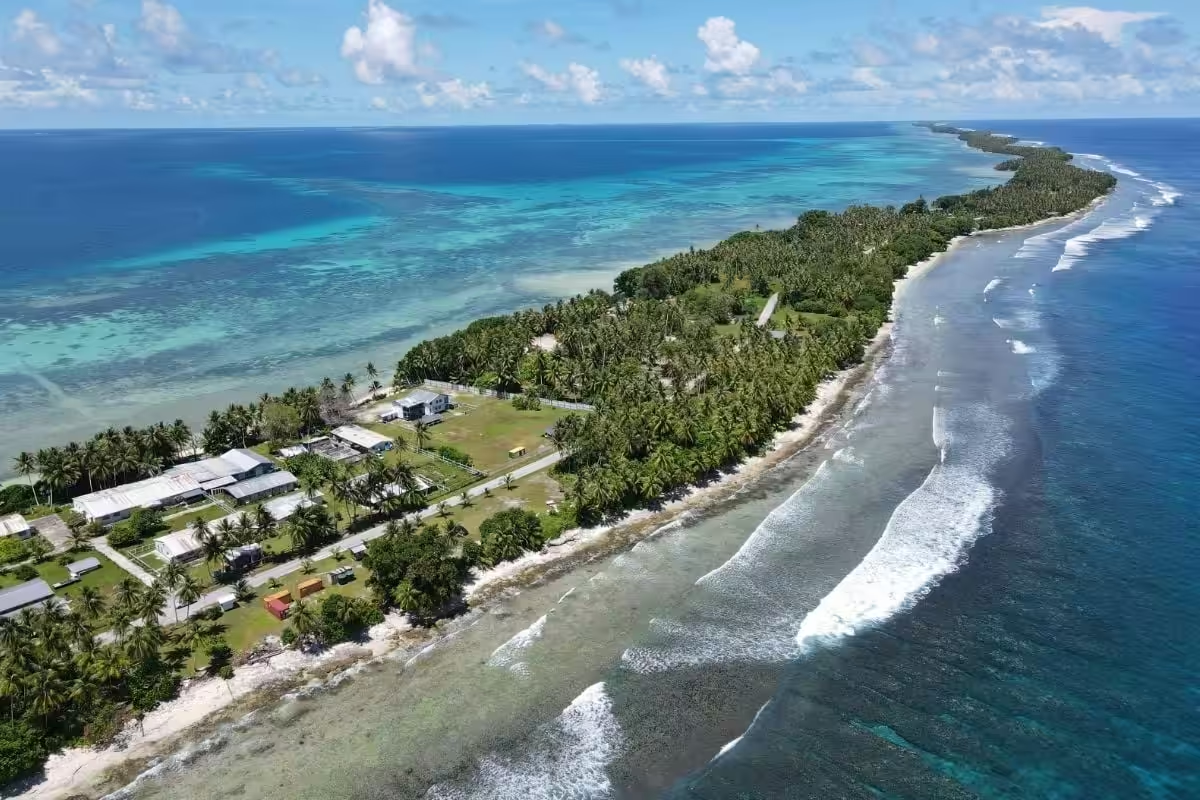
The Republic of the Marshall Islands (RMI) is a 29-atoll nation in the central Pacific and a freely associated state of the United States under the Compact of Free Association (COFA). The US dollar is the official currency, English is an official language alongside Marshallese, and the country hosts US defence operations, a fast-growing international shipping registry and a small but skilled local workforce. For companies looking to hire employees in Marshall Islands, the compliance terrain is unusual: there is no consolidated labour code, much of private employment is governed by individual contracts, but statutory obligations around social security, health-fund contributions, income tax and work permits are active and enforced by the government of the Marshall Islands.
An employer of record in Marshall Islands acts as the legal employer on your behalf, runs compliant payroll in USD, registers the employee with the Marshall Islands Social Security Administration (MISSA) and the national Health Fund, and manages work-permit sponsorship where the employee is not a US, Federated States of Micronesia (FSM) or Palau citizen. This guide explains every compliance layer an EOR handles in Marshall Islands in 2026 so you can hire without setting up a local entity.
How an Employer of Record Works in the Marshall Islands
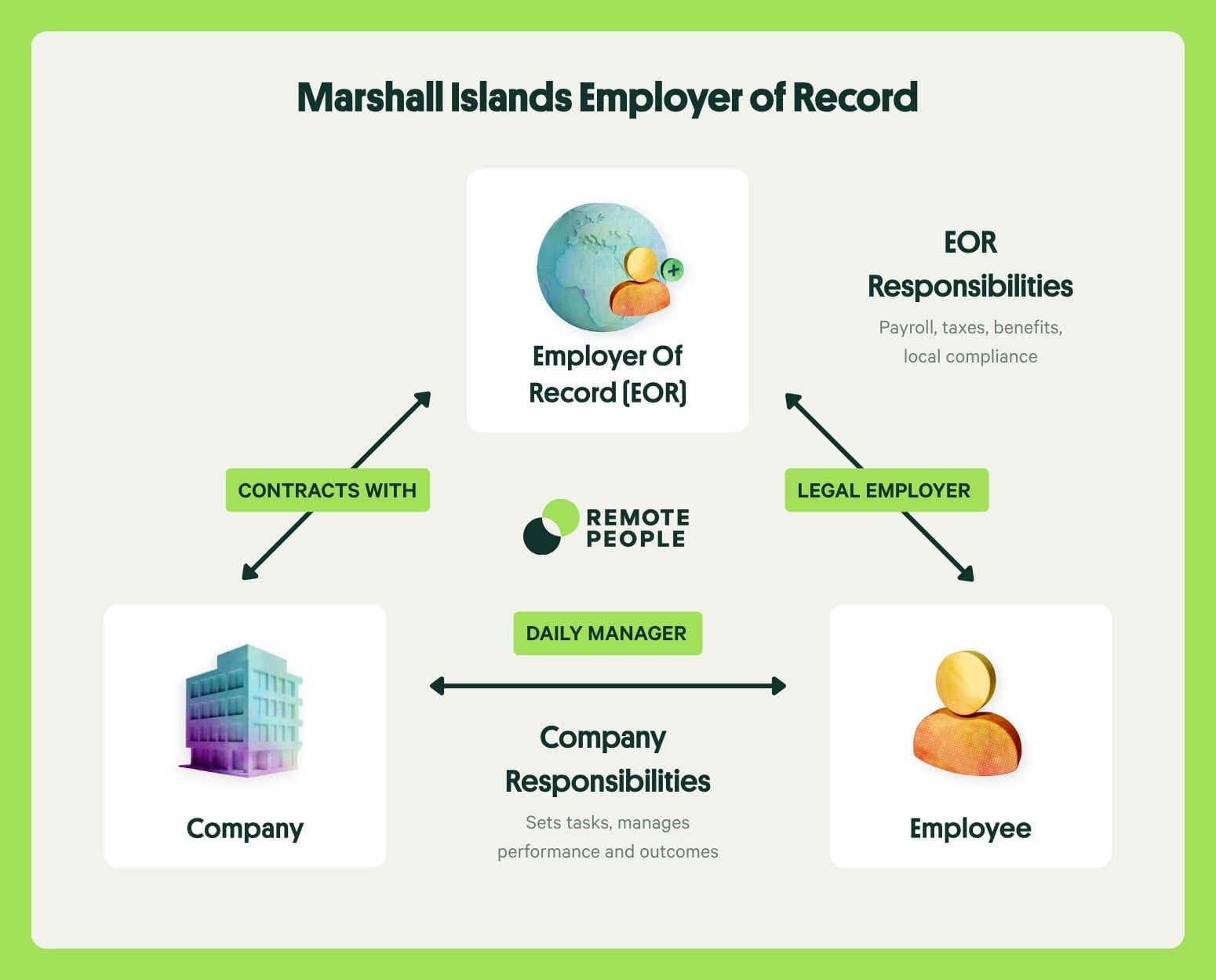
If you’d like to learn more about how Employer of Record (EOR) services work, read our What Is an Employer of Record (EOR)? guide for a complete overview of the model, its benefits, and when to use it.
If you’re comparing providers, our Best Employer of Record (EOR) Providers guide reviews the leading platforms to help you choose the right solution for your business.
Who Uses an EOR in Marshall Islands?
A Marshall Islands EOR is used by organisations that need a compliant employment vehicle in RMI without the cost and delay of setting up a local foreign corporation. Typical scenarios include:
- Testing the RMI market before committing: A company looking to build a team in Marshall Islands can hire one or two employees through an EOR to validate operations before registering an entity with the Registrar of Corporations.
- Hiring a small team without entity overhead: For organisations expanding into Marshall Islands with fewer than fifteen employees, the annual cost of maintaining a local entity, bookkeeping and Ministry of Finance filings typically exceeds the EOR service fee.
- Onboarding quickly: Any business hiring employees in Marshall Islands through an established EOR can typically get a worker employed and on payroll within one to two weeks, compared with several months for a new corporation.
- Hiring foreign nationals needing work permits: Because the Labour (Non-Resident Workers) Act 2018 places the advertisement, application and repatriation duties on the local employer, an EOR that is already a registered RMI employer can sponsor work-permit applications much faster than an offshore company.
US, FSM and Palau citizens can legally work in RMI without a work permit under COFA, which simplifies hiring for those nationalities, but all employees still require MISSA registration, Health Fund enrolment and income tax withholding, duties the EOR takes on in full.
Typical Onboarding Timeline
- EOR agreement and employee details: 1–2 days to sign the service agreement and collect employee passport, tax ID (if any) and bank details.
- Employment contract drafting and review: 2–3 days to draft the written contract with a statutory-compliant six-month probation clause and agreed leave entitlements.
- MISSA and Health Fund registration: 3–7 days to register the employer (if not already registered) and enrol the employee for social security and Health Fund contributions.
- Payroll setup: 2–3 days to configure USD payroll, tax withholding codes and benefits.
- Employee onboarding and first day: 1 day.
- Total: Most EOR providers can onboard an employee in Marshall Islands within 1–2 weeks where the hire is a citizen or COFA-covered national.
Work permits for non-COFA nationals extend the timeline substantially. Under the Labour (Non-Resident Workers) Act 2018 the employer must advertise the role in a local newspaper and on radio for at least 30 days before the non-resident worker application can be submitted, and the Division of Immigration review typically adds a further 4–8 weeks.
Hire in Marshall Islands
USD payroll, no currency conversion risk, COFA-exempt onboarding for US/FSM/Palau citizens, and a pragmatic MISSA/Health Fund compliance regime make the Marshall Islands a manageable entry point for Pacific-focused remote teams.
We handle employment contracts, USD payroll, MISSA and Health Fund registration, wages-tax withholding, and full RMI compliance.
No local entity needed. Your team can start in days.
Employment Laws and Regulations in Marshall Islands
Marshall Islands does not have a single consolidated labour code. Private-sector employment is governed by a combination of statutes, regulations and the written employment contract. The principal laws include the Labour (Non-Resident Workers) Act 2018 (RMI Parliament), the Minimum Wage Act (most recently amended by P.L. 2024-13), the Income Tax Act 1989 as amended, and the Social Security Act that creates MISSA. Sector-specific rules apply in the public service under Public Service Commission regulations. The Ministry of Foreign Affairs houses the Chief of Labour for non-resident worker matters, while the Division of Customs, Treasury, Revenue and Taxation (Ministry of Finance) enforces wages and salaries tax.
Employment Contracts
Written employment contracts are standard practice in Marshall Islands and are mandatory for non-resident workers under the Labour (Non-Resident Workers) Act 2018. The contract must specify the job description, hours, rate of pay, probation period and duration (fixed-term or indefinite). English is the working language for legal documents and government filings, and a Marshallese translation is advisable where the employee is a Marshallese citizen. Indefinite (open-ended) and fixed-term contracts are both permitted; fixed-term contracts are most common for non-resident workers because their statutory work permit is initially capped at one year under the 2018 Act.
Working Hours and Overtime
The standard workweek in Marshall Islands is 40 hours, typically spread over five eight-hour days, with at least one rest day per week. Private-sector employers commonly follow the US model of a 40-hour week with overtime payable for hours beyond 40, reflecting the dominant US economic influence and the public-sector rules applied by the Public Service Commission. Overtime is customarily paid at 1.5 times the regular hourly rate. Because RMI lacks a consolidated labour code with a detailed overtime schedule, the overtime premium and any night, rest-day or holiday multipliers are typically agreed in the employment contract and administered by the EOR.
Public-sector overtime rules, promulgated by the Public Service Commission, provide a useful benchmark for private employers: overtime above 40 hours is paid at 1.5x, and work on a gazetted public holiday is customarily paid at 2.0x or taken as compensatory time off. Private employers are not bound by the PSC rules, so the EOR captures the agreed multipliers in the employment contract to avoid disputes.
Marshall Islands overtime and premium pay rates · Per customary practice and PSC benchmark | |||
Hour type |
Rate multiplier |
Weekly/daily cap |
Notes |
|---|---|---|---|
Standard hours |
1.0x |
40 hrs/week; 8 hrs/day |
Standard workweek benchmark under Public Service Commission rules and customary private practice. |
Weekday overtime (above 40 hrs/week) |
1.5x |
No statutory cap |
Payable for hours worked beyond the agreed standard workweek; must be agreed in the employment contract for private-sector workers. |
Weekly rest-day work |
1.5x–2.0x |
Contract-defined |
Sunday and sixth-day work typically carries a premium or compensatory time off; rate set in contract. |
Public holiday work |
2.0x or compensatory time off |
n/a |
Applies to work on any of the 10 gazetted public holidays listed in Table 4. |
Night hours |
No statutory premium |
n/a |
Not codified; may be agreed as a contractual premium. Often aligns with PSC shift differentials. |
Because RMI does not impose a statutory cap on total overtime hours, the EOR should document any internal cap in the employment contract and ensure overtime earnings are included in the wages base used for MISSA, Health Fund and income tax withholding. Overtime premiums do not interact with a mandatory 13th-month payment because RMI has no statutory 13th-month obligation.
Minimum Wage
The national minimum wage in Marshall Islands is USD 4.50 per hour effective 1 October 2025, rising to USD 5.00 per hour on 1 October 2026 and USD 5.25 per hour on 1 October 2027 under the Minimum Wage (Amendment) Act 2024, P.L. 2024-13 (RMI Parliament). The legislation ended a stagnant USD 3.00 per hour rate that had been in place since 2017 and was based on a Graduate School USA EconMAP assessment of RMI cost of living. The minimum wage applies to all private-sector employees paid hourly; salaried employees must be paid at or above the minimum-wage equivalent when hours are converted.
Probation Period
The statutory probation period for non-resident workers is six months under the Labour (Non-Resident Workers) Act 2018. Private-sector employers commonly apply the same six-month probation period to citizen employees. During probation the employee enjoys the same workplace safety and non-discrimination protections as permanent staff but may be terminated on notice or payment in lieu as specified in the written contract, without the longer notice typically negotiated for permanent employees. Annual leave generally accrues during probation, though sick leave and extended benefits may start only on confirmation.
Leave Entitlements
Marshall Islands private-sector employment relies heavily on the written contract because the country has no consolidated labour code. The figures below reflect the floor commonly applied in formal private employment and the rules used in the public service under the Public Service Commission regulations, which are the most accessible benchmark. An EOR will set these minimums in the employment contract to avoid later disputes.
Annual Leave
Permanent employees in Marshall Islands are customarily entitled to a minimum of 10 days of paid annual leave per year, accruing monthly from the first day of employment. Entitlement typically increases with tenure for long-serving employees. Leave generally accrues during the six-month probation period but may only be taken after confirmation. Unused leave carryover rules are set in the employment contract; many employers cap carryover at one year’s accrual.
Sick Leave
Employees are customarily entitled to 21 days of paid sick leave per year from the first day of employment. A medical certificate is typically required for absences exceeding two consecutive working days. Sick leave is employer-funded and does not reduce annual leave balances. MISSA does not administer a statutory sick-pay scheme for private-sector employees.
Maternity Leave
Female employees are entitled to paid maternity leave, commonly 12 weeks (60 working days) for the first four live births. The Marshall Islands is one of a small group of UN member states without a broad statutory mandate for paid parental leave, so the scope of maternity pay, full or partial salary and who funds it, is driven by the employment contract and any applicable public-service rules. Public-sector employees receive paid maternity leave under PSC regulations; private-sector employers replicate these terms through the EOR contract.
Paternity Leave
Paternity leave is not required by statute in Marshall Islands. Employers may offer short paternity leave (typically 3–5 days) on a voluntary basis, and an EOR will include such a clause in the employment contract where the client company wishes to extend it.
Other Statutory Leave
- Bereavement leave: Not codified; commonly offered as 3–5 days on the death of a close family member and captured in the employment contract.
- Marriage leave: Not statutory; sometimes offered as 1–3 days of paid leave.
- Public holidays: Employees are entitled to paid time off on the gazetted public holidays listed in Table 4.
- Jury duty / civic leave: Public-sector rules provide paid leave for jury service; private employers commonly follow the same practice.
The Labour (Non-Resident Workers) Act 2018 (RMI Parliament) sets written-contract and repatriation rules but does not itself codify a detailed leave schedule for private-sector workers. The summary below shows the entitlements that an EOR will typically embed in the employment contract to meet RMI customary private-sector practice, aligned with the Public Service Commission benchmark. The single most important takeaway is that leave terms in Marshall Islands flow from the written employment contract, the EOR captures them explicitly to avoid uncertainty.
Marshall Islands statutory leave entitlements · Per customary practice and PSC benchmark, 2026 | ||
Leave type |
Duration |
Eligibility and notes |
|---|---|---|
Annual leave |
10 days paid |
Accrues monthly from day one; taken after probation. Carryover set by contract. |
Sick leave |
21 days paid |
Employer-funded; medical certificate required for absences beyond two consecutive working days. |
Maternity leave |
Up to 12 weeks |
Available for the first four live births; pay rate set in employment contract per PSC benchmark. |
Paternity leave |
Not statutory (0 days) |
Voluntary; commonly 3–5 days where offered. |
Bereavement leave |
3–5 days (contract) |
Not codified; typically granted for a close family member. |
Marriage leave |
1–3 days (contract) |
Customary private-sector practice; not statutory. |
Public holidays |
10 gazetted days |
Paid; see Table 4 for the full 2026 calendar. |
Statutory Employee Benefits
Beyond leave, Marshall Islands employers must enrol every employee in the national social security and health-fund programmes administered by MISSA. These contributions are mandatory and are withheld at source.
- Social security: Employer and employee each contribute 8% of quarterly wages up to the USD 10,000 quarterly earnings cap (USD 40,000 per year). MISSA uses the contributions to fund retirement, disability and survivor benefits (MISSA).
- Health Fund: A separate 3.5% contribution on quarterly wages up to USD 5,000 funds basic and supplemental health coverage, with administration transferred to the Ministry of Health in 2002. Collection continues through MISSA (Marshall Islands Health Fund Act of 2002 · WHO).
- Workers’ compensation: A formal RMI Workers’ Compensation programme launched 1 October 2023, administered under MISSA oversight, requiring employer registration and contribution for work-related injury coverage (MISSA).
- Private health insurance: Not mandated. Employers with international assignees often offer supplemental private health cover because the national Health Fund focuses on basic domestic care and overseas referral.
- 13th-month salary: Not mandated; any bonus is voluntary.
Refer to Tables 1 and 2 in the payroll section for the exact employer and employee contribution rates.
Recent Regulatory Updates (2026)
Marshall Islands is midway through a significant tax and wage reform cycle. The Minimum Wage (Amendment) Act 2024 (RMI Parliament) raised the statutory floor from USD 3.00 to USD 4.50 per hour on 1 October 2025, with a further increase to USD 5.00 per hour scheduled for 1 October 2026 and USD 5.25 per hour for 1 October 2027. The increase was based on a Graduate School USA EconMAP cost-of-living assessment recommending a gradual path toward USD 5.23 per hour.
Phase One of the Marshall Islands tax reform, legislated in October 2024 and taking effect in May 2025, revised personal income-tax rates and thresholds under the Income Tax (Amendment) Act 2025 (RMI Parliament). Phase Two, scheduled for October 2026, will introduce a value-added tax (VAT) and a business profit tax that will replace the current turnover tax and local sales taxes (IMF Technical Assistance Report, February 2025). Employers should expect administrative changes to payroll reporting and tax filings as the Division of Customs, Treasury, Revenue and Taxation rolls out VAT registration ahead of the October 2026 effective date. A full Marshall Islands EOR will monitor these changes and update payroll configurations accordingly.
Work Permits and Visas in Marshall Islands
Work Permit Requirements
Who Needs a Work Permit
Only non-resident workers who are not citizens of the United States, the Federated States of Micronesia or Palau require a Marshall Islands work permit. Citizens of the three Freely Associated States (plus US citizens) can live and work in RMI without a work permit under the Compact of Free Association. All other foreign nationals must obtain a non-resident worker permit under the Labour (Non-Resident Workers) Act 2018 before starting work, with the Chief of Labour at the Ministry of Foreign Affairs acting as the approving authority (RMI Parliament).
Eligibility and Required Documents
Applicants must hold a valid passport (with at least six months’ validity beyond the intended stay), a signed employment contract with a registered RMI employer, evidence of qualifications, a police clearance certificate and a medical certificate. The employer must have advertised the role in a local newspaper and on radio for a minimum of 30 days before applying, and must certify in writing that no qualified Marshall Islander could be found. The employer must also undertake in writing to cover the non-resident worker’s repatriation costs at the end of the employment.
Processing Time and Validity
Labour Division review of a complete non-resident worker application typically takes around 21 days after the 30-day advertisement period, with the Division of Immigration entry-visa step adding a further 4–8 weeks. Initial permits are valid for up to one year and are tied to the specific employer and role named on the application (RMI Division of Immigration).
Renewal Process
Work permits are renewable at the end of each calendar year up to a total of two consecutive years under the standard track. A third year is possible only with Cabinet approval. Renewal applications should be filed at least 60 days before the expiry date and require a fresh employer certification plus proof of ongoing MISSA and Health Fund compliance. The employee can continue working during renewal review if the application is filed on time.
Common Visa Types for Foreign Workers
Marshall Islands operates a compact visa system under the Immigration Act and the Compact of Free Association, with the Division of Immigration under the Ministry of Justice, Immigration and Labor issuing entry visas and work permits. The categories below are the routes available to foreign workers in 2026; an EOR registered in RMI can sponsor the first three. Tourist, student and transit visas do not permit employment.
Marshall Islands work visa types for foreign workers · 2026 | ||||
Visa type |
Duration |
Best for |
Leads to permanent residency? |
Processing |
|---|---|---|---|---|
Non-resident worker permit |
Up to 1 year, renewable to 2 years (3 with Cabinet approval) |
Standard skilled or specialist role with an RMI employer |
No (tied to employer) |
30-day ad + 4–8 weeks |
Business / investor entry visa |
Up to 1 year, renewable |
Owners and directors investing or opening an entity in RMI |
Possible with Registrar of Corporations registration |
4–6 weeks |
Special skills / consultancy visa |
Short-term, project-based |
Short engagements, technical assistance, audits |
No |
2–4 weeks |
COFA work-authorisation exemption |
Indefinite (tied to citizenship) |
US, FSM and Palau citizens working in RMI |
n/a (no permit required) |
None |
- Tourist visa: Issued for up to 30 days, extendable; does not permit employment.
- Student visa: For full-time study at an RMI institution; does not permit employment beyond study-related placements.
- Transit visa: Short validity; does not permit employment.
How an EOR Handles Work Permits
An EOR registered in Marshall Islands acts as the legal employer for the non-resident worker and takes on the full duty of sponsorship under the Labour (Non-Resident Workers) Act 2018. The EOR runs the 30-day newspaper and radio advertisement, submits the non-resident worker application to the Chief of Labour, liaises with the Division of Immigration on the entry-visa step, and signs the statutory repatriation undertaking. The employee provides personal documents (passport, qualifications, police and medical certificates) and attends the visa interview if required. A work-permit hire extends the onboarding timeline described earlier by several weeks, see the H3 1.4 timeline for details. For US, FSM and Palau citizens no work permit is needed and the timeline stays at the standard 1–2 weeks. The EOR model is the fastest legal route for non-resident workers because a client without a local entity cannot sponsor a permit directly.
Payroll, Taxes, and Social Security in Marshall Islands
Employer Contributions
Marshall Islands employers contribute to MISSA for social security and to the national Health Fund on behalf of each employee. Contributions are calculated on quarterly wages subject to statutory caps and are filed each quarter with MISSA. The rates below are set by MISSA (MISSA) and reflect the 2026 position.
Marshall Islands employer social security contributions · 2026 rates | ||
Component |
Rate |
Notes |
|---|---|---|
MISSA social security |
8% |
Applies to quarterly wages up to USD 10,000 (USD 40,000/year cap). |
Health Fund |
3.5% |
Applied to quarterly wages up to USD 5,000; collected via MISSA; administered by Ministry of Health. |
Workers’ compensation |
Variable (programme fee) |
Employer registration required since 1 October 2023; contribution set by MISSA workers’ compensation schedule. |
Total employer contribution (indicative) |
11.5% |
Applied to capped quarterly wage base; excludes workers’ compensation premium. |
Source: MISSA Taxable Earnings and MISSA Workers’ Compensation | ||
Employee Contributions
Employees have matching social security and health-fund contributions withheld from each pay cycle, plus wages and salaries tax under the Income Tax Act 1989 as amended. All deductions are remitted by the employer (or EOR) to MISSA and the Division of Customs, Treasury, Revenue and Taxation.
Marshall Islands employee payroll deductions · 2026 monthly withholdings | ||
Withholding |
Rate |
Notes |
|---|---|---|
MISSA social security |
8% |
Matches employer contribution; quarterly cap USD 10,000 wages. |
Health Fund |
3.5% |
Quarterly cap USD 5,000; collected via MISSA. |
Wages and salaries tax (low band) |
8% |
Applied to annual taxable income above the USD 1,040 allowance and up to USD 10,400. |
Wages and salaries tax (high band) |
12% |
Applied to annual taxable income above USD 10,400. |
Combined employee deduction (indicative, above threshold) |
23.5% |
Top-band combined rate on wages above USD 10,400; excludes any voluntary contributions. |
Income Tax
Personal income tax in Marshall Islands is administered under the Income Tax Act 1989 as amended by the Income Tax (Amendment) Act 2025 (RMI Parliament). The tax is levied on wages and salaries with two statutory rate bands. A low-income exemption shields annual earnings up to USD 8,320 from tax; wages between USD 8,320 and USD 10,400 are subject to an exemption of USD 1,040 so only income above the allowance is taxed at the 8% rate.
Marshall Islands income tax brackets · 2026 | |
Annual taxable income (USD) |
Tax calculation |
|---|---|
Up to USD 1,040 (annual allowance) |
Exempt |
USD 1,041 – USD 10,400 |
8% of the amount above USD 1,040 |
Above USD 10,400 |
USD 748.80 + 12% of the amount above USD 10,400 |
Payroll Cycle
Private-sector payroll in Marshall Islands is most commonly run on a bi-weekly or semi-monthly cycle, in line with US-style practice. Pay is denominated in USD (the official currency) and is typically delivered by direct deposit through an RMI bank or cash for employees without bank accounts. Pay slips must show gross pay, each deduction (MISSA, Health Fund, wages tax) and net pay. MISSA and Health Fund contributions are filed and paid quarterly, with deadlines ten days after quarter-end: 10 April (Q1), 10 July (Q2), 10 October (Q3) and 10 January (Q4 of the prior year). Wages and salaries tax is remitted monthly to the Division of Customs, Treasury, Revenue and Taxation with an annual return filed in line with the Ministry of Finance calendar.
13th Month Salary and Bonus Pay
Marshall Islands does not mandate a 13th-month salary, a 14th-month salary, or any statutory holiday bonus. Employers may pay a Christmas or year-end bonus as a voluntary benefit, a common practice in larger private-sector employers and in the shipping registry sector, but there is no legal requirement. Where an EOR offers a bonus on behalf of the client, the full amount is treated as taxable wages, subject to the 8%/12% wages and salaries tax and to MISSA and Health Fund deductions up to the quarterly caps.
Cost of Hiring Through an EOR in Marshall Islands
EOR Service Fees
Marshall Islands EOR service fees typically range from USD 300 to USD 600 per employee per month, depending on salary, benefits complexity and whether work-permit sponsorship is required. The fee covers MISSA and Health Fund registration, monthly payroll runs, wages-tax withholding, quarterly MISSA filings, annual income-tax reporting, benefits administration, paid-leave tracking and employment-contract management. Work-permit sponsorship for non-COFA nationals typically attracts a one-off supplementary fee to cover the advertisement, application and immigration liaison.
Total Employment Cost Breakdown
The table below shows a representative monthly employer cost for a Marshall Islands hire at a gross salary of USD 3,500 per month. Because the quarterly MISSA cap is USD 10,000, a USD 3,500 monthly salary is fully within the contribution base for all three months of the quarter. The Health Fund base is also within the USD 5,000 quarterly cap for the first month of each quarter only, but the table uses the full 3.5% on the monthly gross for simplicity of cost planning.
Marshall Islands employer cost example · USD 3,500 gross · 2026 | ||
Line item |
Amount (USD) |
% of gross |
|---|---|---|
Gross monthly salary |
$3,500.00 |
100.0% |
MISSA employer contribution (8%) |
$280.00 |
8.0% |
Health Fund employer contribution (3.5%, capped share) |
$58.33 |
1.7% |
Workers’ compensation (programme fee, indicative) |
$20.00 |
0.6% |
EOR service fee (monthly flat) |
$450.00 |
12.9% |
Total monthly employer cost |
$4,308.33 |
123.1% |
All amounts in USD, Marshall Islands’ official currency. Health Fund contribution is capped at USD 5,000 of quarterly wages; the monthly figure shown is an average smoothed across the quarter.
Ready to hire in Marshall Islands? Get started with RemotePeople, we handle employment contracts, USD payroll, MISSA and Health Fund registration, wages-tax withholding and full RMI compliance. See our transparent pricing for a fee breakdown. No local entity needed. Contact us for a quote.
Benefits of Using an EOR in Marshall Islands
Marshall Islands is a small, geographically remote market with unique compliance layers, MISSA quarterly filings, the COFA immigration exemption, and an active tax and wage reform cycle. An EOR solves for all of these in a single service. The benefits below explain why an EOR is usually the fastest and lowest-risk way to hire one or a small team in RMI.
- Rapid market entry: An EOR already registered with MISSA and the RMI Registrar of Corporations can onboard a citizen or COFA-national employee within 1–2 weeks, versus several months to register a new foreign corporation, open a local bank account and register for MISSA and the Health Fund independently.
- Compliance assurance: The EOR takes full statutory responsibility for MISSA and Health Fund filings, wages-tax withholding, the Income Tax (Amendment) Act 2025 thresholds and the Labour (Non-Resident Workers) Act 2018 sponsorship duties, shifting the compliance burden away from the client company.
- Cost efficiency vs a local entity: Maintaining a Marshall Islands foreign corporation carries annual registration fees, a registered agent cost, local accounting and tax-return fees that typically exceed USD 10,000 per year. For teams of fewer than 15 employees, the EOR fee of USD 300–600 per employee per month is materially cheaper.
- Local expertise: A Marshall Islands EOR understands the quirks of RMI payroll, the quarterly USD 10,000 MISSA cap, the separate USD 5,000 Health Fund cap, the wages-tax allowance, the October 2026 VAT rollout, and applies them correctly without the client having to read the underlying statutes.
- Flexibility to scale up or down: Hiring and offboarding employees through an EOR is a commercial transaction with the service provider, not a company law process. Teams can be scaled up or down in line with demand without liquidating an entity.
- Risk mitigation: The EOR assumes employer liability, funds statutory leave, manages the six-month probation, holds the non-resident worker’s work permit and covers the statutory repatriation obligation under the 2018 Act, reducing exposure to missed filings or disputed terminations.
- Employee experience: Marshall Islands-based employees receive a written contract, a proper RMI pay slip in USD, a Health Fund enrolment and access to MISSA benefits, matching the expectations they would have from a local employer.
For companies expanding into Marshall Islands, the EOR model turns what would otherwise be a multi-month entity-setup project into a service agreement that begins payroll in days. Speak to RemotePeople to scope your RMI hire.
Termination and Offboarding in Marshall Islands
Notice Periods
Marshall Islands has no generally applicable statutory notice period for private-sector dismissals. Notice is governed by the written employment contract, which in practice commonly sets 2 weeks for employees with short tenure and 30 days for longer-serving staff. For non-resident workers, the Labour (Non-Resident Workers) Act 2018 requires written notice or payment in lieu consistent with the contract, and the employer must also plan for the statutory repatriation obligation. During the six-month probation period, either party can usually end the contract on shorter notice, 1 week or payment in lieu, provided the conditions specified in the written contract are met.
Marshall Islands statutory notice periods by position level · Per contract and Labour (Non-Resident Workers) Act 2018 | |||
Position level / tenure |
Notice period |
During probation |
Notes |
|---|---|---|---|
Probation (first 6 months) |
1 week (typical) |
Yes, shorter contractual notice |
Payment in lieu permitted if stated in contract. |
Less than 2 years |
2 weeks (typical) |
n/a |
Standard private-sector practice; confirm in written contract. |
2 – 5 years |
30 days (typical) |
n/a |
Often aligned to public-service benchmark. |
5+ years / managerial |
30–60 days (contract) |
n/a |
Negotiated at senior level; payment in lieu common. |
Non-resident worker (any tenure) |
Per written contract |
Per contract |
Repatriation costs remain the employer’s obligation under the 2018 Act. |
Exceptions to notice apply where there is just cause for summary dismissal (for example, gross misconduct, dishonesty or a serious safety breach), where the parties reach a mutual separation agreement, or where a fixed-term contract expires at term. In practice, summary dismissal is documented in writing and the reason recorded for the employee’s file.
Severance Pay
Marshall Islands has no general statutory severance pay obligation for private-sector dismissals. Severance is discretionary and is paid only where the employment contract, a collective agreement or a negotiated separation package provides for it. For permanent employees with long tenure, employers commonly offer an ex-gratia severance payment of one week to one month’s salary per completed year of service to secure a clean exit, but this is a contractual or commercial matter rather than a legal requirement. A Marshall Islands EOR will document any severance formula in the employment contract so expectations are clear at the point of hire.
Marshall Islands severance pay schedule by years of service · Per contract (no statutory floor) | |||
Years of service |
Severance amount (typical contract) |
Base salary definition |
Notes |
|---|---|---|---|
Less than 1 year (post-probation) |
Nil (no statutory entitlement) |
n/a |
Contract-defined; commonly nil below one year. |
1 year |
2 weeks gross pay (indicative) |
Gross monthly base salary |
Voluntary; not statutory. |
3 years |
1 month gross pay (indicative) |
Gross monthly base salary |
Voluntary; driven by contract. |
5 years |
1.5 months gross pay (indicative) |
Gross monthly base salary |
Voluntary. |
10 years |
3 months gross pay (indicative) |
Gross monthly base salary |
Voluntary; negotiated at separation. |
Calculation Method
Where severance is paid, the formula is typically a fixed number of weeks or months of gross monthly base salary per completed year of service, as documented in the employment contract. The base salary definition usually covers gross pay excluding overtime and discretionary bonuses, but employers can choose to include a 13th-month payment (where offered) in the base. See Table 13 for worked examples; the numbers there are indicative contractual benchmarks, not statutory minima.
Caps and Exceptions
Because severance is contractual in Marshall Islands, any cap is set in the contract itself. Employers commonly cap aggregate severance at 6–12 months’ pay for very long-serving staff. Severance is typically not paid where the employee is dismissed for just cause (gross misconduct, dishonesty), where a fixed-term contract ends at term, or during the six-month probation period unless the contract specifies otherwise.
Grounds for Termination
Private-sector termination in Marshall Islands proceeds under the written employment contract and general principles of fair dealing. Valid grounds include redundancy, poor performance (typically after a documented improvement plan), misconduct, gross misconduct (summary dismissal without notice) and mutual agreement. Non-resident workers may also need their work permit cancelled with the Chief of Labour and the Division of Immigration; the EOR handles this step. Employers should document the reason for termination in writing, pay all accrued wages and leave, issue a final pay slip and complete MISSA and Health Fund deregistration within the quarterly filing cycle.
EOR vs. Other Hiring Models in Marshall Islands
EOR vs. Setting Up a Local Entity
For companies weighing entry modes into the Marshall Islands, the two realistic routes are engaging a registered EOR or incorporating a new RMI foreign corporation. The table below compares setup time, cost and compliance workload using current registration fees from the RMI Registrar of Corporations and the MISSA employer rates.
Marshall Islands EOR vs local entity comparison · Setup time, cost, risk and best-fit | ||
Factor |
Employer of Record |
Own Entity (RMI Foreign Corporation) |
|---|---|---|
Setup time | 1–2 weeks | 2–4 months |
Upfront cost | $0 | $3,000–$8,000 (registration, registered agent, legal) |
Ongoing cost | $300–$600/employee/month | $10,000–$20,000/year maintenance |
Local partner required | No (EOR is the local entity) | Yes, registered agent required under RMI company law |
Social insurance registration | Handled by EOR | You register with MISSA and Health Fund |
Payroll & tax filing | Handled by EOR | You manage quarterly MISSA and monthly wages-tax remittance |
Best for team size | 1–15 employees | 15+ employees |
Scale down / exit | Easy, no entity to unwind | Costly, legal dissolution required |
Government contracts | Not eligible | Eligible (requires local entity) |
Source: MISSA and RMI Ministry of Finance | ||
An RMI foreign corporation is a valid long-term structure for companies that need to bid on government contracts or operate a physical facility in the Marshall Islands, but it brings recurring costs, registered-agent fees, an annual return, local accounting and MISSA compliance, that only pay off at scale. For any company hiring fewer than fifteen employees or validating the market before committing to infrastructure, an EOR is the faster and materially cheaper route.
The cost calculus also changes after Phase Two of the tax reform takes effect in October 2026. A direct RMI entity will need to register for the new VAT and profit tax, while an EOR absorbs those payroll-adjacent filings on the client’s behalf.
EOR vs. Hiring Independent Contractors
The choice between hiring a worker as an RMI employee via an EOR or engaging them as an independent contractor turns on the substance of the relationship, not the label on the invoice. The table below contrasts the two arrangements against the compliance tests applied by the MISSA and the RMI Division of Customs, Treasury, Revenue and Taxation.
Marshall Islands EOR vs independent contractors · Compliance, cost, and risk | ||
Factor |
EOR (Full-Time Employee) |
Independent Contractor |
|---|---|---|
Legal relationship | Employee of the EOR | Self-employed, no employment relationship |
Compliance risk | Low, EOR ensures RMI payroll, MISSA and tax compliance | High, misclassification risk if relationship resembles employment |
Payroll & tax | EOR handles MISSA, Health Fund and wages-tax withholding | Contractor invoices you; they handle their own presumptive/profit tax filings |
Benefits & leave | Statutory benefits, paid leave, MISSA coverage | No entitlement to employee benefits |
IP protection | Stronger, employment contract assigns IP by default | Weaker, requires explicit IP assignment clause |
Termination | Subject to contract notice and (for non-resident workers) repatriation | Contract can be ended per agreement terms |
Best for | Long-term, core team roles | Short-term projects, specialized tasks |
Cost structure | Salary + employer contributions + EOR fee | Contractor fee (typically higher gross, lower total cost) |
Misclassification is a real risk in the Marshall Islands because the distinction between employee and contractor is drawn less by statute than by the substance of the engagement. A worker who follows a fixed schedule, uses company equipment, reports to a manager and works only for one client is likely to be reclassified as an employee on audit. The consequence is retroactive MISSA, Health Fund and wages-tax liability, plus penalties, and the award of statutory leave entitlements.
For ongoing, embedded roles the EOR route is safer and cleaner. For genuine project work with a clear scope and deliverables, a contractor engagement via a contractor of record is appropriate.
EOR vs. PEO (Professional Employer Organization)
PEO (Professional Employer Organization) arrangements are not codified in RMI statute; service providers that describe themselves as PEOs usually act as HR outsourcers for companies that already hold their own RMI registration. The table below shows how PEO and EOR models differ on legal-employer status, entity requirements and compliance liability.
Marshall Islands EOR vs PEO comparison · Legal employer, liability, and setup | ||
Factor |
Employer of Record (EOR) |
PEO |
|---|---|---|
Legal employer | EOR is the legal employer | You remain the legal employer (co-employment) |
Local entity required | No, the EOR is the local entity | Yes, you must have your own entity in Marshall Islands |
Best for | Companies without a local entity | Companies that already have a local entity |
Compliance liability | EOR assumes compliance responsibility | Shared liability between you and the PEO |
Setup time | 1–2 weeks | Depends on your entity setup (weeks to months) |
Control over HR policies | EOR manages within RMI law framework | More direct control, PEO advises |
Typical use case | Market entry, small remote teams, testing new markets | Established local operations needing HR outsourcing |
Source: MISSA and Labour (Non-Resident Workers) Act 2018 | ||
Marshall Islands does not operate a formal regulatory framework for Professional Employer Organizations. Service providers that describe themselves as PEOs in the RMI context are usually either foreign-registered EORs or local HR-outsourcing firms that provide payroll and benefits administration to companies that already hold an RMI foreign corporation. The practical difference is that a PEO arrangement requires the client to maintain its own registered entity, whereas an EOR does not.
For most companies entering Marshall Islands the EOR model is the simpler and cheaper route, no entity, no co-employment complexity, and a single counterparty carrying the statutory compliance duties.
Public Holidays in Marshall Islands
Marshall Islands observes ten gazetted public holidays each year under the Holidays Regulations. Two holidays, Dri-Jerbal Day and Gospel Day, fall on the first Friday of September and December respectively. Good Friday moves with Easter. All other holidays are fixed dates. Employees are entitled to paid time off on these days; work performed on a public holiday is customarily paid at the holiday premium shown in Table 10.
Marshall Islands public holidays · 2026 calendar year | ||
Date |
Holiday |
Type |
|---|---|---|
Thursday, 1 January 2026 | New Year’s Day | National |
Sunday, 1 March 2026 | Nuclear Victims Remembrance Day | National |
Friday, 3 April 2026 | Good Friday | Religious (movable) |
Friday, 1 May 2026 | Constitution Day | National |
Friday, 3 July 2026 | Fisherman’s Day | National (1st Friday of July) |
Friday, 4 September 2026 | Dri-Jerbal Day (Workers’ Day) | National (1st Friday of September) |
Friday, 25 September 2026 | Manit Day | National (last Friday of September) |
Tuesday, 17 November 2026 | President’s Day | National |
Friday, 4 December 2026 | Gospel Day | National (1st Friday of December) |
Friday, 25 December 2026 | Christmas Day | Religious |
Source: RMI Maritime Registry and timeanddate.com | ||
When a fixed-date holiday falls on a Sunday, it is customarily observed the following Monday under Ministry of Internal Affairs guidance. Employers should plan payroll around the moving Friday holidays (Fisherman’s, Dri-Jerbal, Manit, Gospel) because the actual calendar date shifts year to year.
How to Get Started with an EOR in Marshall Islands
- Define the role and location: Confirm the job description, salary in USD, expected start date and whether the hire is a US / FSM / Palau citizen (COFA-exempt) or a non-resident worker who will need a permit.
- Engage a Marshall Islands EOR: Sign the EOR service agreement and share the candidate’s passport, residence details and any supporting documents.
- Drafting the employment contract: The EOR drafts an RMI-compliant written contract in English (with Marshallese translation where required), embedding the six-month probation, leave entitlements and notice terms.
- Run the compliance setup: The EOR registers the employee with MISSA, enrols them in the Health Fund, sets up wages-tax withholding under the Income Tax (Amendment) Act 2025, and (for non-COFA hires) runs the Labour (Non-Resident Workers) Act 2018 permit process.
- Go live on payroll: First USD payroll runs within days of the employee’s start date; quarterly MISSA filings and monthly wages-tax remittance continue for the duration of the engagement.
RemotePeople handles all of the above as a single service. Contact us for a Marshall Islands hiring quote, or browse our full list of EOR countries and global payroll solutions to compare options.
Where companies hiring in the Marshall Islands expand next
Companies operating in the Marshall Islands often extend across the Asia-Pacific, drawing on English-speaking talent and aligned business culture. After building a team in the Marshall Islands, employers often look to hiring in Papua New Guinea for the regional Pacific talent footprint, then an EOR partner in Australia for Pacific-region proximity and English-first hiring. New Zealand follows with aligned Pacific workforce norms, and a team in Fiji typically closes the regional footprint via shared Pacific business rhythm.
Frequently Asked Questions
EOR service fees typically range from USD 300 to USD 600 per employee per month. On top of the fee, employer statutory contributions are 8% MISSA social security and 3.5% Health Fund (both capped on quarterly wages, per MISSA Taxable Earnings), plus a small workers' compensation programme fee. For a USD 3,500 per month employee, total monthly employer cost is around USD 4,300.
1–2 weeks for citizens and COFA-covered nationals (US, FSM, Palau). For non-resident workers the Labour (Non-Resident Workers) Act 2018 requires a 30-day local advertisement period plus 4–8 weeks for the work-permit and visa review, extending total onboarding to around 2–3 months.
No. A registered Marshall Islands EOR acts as the legal employer on your behalf, so you do not need to register a foreign corporation, open a local bank account, or register directly with MISSA.
No. There is no statutory 13th-month or 14th-month salary in Marshall Islands. Year-end bonuses are voluntary; where paid, they are fully taxable as wages under the RMI Division of Customs, Treasury, Revenue and Taxation.
Under a standard RMI employment contract drafted by the EOR, intellectual property created in the course of employment vests with the employer and is assigned to the client company (you), not the EOR, through the EOR service agreement.
Yes. Converting a long-running contractor to an employee is often recommended where the engagement resembles employment (fixed schedule, company tools, single client), because RMI misclassification exposes the employer to retroactive MISSA, Health Fund and wages-tax liability.
The EOR manages the offboarding: written notice consistent with the employment contract, final payroll run, MISSA and Health Fund deregistration, and (for non-resident workers) work-permit cancellation and repatriation arrangements under the Labour (Non-Resident Workers) Act 2018.
Yes. USD 4.50 per hour (from 1 October 2025), rising to USD 5.00 per hour on 1 October 2026 and USD 5.25 per hour on 1 October 2027 under the Minimum Wage (Amendment) Act 2024 (P.L. 2024-13).
Employer of Record in
Employer of Record in
Employer of Record in
Employer of Record in
Employer of Record in
Employer of Record in
Employer of Record in
Employer of Record in




