
 Recruit
Employer of Record in Mongolia
-
 Drew Donnelly
- Published
- September 22, 2026
Hire employees in Mongolia without setting up a local entity. RemotePeople handles payroll, contracts, tax withholding, and full Mongolia compliance — so you can build your Mongolia team in days, not months.
Hire in Mongolia — book a free 30-minute demo
Tell us what you need. You'll get a tailored, transparent proposal within 24 hours, plus a free call to walk through it.
Tell us about your company
So we can match you with a specialist who knows your market — and unlock volume pricing tiers.
* All fields are required.
Where and when are you hiring?
Tell us the geography and timing and we'll quote each country line by line, with onboarding timelines.
* All fields are required.
Help us beat your current setup
We'll benchmark your current deal and send a line-by-line proposal in 24 hours — showing exactly where we cut cost, time, or risk. After you submit, you can book a call to walk through it together.
* All fields are required.
Thanks! Your proposal is on its way.
Expect a tailored, line-by-line proposal in your inbox within 24 hours. In the meantime…
Want to walk through it together?
Book a free 30-minute call with one of our specialists. We'll explain every line, answer your questions, and tailor the proposal further if you need.
No obligation. Pick a time that works for you.








- Hire in Mongolia — book a free 30-minute demo
- Tell us about your company
- Where and when are you hiring?
- Help us beat your current setup
- Thanks! Your proposal is on its way.
- How an Employer of Record Works in Mongolia
- Employment Laws and Regulations in Mongolia
- Work Permits and Visas in Mongolia
- Payroll, Taxes, and Social Security in Mongolia
- Cost of Hiring Through an EOR in Mongolia
- Benefits of Using an EOR in Mongolia
- Termination and Offboarding in Mongolia
- EOR vs. Other Hiring Models in Mongolia
- Public Holidays in Mongolia
- How to Get Started with an EOR in Mongolia
- Where companies hiring in Mongolia expand next
- Frequently Asked Questions
- Related EOR Destinations

Start hiring in Mongolia
Let RemotePeople handle payroll, compliance, and HR admin worldwide so you can focus on building your team.

Mongolia offers a young, highly literate workforce and strategic access to the markets of Northeast and Central Asia. For companies looking to hire employees in Mongolia, the Revised Labour Law of 2021, progressive personal income tax updates that take effect on 1 January 2026, and a work permit regime administered by the Labour and Social Welfare Services General Office create compliance obligations that must be handled correctly from day one.
An employer of record in Mongolia becomes the legal employer of your team on paper, manages bilingual employment contracts in Mongolian, registers employees with the social insurance funds, withholds personal income tax, handles the pre-work permit for foreign hires, and takes on full statutory liability, allowing you to onboard talent in Ulaanbaatar or the provinces within one to two weeks without setting up a local entity.
How an Employer of Record Works in Mongolia
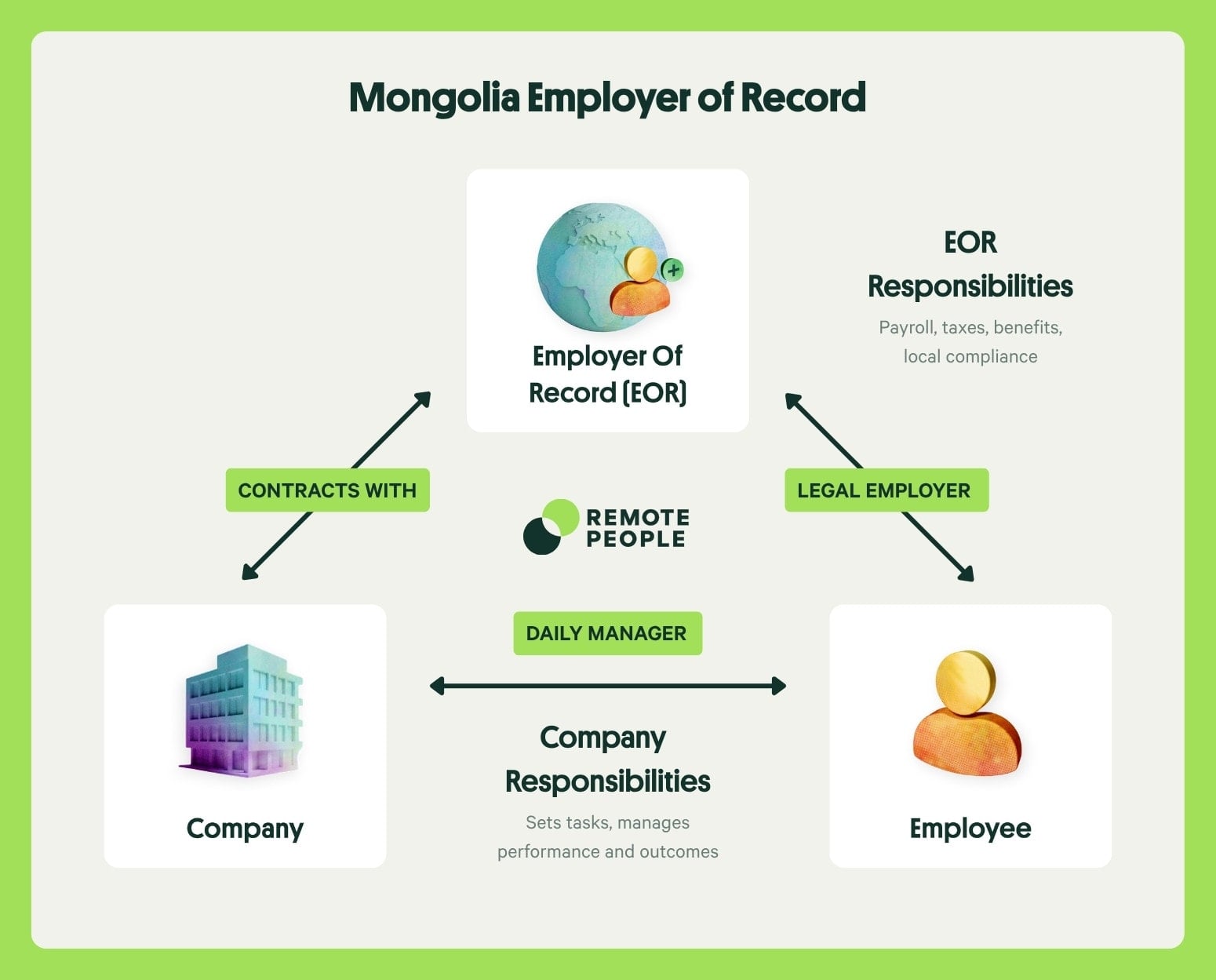
If you’d like to learn more about how Employer of Record (EOR) services work, read our What Is an Employer of Record (EOR)? guide for a complete overview of the model, its benefits, and when to use it.
If you’re comparing providers, our Best Employer of Record (EOR) Providers guide reviews the leading platforms to help you choose the right solution for your business.
Who Uses an EOR in Mongolia?
EOR arrangements in Mongolia are used by organizations that need a compliant hire in Ulaanbaatar or elsewhere in the country without the time and expense of incorporating a local entity. The scenarios below are the most common.
EORs serve companies testing the Mongolian market, allowing them to hire a small group of employees to validate demand, operational costs, and talent availability before committing to a branch or subsidiary. They suit businesses with fewer than ten employees in Mongolia that want to avoid the capital, tax, and reporting obligations of a limited liability company, and they enable rapid onboarding when entity setup would take two to three months versus one to two weeks through an EOR. They are also the practical route for hiring foreign nationals under the Labour Migration Law that took effect on 1 July 2022 (PwC Mongolia Tax Alert), since every foreign employee needs a pre-work permit and an HG visa that an established EOR can secure faster than a newly incorporated entity.
After an initial project or assessment phase, some companies graduate to their own Mongolian entity, while others continue to run their Mongolia operations through an EOR indefinitely because the cost of ongoing compliance is lower than maintaining a local HR and payroll function.
Typical Onboarding Timeline
An EOR can typically onboard a Mongolian national in one to two weeks, provided the candidate has their national ID, social insurance book, and tax registration in order. Foreign nationals who need a pre-work permit and HG visa should plan for four to six weeks.
- EOR agreement and employee details (1–2 days): You sign the service agreement with the EOR and submit the employee’s full name, national ID or passport, role, salary, and start date.
- Employment contract drafting and review (2–3 days): The EOR produces the Mongolian-language employment contract, sends it to the employee for review, and arranges signature.
- Social insurance and tax registration (3–7 days): The EOR registers the employee with the Social Insurance General Office and the General Department of Taxation and obtains the digital payroll profile.
- Payroll setup and benefits enrolment (2–3 days): The EOR activates the employee on the payroll system, enrols them in health insurance and any supplementary benefits, and issues login credentials for the self-service portal.
- Employee onboarding and first day (1 day): The employee receives an onboarding pack, equipment arrangement, and the first-day briefing.
Most EOR providers can onboard an employee in Mongolia within one to two weeks. Timelines extend when the role requires a pre-work permit, criminal record check, medical clearance, or industry-specific permit, and when the employee is hired outside Ulaanbaatar where social insurance offices operate on shorter hours.
Hire in Mongolia
A young, highly literate workforce, the 2026 MNT 800,000 tax-free income threshold, low-cost social insurance, and fast growth of remote-ready talent make Mongolia a smart Central Asian market to hire in.
We handle employment contracts, payroll, tax withholding, and full Mongolia compliance.
No local entity needed. Your team can start in days.
Employment Laws and Regulations in Mongolia
Mongolia’s employment framework is governed by the Revised Labour Law of Mongolia adopted on 2 July 2021 and effective from 1 January 2022, which replaced the 1999 Labour Law in full (World Bank Jobs Blog). The Ministry of Labour and Social Protection is the primary regulator, while the General Department of Taxation enforces PIT rules and the Social Insurance General Office collects contributions. The Revised Labour Law strengthened protections against discrimination, introduced explicit anti-harassment provisions, recognized remote and flexible work, and clarified severance and termination rules, all of which apply to every employment relationship in Mongolia regardless of whether the employer is a local entity or an EOR.
Employment Contracts
Every employment relationship in Mongolia must be governed by a written, Mongolian-language employment contract signed by both parties before work begins. Article 16 of the Revised Labour Law lists the mandatory clauses: job title and description, place of work, base salary, working hours, probation period (if any), and the conditions under which the contract can be terminated. Contracts may be indefinite or fixed-term; fixed-term contracts are limited to specific, justifiable situations such as seasonal work, project-based roles, and replacements for employees on maternity or long-term leave, and converting a fixed-term contract into multiple successive fixed-term contracts for the same role is restricted. Bilingual Mongolian-English contracts are common for international employers, but the Mongolian version is the legally binding original. An EOR ensures every contract meets these requirements and that a signed copy is retained for the statutory record-keeping period.
Working Hours and Overtime
The standard workweek in Mongolia is 40 hours, normally distributed as eight hours per day over five days, with a minimum 30-minute break after six continuous hours of work. The Revised Labour Law caps total working time at 56 hours per week, including overtime, and limits overtime itself to four hours per day and 120 hours per calendar year (Revised Labour Law). Overtime on a regular working day is paid at a minimum of 150% of the employee’s ordinary hourly rate, while work on weekly rest days and public holidays is paid at no less than 200% unless the employee takes a compensatory day off. Night work between 22:00 and 06:00 attracts a premium of at least 20% of the ordinary hourly rate when time off in lieu is not given. Working hours for miners, hazardous occupations, minors under 18, and pregnant employees are additionally restricted under Articles 87 to 92 of the law.
The following table summarises the overtime and premium pay multipliers that an EOR applies when calculating monthly payroll in Mongolia. Managerial employees who set their own hours are generally excluded from overtime pay, and the 120-hour annual cap applies to all other staff regardless of contract type.
Mongolia overtime and premium pay rates · Per Revised Labour Law of Mongolia (2021) |
|||
Hour Type |
Rate Multiplier |
Weekly/Daily Cap |
Notes |
|---|---|---|---|
Weekday overtime |
1.5x ordinary hourly rate |
4 hrs/day; 120 hrs/year |
Total working time cannot exceed 56 hrs/week including overtime |
Weekly rest day work |
2.0x ordinary hourly rate |
Counts toward 120 hrs/year cap |
Compensatory day off may replace premium pay by agreement |
Public holiday work |
2.0x ordinary hourly rate |
Counts toward 120 hrs/year cap |
Premium doubles the day’s base pay, not the overtime itself |
Night work (22:00–06:00) |
Ordinary rate + 20% supplement |
No separate daily cap |
Time off in lieu may be offered instead of the supplement |
Minors and pregnant employees |
Overtime prohibited |
Not applicable |
Under-18s, pregnant employees, and nursing mothers may not be assigned overtime |
Overtime must be recorded in writing and paid with the following month’s salary. Employers cannot convert unpaid overtime into a flat monthly allowance, and any collective agreement may set rates above the statutory floor but never below. Overtime pay is treated as salary income for PIT purposes and is fully subject to social insurance contributions on both the employer and employee side.
Minimum Wage
Mongolia operates a single national minimum wage that applies to all full-time employees regardless of sector or region. Effective 1 April 2025, the National Tripartite Committee on Labour and Social Partnership raised the minimum wage by 20% to MNT 792,000 per month, equivalent to MNT 4,714 per hour (Ministry of Labour). The increased floor remains in force throughout 2026 unless and until the Tripartite Committee approves a new decision. Part-time and hourly workers must be paid at least the pro-rated hourly equivalent, and the minimum wage sits below the maximum social insurance contribution ceiling of MNT 910,800 per month, so most workers remain inside the contribution base. Employers cannot offset statutory benefits against the minimum wage; it must be paid as gross base salary before any voluntary deductions.
Probation Period
Mongolian employers may include a probationary period in the employment contract to assess a new hire’s fit for the role. Under Article 24 of the Revised Labour Law, the initial probation period cannot exceed three months and may be extended once, by mutual written agreement, for a further period of up to three months, capping the total probation at six months. If the contract is silent on probation, the employee is considered hired without a trial period. During probation, employees enjoy the same statutory rights as permanent staff, including leave accrual, social insurance coverage, and overtime protections. Either party may terminate the contract during probation by giving seven calendar days’ written notice, and severance is not owed if the termination is based on unsuitability determined within the probation period.
Leave Entitlements
Mongolia’s statutory leave framework covers annual leave, sick leave, maternity and paternity leave, and several categories of special leave. Annual and parental leave are governed by the Revised Labour Law, while sick leave benefits beyond the employer-funded first five days are paid by the Social Insurance General Office under the Law on Social Insurance. The next sub-sections break down each entitlement, and the summary table that follows consolidates the full schedule.
Annual Leave
Employees in Mongolia are entitled to a minimum of 15 working days of paid annual leave after completing one year of continuous service with the same employer. Tenure-based bonus days are added under Article 80 of the Revised Labour Law: three extra days for employees with 6 to 10 years of service, five extra days for 11 to 15 years, seven extra days for 16 to 20 years, and so on up to 18 extra days for workers with more than 31 years of service. Employees under 18 and those with disabilities receive an additional five days on top of the 15-day base. Leave is normally taken in a continuous block, though it can be split by mutual agreement as long as one segment is at least seven working days. Any unused leave balance is paid out in cash on termination.
Sick Leave
Employees on certified sick leave are paid by the employer for the first five calendar days of each illness at the employee’s ordinary salary. From day six onward, the Social Insurance General Office pays a sickness benefit at a tiered rate determined by the length of insured service: 50% of average wages for employees with under five years of contributions, 55% for those with 5 to 14 years, and 75% for employees with 15 or more years of insured service (ISSA Mongolia Country Profile). Maximum paid sick leave is 66 working days for ordinary illness and 132 working days per year for cancer or tuberculosis. Employees must produce a medical certificate from a licensed health provider for both the employer-paid and social insurance portions of the benefit.
Maternity Leave
Pregnant employees receive 120 calendar days of maternity leave, split as 60 days before the expected birth date and 60 days after, with additional days granted in case of complications or multiple births. The Social Insurance General Office pays the maternity benefit at the statutory rate applied to the employee’s average salary over the 12 months preceding the leave, provided the employee has accumulated at least 12 months of social insurance contributions, including six of the immediate pre-leave months. The employer continues to make social insurance contributions on the employee’s behalf during the leave, and the employee’s position is protected until she returns.
Paternity Leave
Fathers are entitled to a minimum of ten working days of paid paternity leave when their child is born, introduced in the Revised Labour Law and paid by the employer at the ordinary salary rate. The leave must be taken within the first few weeks of the child’s life and cannot be monetised in lieu of time off. Paternity leave is independent of annual leave and does not reduce the employee’s remaining entitlements.
Other Statutory Leave
The Revised Labour Law recognises several additional leave categories that an EOR tracks on the employee’s behalf.
Either parent may take unpaid childcare leave until the child reaches three years of age, with job protection for the duration. Most collective agreements and internal regulations grant three to five working days of marriage leave for an employee’s own wedding, and up to five working days of bereavement leave on the death of a close family member. Employees pursuing further education relevant to their role may be granted paid or unpaid study leave by agreement, and paid civic duty leave for jury duty, court summons, military service, and certain civic obligations is protected by the law.
Under the Revised Labour Law of Mongolia effective 1 January 2022, the table below summarises every statutory leave entitlement an employer must honour. The single most important takeaway is that annual leave accrues from day one of employment but can only be taken after the first 12 months of continuous service, with unused days paid out on termination.
Mongolia statutory leave entitlements · Per Revised Labour Law of Mongolia (2021) |
||
Leave Type |
Duration |
Eligibility & Notes |
|---|---|---|
Annual leave |
15 working days |
Minimum after 1 year of service; +3 to +18 days based on tenure; +5 days for under-18 and disabled workers |
Sick leave (employer-paid) |
5 calendar days |
100% of ordinary salary; medical certificate required |
Sick leave (social insurance) |
From day 6 onward |
50% / 55% / 75% of average wage based on insured service; capped at 66 working days (132 for cancer or TB) |
Maternity leave |
120 calendar days |
60 days pre-birth + 60 days post-birth; paid by social insurance with 12+ months of contributions |
Paternity leave |
10 working days |
Paid by employer at ordinary salary; taken in first weeks after birth |
Childcare leave |
Until child turns 3 |
Unpaid; job-protected; either parent may use |
Bereavement, marriage, civic duty |
3–5 working days |
Paid; duration set by contract or internal regulations |
Statutory Employee Benefits
Beyond paid leave, Mongolian employers must provide a package of mandatory benefits centred on social insurance and health insurance. The list below captures the statutory items an EOR funds and administers on your behalf, with rates cross-referenced to the contribution tables in the payroll section.
Pension insurance is funded at 8.5% by the employer and 7% by the employee on gross wages, remitted to the Social Insurance General Office, with benefits payable at the statutory retirement age. Health insurance contributions of 2% from each side give access to the public health system, while unemployment insurance at 0.2% from each side funds the unemployment benefit paid to qualifying leavers. Industrial accident and occupational disease insurance is an employer-only contribution of 0.8% to 2.8%, set by the risk class of the industry from office-based services at the low end to mining at the high end. A 1% employer contribution funds the benefit insurance pool that pays short-term maternity, sickness, and funeral grants. All contributions, both employer and employee, are capped on a monthly wage of MNT 910,800, above which no further social insurance is deducted.
Recent Regulatory Updates (2026)
Two reforms dominate Mongolia’s 2026 employment framework. The most significant is the amendment to the Personal Income Tax Law that took effect on 1 January 2026, introducing a new monthly tax-free threshold of MNT 800,000 (MNT 9.6 million annually) on employment income (PwC Mongolia tax updates). Only the portion of monthly salary that exceeds MNT 800,000 is taxed at the progressive 10%, 15%, and 20% brackets, which has measurably increased take-home pay for employees earning below MNT 3 million per month. The second update is the Labour Migration Law that came into force on 1 July 2022 and continues to govern foreign hires; the annual foreign worker quota is reconfirmed each year and, for 2025 and 2026, the government lifted quota restrictions across most sectors except management roles in international representation offices. Employers should also note the Labour Dispute Resolution amendments that came into force alongside the 2021 Revised Labour Law, which moved most individual disputes to specialised labour tribunals and shortened the filing window to three months.
Work Permits and Visas in Mongolia
Work Permit Requirements
Foreign employment in Mongolia is regulated by the Law on Labour Migration that took effect on 1 July 2022 and the supporting regulations of the Labour and Social Welfare Services General Office. Before a foreign employee’s first day of work, the employer must secure a pre-work permit, pay the annual workplace levy, and support the employee through the HG visa process at a Mongolian embassy. The subsections below walk through eligibility, documents, processing time, and renewal.
Who Needs a Work Permit
Every foreign national intending to work in Mongolia needs both a pre-work permit issued by the Labour and Social Welfare Services General Office and an HG category work visa issued by the Immigration Agency of Mongolia. Mongolian nationals, dual citizens holding Mongolian citizenship, and holders of a valid T-category permanent residence permit are exempt. Citizens of countries with bilateral visa-waiver agreements, such as the United States, can enter visa-free for short stays but still require the HG visa and work permit if they intend to take up paid employment.
Eligibility and Required Documents
The employer, whether a local entity or an EOR, drives the pre-work permit process. Required documents include the signed employment contract, the employee’s passport (valid for at least 18 months), a notarised copy of qualifications, a criminal record certificate from the home country, a health certificate covering HIV, tuberculosis, and narcotics, and proof that the role was offered to Mongolian candidates first where applicable. The Labour Migration Law and its implementing regulations also require the employer to pay a workplace levy set annually by the government, typically a multiple of the minimum wage per foreign hire.
Processing Time and Validity
The pre-work permit is issued within about 10 business days of a complete submission, and the subsequent HG visa is issued by the Mongolian embassy or consulate abroad within three to five business days. In total, an employer should plan for four to six weeks from initial request to the employee’s first day in Mongolia. The HG visa is typically valid for up to one year and is tied to the employer named on the permit.
Renewal Process
Work permits are renewed annually on the same calendar as the original issuance, with the renewal application submitted at least 30 days before expiry. The employee can continue to work during the renewal window as long as the application was filed in time. A change of employer requires a new pre-work permit even if the employee remains in Mongolia.
Common Visa Types for Foreign Workers
Mongolia’s visa framework is operated by the Immigration Agency of Mongolia under the Ministry of Justice and Home Affairs. Work-related visas are issued under the HG category with several sub-classifications for different types of foreign workers. The table below summarises the main work-related visas available; an EOR can typically sponsor most of them on the client’s behalf, although the investor route requires a local entity registered at the Investment and Trade Agency.
Mongolia work visa types for foreign workers · 2026 |
||||
Visa Type |
Duration |
Best For |
Leads to APT? |
Processing |
|---|---|---|---|---|
HG-1 Work Visa |
Up to 1 year, renewable |
Standard employment with a local or EOR employer |
Yes |
4–6 weeks total |
HG-2 Intra-Company Transfer |
Up to 3 years, renewable |
Employees transferring within a multinational group |
Yes |
4–6 weeks total |
T Investor Visa |
Up to 3 years, renewable |
Foreign-invested companies registered in Mongolia |
Yes |
6–8 weeks (entity required) |
O Official / Diplomatic Visa |
Per assignment |
Staff of embassies and international organizations |
No |
2–4 weeks |
S Student Visa with work addendum |
Duration of study |
Students taking on part-time employment during studies |
No |
3–4 weeks |
- Tourist visa (J): Does not permit paid employment; any work triggers an overstay and deportation risk.
- Private visa (H3): For visiting family; no employment rights.
- Transit visa (A): Valid only for transit through Mongolia en route to a third country.
How an EOR Handles Work Permits
An EOR in Mongolia typically owns the pre-work permit process end to end, from drafting the employment contract on which the application is based, to filing with the Labour and Social Welfare Services General Office, to coordinating with the candidate on notarised documents, criminal record checks, and medical certificates. Once the pre-work permit is issued, the EOR supports the employee’s HG visa application at the Mongolian consulate abroad. The employee still needs to complete biometrics and produce personal documents, but the administrative heavy lifting sits with the EOR. Engaging an EOR for a foreign hire extends the one-to-two-week Mongolian-national timeline to about four to six weeks, in line with the figures in the onboarding timeline section above. One limitation worth flagging is that a handful of regulated sectors, such as mining exploration and certain financial services, still require a licensed local entity for sponsorship; in those cases, an EOR can typically handle payroll and HR but a local vehicle is needed to hold the permit.
Payroll, Taxes, and Social Security in Mongolia
Employer Contributions
Employers in Mongolia remit a bundle of social insurance contributions to the Social Insurance General Office, calculated on monthly gross wages up to a ceiling of MNT 910,800 per employee. The table below uses the lowest industrial accident rate (0.8%) that applies to standard office-based roles; mining, construction, and other higher-risk sectors pay the upper end of that range, bringing the total employer burden to 14.5%.
Mongolia employer social security contributions · 2026 rates |
||
Contribution |
Rate |
Notes |
|---|---|---|
Pension insurance |
8.5% |
Capped at MNT 910,800/month wage base |
Benefit insurance |
1.0% |
Funds maternity, sickness, funeral benefits |
Health insurance |
2.0% |
Access to public health system |
Unemployment insurance |
0.2% |
Funds unemployment benefit |
Industrial accident and occupational disease insurance |
0.8% – 2.8% |
Rate depends on industry risk class (office work = 0.8%) |
Total employer cost (office sector) |
12.5% |
Can reach 14.5% for highest-risk industries |
Employee Contributions
Employees pay a combined 11.5% of gross wages into the Social Insurance General Office, which the employer withholds and remits each month. The contribution is also capped at MNT 910,800 in monthly wages. The breakdown below follows the same structure as the employer side but without the industrial accident component.
Mongolia employee payroll deductions · 2026 monthly withholdings |
||
Deduction |
Rate |
Notes |
|---|---|---|
Pension insurance |
7.0% |
Capped at MNT 910,800/month wage base |
Benefit insurance |
0.8% |
Funds short-term benefits (maternity, sickness) |
Health insurance |
2.0% |
Access to public health system |
Unemployment insurance |
0.2% |
Funds unemployment benefit |
Industrial accident insurance (employee share) |
1.5% |
Covers employee’s contribution to the work injury fund |
Total employee withholding |
11.5% |
Plus PIT withheld on income above MNT 800,000/month |
Income Tax
Mongolian tax residents pay personal income tax on employment income at progressive rates of 10%, 15%, and 20%. Effective 1 January 2026, the first MNT 800,000 of monthly wages is tax-free, and only the portion above that threshold is taxed (PwC Mongolia PIT). Non-residents are taxed at a flat 20% on Mongolia-source employment income, with no tax-free threshold.
Mongolia income tax brackets · 2026 |
|
Annual Taxable Income (MNT) |
Tax Calculation |
|---|---|
Up to MNT 9,600,000 (monthly MNT 800,000) |
0% (tax-free threshold, resident employees) |
MNT 9,600,001 – MNT 120,000,000 |
10% of amount above MNT 9,600,000 |
MNT 120,000,001 – MNT 180,000,000 |
MNT 12,000,000 + 15% of amount above MNT 120,000,000 |
Above MNT 180,000,000 |
MNT 21,000,000 + 20% of amount above MNT 180,000,000 |
Non-resident employment income |
Flat 20% on Mongolia-source income |
Payroll Cycle
Payroll in Mongolia is paid monthly in Mongolian tögrög, with salary normally credited to the employee’s Mongolian bank account on the last working day of the month. Cash payment is permitted for small employers but is rare and discouraged for compliance reasons. Employers must issue an itemised payslip showing gross salary, social insurance deductions, PIT, and any allowances. Social insurance contributions are reported and paid monthly by the 5th day of the following month to the Social Insurance General Office, while PIT withheld is remitted to the General Department of Taxation on the 10th day of the following month. Annual PIT reconciliation and the employer’s year-end declaration are due by 15 February of the following year.
13th Month Salary and Bonus Pay
A 13th month salary is not mandatory in Mongolia. The Revised Labour Law does not require employers to pay an additional month of salary at year-end, and neither does the Law on Social Insurance or the Personal Income Tax Law. In practice, many large private-sector employers, state-owned enterprises, and international companies pay a year-end bonus equivalent to one month’s salary or a performance-based multiple, but the amount and eligibility are set by the employment contract, internal regulations, or a collective agreement. When paid, bonuses are fully subject to PIT at the progressive rates and to social insurance contributions up to the MNT 910,800 monthly ceiling. Because Mongolia has no statutory 13th or 14th month requirement, EOR cost planning can focus on the 12-month base salary plus any voluntary bonus policy.
Cost of Hiring Through an EOR in Mongolia
EOR Service Fees
EOR service fees in Mongolia typically range from USD 300 to USD 600 per employee per month, depending on the provider, employee count, and scope of services. The fee covers in-country legal employment, employment contract drafting in Mongolian, monthly payroll processing, social insurance and PIT filings, leave administration, HR support, and termination handling. Foreign hires often carry a one-time work permit fee of USD 500 to USD 1,500 to cover the pre-work permit filing, the government workplace levy, and visa support. An EOR fee removes the fixed cost of running a local entity (accounting retainer, tax filings, legal representative, statutory reporting) and scales with headcount, so the economics favour EOR up to roughly 15–20 employees.
Total Employment Cost Breakdown
The cost example below is based on a gross monthly salary of USD 3,000 converted at an indicative rate of USD 1 ≈ MNT 3,450, which gives a Mongolian gross of roughly MNT 10,350,000. At this salary level, all social insurance contributions are capped at the MNT 910,800 base, so the effective employer burden is lower than the headline 12.5%. The table shows the USD cost a US-dollar-priced EOR buyer would see.
Mongolia employer cost example · USD 3,000 gross · 2026 |
||
Employer Cost |
Amount (USD) |
% of Gross |
|---|---|---|
Gross salary |
$3,000.00 |
100.0% |
Pension insurance (8.5%, capped) |
$22.44 |
0.7% |
Benefit insurance (1.0%, capped) |
$2.64 |
0.1% |
Health insurance (2.0%, capped) |
$5.28 |
0.2% |
Unemployment insurance (0.2%, capped) |
$0.53 |
0.0% |
Industrial accident insurance (0.8%, office) |
$2.11 |
0.1% |
EOR service fee (est.) |
$450.00 |
15.0% |
Total employer cost |
$3,483.00 |
116.1% |
Figures converted at 1 USD ≈ MNT 3,450 (April 2026 indicative rate). Social insurance contributions are capped on monthly wages of MNT 910,800 (~USD 264), so higher salaries face the same absolute contribution as in the example.
Ready to hire in Mongolia? Get started with RemotePeople – we handle employment contracts, payroll, tax withholding, and full Mongolia compliance. No local entity needed. Contact us at remotepeople.com/contact.
Benefits of Using an EOR in Mongolia
Hiring through an EOR turns Mongolia from a multi-month compliance project into a one-week HR transaction. The following benefits are the ones most often cited by companies that have compared direct employment through a local entity with the EOR route.
The first benefit is speed to market: a Mongolian national can be onboarded in one to two weeks and a foreign hire in four to six weeks, compared with two to three months to incorporate a limited liability company, register with the tax and social insurance authorities, and set up a local payroll function. The second is compliance assurance, since the EOR’s in-country legal team tracks the Revised Labour Law, the 2026 PIT reform, and the Labour Migration Law so contracts, payroll, and terminations remain compliant without an in-house Ulaanbaatar HR team.
Cost efficiency is the third advantage: entity setup runs USD 5,000 to USD 15,000 up front plus USD 10,000 to USD 25,000 per year in accounting, legal, and tax filings, and an EOR at USD 300 to USD 600 per employee per month is cheaper until headcount reaches roughly 15 to 20 permanent employees. EORs also add local expertise through bilingual HR support in Mongolian and English, working relationships with the Social Insurance General Office and the General Department of Taxation, and familiarity with Mongolian banking quirks such as MNT payroll accounts and the common use of XacBank, Khan Bank, and Trade and Development Bank networks.
Flexibility is a further draw: companies can hire one employee, scale to twelve, and exit the market within 30 days without triggering entity dissolution or the commercial register deregistration process that otherwise takes six to nine months. Risk mitigation is built in because the EOR assumes legal employer liability for misclassification, wrongful termination, and social insurance under-reporting, limiting your exposure to the service agreement. Finally, the employee experience improves: each hire receives a Mongolian employment contract, full social insurance and health cover, statutory leave, and a local payslip in MNT, rather than an offshore contractor arrangement that would put them outside the public benefits system.
Combined, these benefits explain why Mongolia is one of the Central Asian markets where EOR adoption grew fastest between the 2021 Labour Law reform and the 2026 PIT changes.
Termination and Offboarding in Mongolia
Notice Periods
The Revised Labour Law of Mongolia requires an employer to give written notice before terminating an indefinite-term employment contract, and the statutory floor varies with the ground for dismissal. Under Article 80 of the Revised Labour Law, the standard notice is 30 calendar days for economic redundancy or when the employee’s qualifications no longer match the role, and 45 calendar days for most other permitted grounds. Notice can be paid in lieu only with the employee’s written consent. Employees resigning voluntarily must give 30 days’ notice unless the contract provides a shorter period.
Mongolia statutory notice periods by position level · Per Revised Labour Law of Mongolia (2021) |
|||
Termination Scenario |
Notice Period |
During Probation |
Notes |
|---|---|---|---|
Economic redundancy or reorganisation |
30 calendar days |
7 calendar days |
Employer must consult staff representatives |
Employee qualifications insufficient for role |
30 calendar days |
7 calendar days |
Employer must document performance issues in writing |
Health-based inability to perform role |
45 calendar days |
7 calendar days |
Medical certificate required; alternative roles must be considered |
Senior managerial positions |
45 calendar days |
14 calendar days |
Often extended to 60–90 days by contract |
Employee resignation (voluntary) |
30 calendar days |
7 calendar days |
Contract may allow shorter notice by mutual agreement |
Just cause (gross misconduct) |
Immediate |
Immediate |
Written disciplinary procedure required; no severance |
Mutual-agreement separations and fixed-term contract expiries do not require the statutory notice period because the end date is known in advance or jointly chosen. Where notice is given, the employee continues to work, accrue leave, and earn salary and social insurance credits until the final day, unless the employer chooses to pay in lieu with written consent.
Severance Pay
Severance pay in Mongolia is mandatory when the employer terminates an indefinite-term contract for economic redundancy, organisational change, the employee’s insufficient qualifications, or health-based inability to work. The Revised Labour Law calibrates severance to the length of continuous service with the same employer, ranging from one to four months of base salary. Severance is not owed when the employee resigns, the contract ends for just cause, or the fixed-term contract reaches its natural end date.
Mongolia severance pay schedule by years of service · Per Revised Labour Law of Mongolia (2021) |
|||
Years of Service |
Severance Amount |
Base Salary |
Notes |
|---|---|---|---|
Less than 1 year (post-probation) |
1 month base salary |
Contractual base salary, gross |
Not payable during probation |
1 year |
MNT 792,000 minimum; typically 1 month base |
Gross base salary at termination |
Rounded to full months of service |
3 years |
2 months base salary |
Gross base salary at termination |
Includes fixed contractual allowances |
5 years |
3 months base salary |
Gross base salary at termination |
Collective agreements may increase the amount |
10 years or more |
4 months base salary |
Gross base salary at termination |
Statutory cap; additional months by contract |
Calculation Method
Severance is calculated on the employee’s gross base salary at the moment of termination, multiplied by the number of statutory months shown in the table above. Fixed contractual allowances (housing, transport, role allowance) count as part of base salary for this purpose, while variable bonuses, overtime pay, and discretionary year-end payments do not. An EOR pays severance in a single lump sum on the final day of employment together with any unused annual leave payout, pro-rated salary, and outstanding expense reimbursements.
Caps and Exceptions
The statutory cap sits at four months of base salary for employees with 10 or more years of service, but collective agreements in unionised sectors, the civil service, and some state-owned enterprises can lift the cap to five or six months. Severance is not payable on termination for just cause such as theft, fraud, repeated disciplinary breaches, or gross misconduct, on voluntary resignation, on mutual-agreement terminations unless the parties stipulate otherwise, or during the probation period. Fixed-term contracts that end on their scheduled date do not trigger severance, but if the employer terminates a fixed-term contract early without cause, the remaining salary for the balance of the term is payable as compensation.
Grounds for Termination
An employer in Mongolia can lawfully end an indefinite-term contract only on the grounds listed in the Revised Labour Law, which include economic redundancy, organisational restructuring, the employee’s insufficient qualifications as evidenced by a performance assessment, health-based inability to perform the role, repeated or serious disciplinary breaches, and reaching retirement age by mutual agreement. Dismissals based on pregnancy, trade union activity, whistleblowing, filing a legitimate workplace complaint, or other protected characteristics are void and expose the employer to reinstatement, back pay, and damages. Before a termination notice is issued, the employer should document the ground, consult workers’ representatives where applicable, and offer alternative roles in redundancy scenarios. An EOR manages the full procedural file so that any disputed termination can be defended before the labour tribunal.
EOR vs. Other Hiring Models in Mongolia
EOR vs. Setting Up a Local Entity
The question most Mongolia-bound employers face is whether to use an EOR or incorporate a limited liability company of their own. The comparison below sets the two options side by side on setup time, upfront and ongoing cost, compliance lift, and the team size at which each model becomes economically efficient.
Mongolia EOR vs local entity comparison · Setup time, cost, risk and best-fit |
||
Comparison |
Employer of Record |
Own Entity |
|---|---|---|
Setup time |
1–2 weeks |
2–3 months (GASI registration, tax registration, bank account, social insurance) |
Upfront cost |
$0 |
$5,000–$15,000 (legal, registration, notary, bank) |
Ongoing cost |
$300–$600/employee/month |
$10,000–$25,000/year (accounting, tax, legal representative) |
Local partner required |
No (EOR is the local entity) |
No, but legal representative and local director recommended |
Social insurance registration |
Handled by EOR |
You register each employee with SIGO |
Payroll and tax filing |
Handled by EOR |
You manage it or outsource to a local accounting firm |
Best for team size |
1–15 employees |
15+ employees |
Scale down or exit |
Easy – terminate service agreement with 30 days’ notice |
Costly – 6–9 month commercial register deregistration, tax audit |
Government contracts |
Not eligible |
Eligible (requires registration with the Invest Mongolia Agency) |
An EOR is the faster and lower-risk route when you are testing the Mongolian market, hiring a small team, or running a finite project. The economics tip in favour of a local entity once your headcount exceeds 15 to 20 permanent employees and the fixed cost of maintaining an LLC is spread across enough payroll.
A local entity is the right path when you plan to bid on government contracts, hold regulated licences such as mining or financial services, or sign large long-term contracts that require a Mongolian taxpayer ID on the customer side. The trade-off is a longer setup window and a higher ongoing burn, and a genuine wind-down process if the business does not work out.
EOR vs. Hiring Independent Contractors
Contractors and employees are treated very differently under Mongolian law, and the economics often look attractive on paper before you factor in misclassification risk. The table below compares an EOR-employed team member against a self-employed contractor on legal relationship, compliance, benefits, IP protection, and best-fit use cases.
Mongolia EOR vs independent contractors · Compliance, cost, and risk |
||
Comparison |
EOR (Full-Time Employee) |
Independent Contractor |
|---|---|---|
Legal relationship |
Employee of the EOR |
Self-employed, no employment relationship |
Compliance risk |
Low – EOR ensures Revised Labour Law compliance |
High – misclassification risk if the relationship resembles employment |
Payroll and tax |
EOR handles PIT withholding, social insurance, filings |
Contractor invoices you; they handle their own PIT and social insurance |
Benefits and leave |
Statutory benefits, paid leave, social insurance |
No entitlement to employee benefits |
IP protection |
Stronger – employment contract assigns IP by default |
Weaker – requires explicit IP assignment clause |
Termination |
Subject to statutory notice and severance |
Service contract can be ended per agreement terms |
Best for |
Long-term, core team roles |
Short-term projects, specialised tasks |
Cost structure |
Salary + employer contributions + EOR fee |
Contractor fee (typically higher gross, lower total cost) |
Mongolia applies a multi-factor test to distinguish contractors from employees, focusing on subordination, integration into the client’s organisation, exclusivity, and provision of equipment. A contractor who works set hours, uses company equipment, follows the client’s daily instructions, and earns almost all income from a single client is only appropriate for a narrow set of cases such as specialised advisory work or finite creative projects.
If the Mongolian tax authority or labour inspectorate reclassifies a contractor as a disguised employee, the client faces back social insurance contributions, PIT, interest, and administrative fines, plus exposure to reinstatement and severance claims. The contractor route is appropriate for limited-scope, project-based assignments, while long-term, core-team roles fit better with an EOR.
EOR vs. PEO (Professional Employer Organization)
EOR and PEO are often used interchangeably in marketing copy, but they describe different legal structures. The table below clarifies which model owns the employment relationship in Mongolia and which circumstances each fits best.
Mongolia EOR vs PEO comparison · Legal employer, liability, and setup |
||
Comparison |
Employer of Record (EOR) |
PEO |
|---|---|---|
Legal employer |
EOR is the legal employer |
You remain the legal employer (co-employment concept) |
Local entity required |
No – the EOR is the local entity |
Yes – you must have your own entity in Mongolia |
Best for |
Companies without a Mongolian entity |
Companies that already have a Mongolian entity |
Compliance liability |
EOR assumes compliance responsibility |
Shared liability between you and the PEO |
Setup time |
1–2 weeks |
Depends on your entity setup (weeks to months) |
Control over HR policies |
EOR manages within Revised Labour Law framework |
More direct control, PEO advises |
Typical use case |
Market entry, small remote teams, testing new markets |
Established local operations needing HR outsourcing |
The key difference is ownership of the employment relationship. An EOR is the legal employer, which is the right model when you do not have a Mongolian entity and want full compliance absorbed by the provider. A PEO sits alongside your existing Mongolian entity in a co-employment structure, handling HR operations while you retain the primary employer role and liability.
Mongolia has no formal PEO legal framework; co-employment is not recognised as a distinct category under the Revised Labour Law. What is sometimes marketed as a PEO in Mongolia is in practice an HR outsourcing or payroll outsourcing arrangement that sits on top of your own entity. For companies that want to skip the local entity entirely, the EOR route is the cleaner, legally supported option.
Public Holidays in Mongolia
Mongolia observes a mix of civil, Buddhist, and historical national holidays. The 2026 calendar below follows the government calendar published by the Cabinet Secretariat, and includes the multi-day Tsagaan Sar (Lunar New Year) and Naadam Festival periods that traditionally close most offices and reduce banking operations.
Mongolia public holidays · 2026 calendar year |
||
Date |
Holiday |
Type |
|---|---|---|
1 January 2026 |
New Year’s Day |
Public holiday |
18–20 February 2026 |
Tsagaan Sar (Lunar New Year) |
Public holiday (3 days) |
8 March 2026 |
International Women’s Day |
Public holiday |
31 May 2026 |
Buddha Day (Vesak) |
Public holiday |
1 June 2026 |
Mothers’ and Children’s Day |
Public holiday |
11–15 July 2026 |
Naadam Festival (National Day) |
Public holiday (5 days) |
10 November 2026 |
Genghis Khan’s Birthday (National Pride Day) |
Public holiday |
26 November 2026 |
Proclamation of the Republic Day |
Public holiday |
29 December 2026 |
Independence Day |
Public holiday |
Payroll scheduling should factor in the Tsagaan Sar (18–20 February 2026) and Naadam (11–15 July 2026) clusters, because most banks and the Social Insurance General Office operate with reduced staffing across those periods. Employees who work on a public holiday are paid at least 2.0 times the ordinary hourly rate or receive compensatory time off, as reflected in the overtime table earlier in this guide.
How to Get Started with an EOR in Mongolia
Engaging an EOR to hire in Mongolia is a short, linear process once you have chosen a provider. The steps below are the ones you will take with RemotePeople to go from signed service agreement to an employee’s first day.
- First, define the role and compensation. Decide the job title, responsibilities, gross salary in MNT or USD, working location, start date, and any benefits on top of the statutory package. The EOR needs these to draft the Mongolian employment contract.
- Second, share candidate details and sign the service agreement. Provide the candidate’s full name, national ID or passport, tax registration number, bank account, and social insurance book reference. You and the EOR sign the master service agreement and a country-specific schedule for Mongolia.
- Third, review and sign the employment contract. The EOR drafts a Mongolian-language employment contract that complies with Articles 16 to 23 of the Revised Labour Law. You review the bilingual version, the EOR countersigns with the candidate, and the original is filed with the EOR.
- Fourth, complete social insurance and tax registration. The EOR registers the employee with the Social Insurance General Office and the General Department of Taxation, sets up the MNT payroll account, and confirms the first pay date.
- Fifth, run the first payroll and settle into steady state. After the first month’s payroll cycle, you move into monthly management, where the EOR handles payroll, social insurance, PIT filings, leave tracking, and any termination or onboarding activity; you focus on direction and performance.
Hire in Mongolia the right way. RemotePeople will manage your employment contracts, payroll, taxes, and work permits so your team can start in under two weeks. Get started at remotepeople.com/contact.
Where companies hiring in Mongolia expand next
Teams building a presence in Mongolia often extend across the Caucasus and Central Asia, where Russian-language coordination and cross-border trade corridors remain strong. After building a team in Mongolia, employers often look to Georgia for overlapping Central Asian talent profiles, then hiring in Armenia for Central Asian cost parity and tech talent. An EOR partner in Azerbaijan follows with aligned Central Asian labor frameworks, and Kazakhstan typically closes the regional footprint via shared Central Asian hiring dynamics.
Frequently Asked Questions
EOR services in Mongolia typically cost between USD 300 and USD 600 per employee per month as a flat service fee. The fee covers employment contracts, monthly payroll, social insurance filings, personal income tax withholding, leave tracking, and HR support. Foreign hires usually carry a one-time work permit fee between USD 500 and USD 1,500 to cover the pre-work permit and the government workplace levy.
A Mongolian national can be onboarded in one to two weeks from the day you sign the EOR service agreement. Foreign hires who need a pre-work permit and an HG visa typically take four to six weeks, driven by the 10-business-day pre-work permit review and the 3 to 5-business-day visa issuance at the consulate.
Yes. An EOR in Mongolia operates as a Mongolian-registered legal employer and contracts with employees under the Revised Labour Law of 2021. The EOR withholds personal income tax at the progressive 10%, 15%, and 20% brackets, remits social insurance contributions of 12.5% to 14.5% (employer) and 11.5% (employee) to the Social Insurance General Office, and files monthly payroll tax returns with the General Department of Taxation (PwC Worldwide Tax Summaries).
Yes. The EOR can apply for the pre-work permit from the Labour and Social Welfare Services General Office and support the employee's HG visa application. The EOR is the legal employer on the permit, so the employee must remain on the EOR's payroll for the duration. A change of employer triggers a new pre-work permit filing.
The employment contract between the EOR and the employee assigns IP to the client company (you), not to the EOR, through a back-to-back clause in the service agreement. This is the standard arrangement for all of RemotePeople's Mongolian contracts and mirrors the default position under the Mongolian Civil Code for work-for-hire employment IP.
Employees hired through an EOR receive the full statutory package under the Revised Labour Law: 15 working days of paid annual leave (plus tenure-based bonus days up to 18 extra), 5 days of employer-paid sick leave plus state-funded sick pay from day 6, 120 days of maternity leave, 10 working days of paid paternity leave, registration with the Social Insurance General Office for pension, health, unemployment, and work injury cover, and 8 to 12 public holidays. Employers often add private medical top-ups and meal or transport allowances.
Contractors are only appropriate for limited-scope, project-based work such as specialised advisory or short-term creative assignments. For ongoing, core-team roles, Mongolia's multi-factor employment test can reclassify a long-term contractor as a disguised employee, triggering back social insurance, back PIT, fines, and potential reinstatement claims. RemotePeople's contractor management solution at remotepeople.com/solutions/hire-contractors is the compliant route when a contractor engagement is genuinely the right fit.
No. Mongolia does not require a statutory 13th or 14th month salary under the Revised Labour Law of 2021 or the Law on Social Insurance. Some employers pay a discretionary year-end bonus equivalent to one month's salary, but the amount and eligibility are set by the employment contract or internal regulations, not by law. Any bonus paid is fully subject to PIT and social insurance up to the MNT 910,800 monthly contribution ceiling.
Employer of Record in
Employer of Record in
Employer of Record in
Employer of Record in
Employer of Record in
Employer of Record in
Employer of Record in
Employer of Record in




