
 Recruit
Employer of Record in Nauru
-
 Drew Donnelly
- Published
- September 22, 2026
RemotePeople’s employer of record in Nauru lets you hire employees in Nauru with mandatory Provident Fund enrollment. We handle Nauru Superannuation Act requirements with employer contributions of 10% and employee contributions of 5% of gross salary, with monthly contribution remittance.
Hire in Nauru — book a free 30-minute demo
Tell us what you need. You'll get a tailored, transparent proposal within 24 hours, plus a free call to walk through it.
Tell us about your company
So we can match you with a specialist who knows your market — and unlock volume pricing tiers.
* All fields are required.
Where and when are you hiring?
Tell us the geography and timing and we'll quote each country line by line, with onboarding timelines.
* All fields are required.
Help us beat your current setup
We'll benchmark your current deal and send a line-by-line proposal in 24 hours — showing exactly where we cut cost, time, or risk. After you submit, you can book a call to walk through it together.
* All fields are required.
Thanks! Your proposal is on its way.
Expect a tailored, line-by-line proposal in your inbox within 24 hours. In the meantime…
Want to walk through it together?
Book a free 30-minute call with one of our specialists. We'll explain every line, answer your questions, and tailor the proposal further if you need.
No obligation. Pick a time that works for you.








- Hire in Nauru — book a free 30-minute demo
- Tell us about your company
- Where and when are you hiring?
- Help us beat your current setup
- Thanks! Your proposal is on its way.
- How an Employer of Record Works in Nauru
- Employment Laws and Regulations in Nauru
- Work Permits and Visas in Nauru
- Payroll, Taxes, and Social Security in Nauru
- Cost of Hiring Through an EOR in Nauru
- Benefits of Using an EOR in Nauru
- Termination and Offboarding in Nauru
- EOR vs. Other Hiring Models in Nauru
- Public Holidays in Nauru
- How to Get Started with an EOR in Nauru
- Where companies hiring in Nauru expand next
- Frequently Asked Questions
- Related EOR Destinations

Start hiring in Nauru
Let RemotePeople handle payroll, compliance, and HR admin worldwide so you can focus on building your team.

Nauru is a micro-nation of approximately 12,000 people in the Pacific Ocean that uses the Australian Dollar and has a growing international business sector. Hiring in Nauru presents unique challenges due to limited statutory labour-law documentation and an absence of comprehensive employment regulations. However, an employer of record (EOR) eliminates the need to establish a local legal entity while handling all payroll, tax compliance, and statutory obligations. RemotePeople’s EOR service manages employment law compliance in Nauru, allowing you to scale your team quickly without the administrative burden of direct entity registration.
How an Employer of Record Works in Nauru
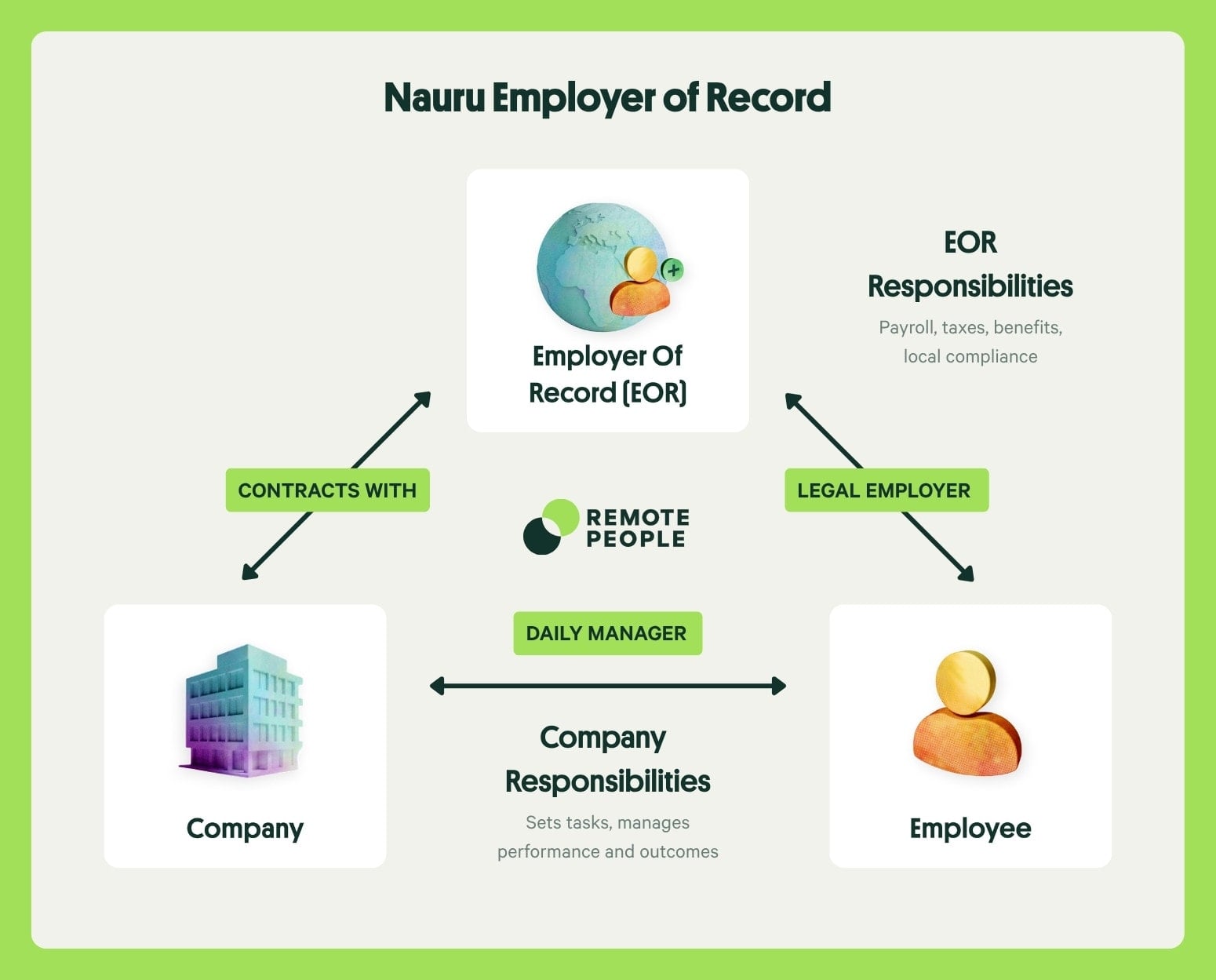
An Employer of Record in Nauru is the official employer for your international hires. You control day-to-day operations and performance management; the EOR handles all legal employment obligations, payroll processing, statutory tax withholding, superannuation contributions, and compliance reporting. This model is particularly valuable in Nauru, where labor law documentation is sparse and regulatory guidance is often informal. An EOR reduces compliance risk and accelerates time to hire, allowing you to onboard employees in days rather than months.
If you’d like to learn more about how Employer of Record (EOR) services work, read our What Is an Employer of Record (EOR)? guide for a complete overview of the model, its benefits, and when to use it.
If you’re comparing providers, our Best Employer of Record (EOR) Providers guide reviews the leading platforms to help you choose the right solution for your business.
Who Uses an EOR in Nauru?
Companies hire through an EOR in Nauru to test market expansion before local incorporation, to scale small teams of 1-15 people without entity setup overhead, and to onboard individual high-value hires in days rather than months. Tech firms, consulting companies, NGOs, and international development organizations commonly use EORs in Nauru to avoid the cost and time burden of local legal entity creation.
- Startups and small teams: New market entrants and small-scale operations benefit from outsourced compliance and avoiding AUD 5,000-15,000 incorporation costs.
- Multinational firms: Global companies use EORs to pilot operations and build local talent pipelines before committing to a subsidiary.
- NGOs and international organizations: Mission-driven organizations use EORs to hire local staff with compliance assurance in a micro-jurisdiction with limited regulatory infrastructure.
- Project-based hiring: Companies with specific project timelines use EORs for flexibility to scale up and down without long-term entity obligations.
Typical Onboarding Timeline
- First, you submit employee information and salary details. This takes 1-2 business days and includes the candidate’s name, banking details, job title, and gross compensation in Australian Dollars.
- Second, the EOR drafts the employment contract. The contract incorporates all Employment Act requirements and includes compensation, working hours, leave entitlements, notice periods, and termination conditions. Signature by employer, EOR, and employee takes 2-3 business days.
- Third, the EOR registers with tax and superannuation authorities. Registration with the Nauru Revenue Office and the Nauru Superannuation Scheme takes 3-5 business days. For non-Nauruans, work visa processing begins at this stage (6-12 weeks separately).
- Fourth, payroll setup is configured. The EOR sets up banking details, tax withholding rules, and superannuation deduction parameters for monthly processing. This takes 1-2 business days.
- Fifth, the employee begins work and receives the first paycheck on the next monthly payroll cycle. Salary is paid in Australian Dollars by bank transfer, with all statutory deductions processed and remitted by the EOR.
Hire in Nauru
The world’s smallest island nation with social security provisions and Nauruan employment regulations.
We handle employment contracts, payroll, social contributions, and full Nauruan compliance.
No local entity needed. Your team can start in days.
Employment Laws and Regulations in Nauru
Nauru’s employment framework is governed primarily by the Employment Act (Contract of Service Act 1922), which remains in force as the foundational employment law, and the Employment and Services Tax Act 2014, which governs employment income taxation. Both statutes apply to all employment relationships in Nauru regardless of employee nationality. Nauru’s regulatory environment is characterized by general legal frameworks with limited detailed statutory prescription, placing responsibility on employers and EOR providers to manage compliance through employment contracts, established market practices, and Department of Justice guidance.
Employment Contracts
The Employment Act requires all formal employment relationships to be documented in writing. Employment contracts in Nauru are written in English and must specify job title, location, compensation, working hours, leave entitlements, notice periods, and termination conditions. Contracts may be permanent (indefinite duration) or fixed-term (specific project or defined period with clear end date).
All wages and salaries must be expressed in Australian Dollars, the official currency of Nauru. Contracts must comply with the Employment Act, and any terms that conflict with statutory requirements are unenforceable to the extent of non-compliance. Wage deductions are permitted only for statutory obligations (taxes, superannuation) or with written employee consent. An EOR ensures contract terms align with current Nauru law and market practice.
Working Hours and Overtime
The standard workweek in Nauru is 40 hours, typically spread across five working days of 8 hours each (U.S. State Department 2024 Country Report: Nauru). Government and Public Service guidance provides for a 30-minute break on shifts exceeding 6 hours. Any work beyond 40 hours per week or 8 hours per day constitutes overtime.
Overtime compensation in Nauru is determined by contract and common practice rather than detailed statutory prescription. The standard practice is 1.5 times the regular hourly rate for weekday overtime hours. Specific multipliers for night shifts, weekend work, or public holiday work are not codified in accessible statutory sources. Overtime is generally voluntary except in emergency situations. An employment contract should clearly define overtime rates and conditions to avoid disputes.
Minimum Wage
Nauru does not have a statutory minimum wage in the private sector. Private-sector wages are determined entirely by negotiation between employer and employee, with no legal wage floor. The public service operates a graduated salary system administered by the Department of Human Resources, but specific public-sector pay rates are not published in accessible sources. Employers can offer any compensation level that both parties agree to in the employment contract.
Probation Period
Nauru’s Employment Act does not prescribe a statutory probation period length. Employers may establish probationary periods of any duration by written agreement in the employment contract. Probation terms, rights, and conditions are contractually determined between employer and employee. No statutory special rights or restrictions apply to probationary termination beyond general Employment Act requirements for fair notice and fair process.
Leave Entitlements
Annual Leave
Employees in Nauru are generally entitled to a minimum of 14 days of paid annual leave per year after completing 12 months of continuous service, consistent with the Employment Act framework catalogued in the Nauru Alphabetical Index of Statutes (PacLII). During the first 12 months of employment, annual leave accrues on a pro-rata basis. Leave is typically paid at the ordinary hourly rate or salary equivalent and must be taken within the calendar year or forfeited unless the employer agrees to carry forward unused balance.
Sick Leave
Statutory sick leave entitlements in Nauru are not detailed in accessible legislative sources. Sick leave is recognized as a statutory entitlement under general employment practice; the number of days, paid versus unpaid status, and certification requirements are typically defined in employment contracts or employer policy. Many employers follow regional practice of providing 5-10 days of paid sick leave annually with medical certification required for absences exceeding two consecutive days.
Maternity Leave
Maternity leave entitlements in Nauru are not codified in detail in accessible statutory sources. The U.S. State Department 2024 Country Report on Nauru confirms that the government does not mandate paid parental leave for private-sector workers. Public servants receive limited paid maternity leave under Public Service conditions of employment. Private-sector maternity leave arrangements should therefore be explicitly negotiated and set out in the employment contract.
Paternity Leave
Paternity leave in Nauru is not a statutory entitlement under the Employment Act as catalogued by PacLII. Common practice provides 3-5 days of leave for new fathers, typically unpaid unless contractually specified. Paternity leave is discretionary unless written into the employment agreement. Employers may offer paternity leave as a voluntary benefit to attract and retain talent.
Other Statutory Leave
Employees are entitled to paid leave on all public holidays recognized by the Nauru government. Bereavement, compassionate, marriage, and religious observance leave are not statutory entitlements in Nauru; these are typically determined by employer policy or individual negotiation in the employment contract. Public holiday observance and paid holiday status are covered separately in Section 9 below.
Nauru statutory leave entitlements · Per Employment Act | |||
Leave Type | Entitlement | Compensation | Notes |
|---|---|---|---|
Annual Leave | 14 days per year | 100% ordinary rate | After 12 months service; pro-rata first year |
Sick Leave | Contract-determined | Paid (typical practice) | Medical certification often required |
Maternity Leave | Contract-determined | Contractually specified | No statutory mandate; negotiate in contract |
Paternity Leave | 3-5 days (customary) | Usually unpaid | Discretionary; not statutory |
Public Holidays | 12 days annually | 100% regular pay | Official government holidays only |
Statutory Employee Benefits
Nauru requires all private and public sector employees to participate in the Nauru Superannuation Scheme (NSS), a mandatory defined-contribution pension and provident fund. The employer contributes 5% of gross salary, and the employee contributes 5% (deducted from paycheck). Contributions are withheld and remitted monthly by the EOR. The official retirement age is 60 years, though early withdrawal is permitted under specified conditions. Individual accounts accumulate contributions with investment returns and are paid as lump-sum or annuity benefits at retirement.
Nauru does not have a traditional social security system; the Nauru Superannuation Scheme serves as the primary retirement security mechanism. Workers’ Compensation is also mandatory; the Workers’ Compensation Act 1956 requires employers to maintain insurance for employee work-related injuries. Health services in Nauru are provided through the public system; no separate statutory health insurance premium exists. An EOR manages all mandatory superannuation deduction and remittance on your behalf.
Recent Regulatory Updates (2026)
No significant labour law reforms have been documented for Nauru in 2024-2026. The U.S. State Department 2024 report notes that Nauru conducts no workplace inspections of private businesses, limiting government enforcement of employment law compliance. The Nauru Revenue Office published official tax rates as of June 2024, with no changes to the Employment and Services Tax threshold (AUD 110,000) or top marginal rate (20%) documented for 2024-2026.
Work Permits and Visas in Nauru
Non-Nauruans require a valid work permit to legally work in Nauru. The Department of Justice and Border Management (Immigration Division) administers work permits and visas under the Immigration Act 2014 and related regulations. An EOR manages the complete visa and work permit process on your behalf, from documentation compilation to renewal tracking.
Work Permit Requirements
Who Needs a Work Permit
All non-Nauruans intending to work in Nauru must obtain a work permit sponsored by a local employer. Nauru citizens do not require permits. Employers must sponsor the permit application, and the process involves coordination with the Department of Justice. An EOR handles all sponsorship obligations and administrative coordination.
Eligibility and Required Documents
Work permit applicants must submit a completed visa application form, a scanned passport (details page), and a letter from the employer stating the employment reason and job description. Additional documentation typically includes the employment contract, proof of qualifications, police clearance, and medical certification. An EOR compiles and certifies all required documents for submission to the immigration authority.
Processing Time and Validity
Specific work permit processing timelines are not published by the Nauru Immigration Division. Typical processing takes 6-12 weeks from submission to issuance, though timelines can vary based on administrative workload. Once granted, the Local Business Employment Visa is renewable indefinitely if visa requirements continue to be met. The permit ties the employee to the sponsoring employer and position.
Renewal Process
Work permits must be renewed before expiration. The renewal process requires updated employment documentation, medical certification, and application of renewal fees. An EOR proactively initiates renewal at least 60 days before expiration to prevent gaps in legal employment status. If an employee changes employers, the new employer must sponsor a new work permit application.
Common Visa Types for Foreign Workers
Nauru offers several visa pathways for non-Nauruans under the Immigration Act 2014 administered by the Department of Justice and Border Management. The Local Business Employment Visa is the primary pathway for employment and is renewed indefinitely by the employer sponsor. Visitor visas are available for tourism and short business visits (1-, 2-, or 3-month options) but do not permit paid employment. Business visas support business visitors and investors but require separate work permit authorization for local employment. Citizenship by investment is also offered as a separate pathway managed by the Government of Nauru.
Nauru work visa types · Immigration Act 2014 | |||
Visa Type | Purpose | Duration | Work Permitted |
|---|---|---|---|
Local Business Employment Visa | Employment in Nauru | Renewable indefinitely | Yes, with employer sponsor |
Business Visa | Business visitors and investors | Varies (typically short-term) | No, unless work permit obtained |
Visitor Visa | Tourism and short visits | 1, 2, or 3 months | No |
Residence Visa | Long-term residence | Extended (conditions-dependent) | Only with work permit |
How an EOR Handles Work Permits
An EOR in Nauru manages the complete work permit lifecycle. The EOR compiles all required documentation, prepares the employment contract in compliant format, submits applications to the Department of Justice, tracks processing status, and communicates with immigration officials on your behalf. For renewals, the EOR proactively initiates applications before expiration to ensure continuous legal employment status. If a work permit is denied, the EOR advises on alternative options or appeals. This end-to-end management eliminates the compliance burden from your organization and ensures timely visa processing.
Payroll, Taxes, and Social Security in Nauru
Nauru’s payroll system combines mandatory superannuation contributions, employment income taxation on a progressive schedule, and statutory withholding obligations. All salaries and wages are paid in Australian Dollars by bank transfer. An EOR manages all calculations, withholdings, and remittance to government authorities on a monthly basis.
Employer Contributions
Employers in Nauru are required to contribute 5% of each employee’s gross salary to the Nauru Superannuation Scheme. This is the only mandatory employer contribution in Nauru; no social security tax, unemployment insurance, or other statutory levies exist beyond superannuation. Workers’ Compensation insurance is mandatory, though premium rates are not published and are negotiated based on occupation and employer claim history.
Nauru employer contributions · 2026 rates | |||
Contribution Type | Rate | Calculation Basis | Annual Cost Example (AUD) |
|---|---|---|---|
Nauru Superannuation Scheme (NSS) | 5% | Gross monthly salary | A$2,727 on A$24,545 annual salary |
Total Employer Contribution | 5% | Gross monthly salary | A$2,727 on A$24,545 annual salary |
Employee Contributions
Employees in Nauru contribute 5% of gross salary to the Nauru Superannuation Scheme, deducted from each paycheck. Employees earning above AUD 110,000 annually also pay Employment and Services Tax at progressive rates up to 20% on income above the threshold. The Nauru Revenue Office administers EST withholding by employers. Net pay is calculated by subtracting both superannuation (5%) and EST from gross salary.
Nauru employee deductions · 2026 monthly withholdings | |||
Deduction Type | Rate | Calculation Basis | Example (Monthly A$2,545) |
|---|---|---|---|
Superannuation (NSS) | 5% | Gross salary | A$227.25 |
Employment & Services Tax (EST) | 0% (below threshold) | Annual income above AUD 110,000 | A$2 (annual salary A$24,545) |
Total Employee Deductions | 5% | Gross salary | A$227.25 |
Income Tax
The Employment and Services Tax Act 2014 established Nauru’s first income tax, effective October 1, 2014. The first AUD 110,000 of annual employment income is tax-exempt, and income above that threshold is taxed at rates up to 20% marginal rate. Specific tax brackets above the AUD 110,000 threshold are not detailed in accessible published sources. The top marginal rate is confirmed as 20% per the Nauru Revenue Office documentation.
Nauru employment and services tax · 2026 brackets | ||
Annual Income (AUD) | Tax Rate | Notes |
|---|---|---|
Up to 110,000 | 0% | Tax-exempt threshold |
110,001 and above | Up to 20% | Progressive rates; top marginal 20% |
Payroll Cycle
Nauru payroll is processed monthly. Salaries are calculated and paid in Australian Dollars by bank transfer to employee accounts. Employers must remit Employment and Services Tax withholdings and superannuation contributions monthly to the Nauru Revenue Office and the Nauru Superannuation Scheme by established deadlines. An EOR handles all monthly payroll processing, tax withholding calculations, superannuation deduction and remittance, and compliance reporting on your behalf.
13th Month Salary and Bonus Pay
A 13th-month bonus or salary is not mandatory in Nauru. Neither the Employment and Services Tax Act 2014 nor the Employment Act catalogued on PacLII imposes a year-end bonus obligation on employers. Bonuses and discretionary pay may be offered by individual employers as contractual benefits, but no widespread statutory practice mandates this payment. Any 13th-month or year-end bonus should be explicitly written into the employment contract to constitute a contractual entitlement.
Cost of Hiring Through an EOR in Nauru
EOR Service Fees
EOR service fees in Nauru typically range from USD 300 to USD 600 per employee per month, depending on the complexity of the hire, benefits configuration, and EOR provider. Fees cover employment contract drafting and management, monthly payroll processing, statutory tax and superannuation withholding and remittance, benefits administration, leave tracking, work permit sponsorship for non-citizens, and ongoing compliance support. An EOR fee replaces the cost of hiring in-house HR staff, accountants, and immigration specialists, which would represent a much larger investment for small operations.
Total Employment Cost Breakdown
An employer’s total cost to hire through an EOR includes the employee’s gross salary, the 5% employer superannuation contribution, and the EOR service fee. The example below assumes a gross salary of USD 3,000 per month (approximately AUD 4,545), which equals approximately AUD 54,545 annually and falls below the AUD 110,000 Employment and Services Tax threshold, resulting in zero EST liability for this employee. This simplified example demonstrates the cost structure before any applicable EST on higher earners.
Nauru EOR total cost example · USD 3,000/month gross · 2026 | ||
Cost Item | Rate | Monthly Amount (USD) |
|---|---|---|
Employee Gross Salary | 100% | $3,000.00 |
Employer Superannuation (NSS) | 5% | $150.00 |
Subtotal: Employer Contributions | 5% | $150.00 |
EOR Service Fee | Flat monthly | $400.00 |
Total Monthly Cost to Employer | 146.7% | $3,550.00 |
All amounts in USD; exchange rate approximately 1 AUD = 0.66 USD. Salary example (USD 3,000 = AUD ~4,545/month = AUD ~54,545/year) falls below the AUD 110,000 EST threshold, so Employment and Services Tax is zero. For employees earning above AUD 110,000 annually, EST is withheld at progressive rates up to 20% marginal, increasing the total cost. Source: RemotePeople EOR Pricing and Nauru Superannuation Scheme | ||
In this example, the total employer cost is USD 3,550 per month, approximately 46.7% above the gross salary of USD 3,000. This includes the USD 150 employer superannuation contribution (5%) and the USD 400 EOR service fee. Employees earning above AUD 110,000 annually will incur additional Employment and Services Tax withholding, increasing the total employer cost. Contact us to discuss your specific hiring needs and obtain an exact cost quote.
Benefits of Using an EOR in Nauru
- Speed to hire: Onboard compliant employees in days rather than months by eliminating local entity setup, business registration, and banking infrastructure costs. An EOR removes the 2-4 month incorporation timeline and AUD 5,000-15,000 upfront expense.
- Compliance assurance: An EOR ensures your hires comply with the Employment Act, Employment and Services Tax Act, and Nauru Superannuation Scheme regulations. Given Nauru’s sparse statutory detail, an EOR’s local expertise and legal review reduce compliance risk significantly.
- Local regulatory expertise: An EOR navigates Nauru’s unique regulatory environment, including gaps in statutory detail on notice periods, severance, and probation. The EOR maintains relationships with the Department of Justice, Nauru Revenue Office, and Nauru Superannuation Scheme administrators.
- Cost efficiency vs. local entity: An EOR avoids the cost and ongoing overhead of hiring in-house HR, payroll accounting, and immigration compliance staff. For teams of 1-15 employees, EOR fees are substantially cheaper than building internal infrastructure.
- Risk mitigation: Nauru’s limited government enforcement of private-sector employment law creates regulatory uncertainty. An EOR mitigates risk by implementing contractual and statutory best practices, even where government oversight is minimal.
- Flexibility to scale: An EOR allows you to scale your team up or down without long-term legal entity obligations. If you decide to exit the market, wind-down is straightforward with no costly entity dissolution process.
- Work permit management: For non-Nauruans, an EOR handles Local Business Employment Visa applications, sponsorship, processing, and renewal tracking, eliminating immigration compliance burden from your organization.
Termination and Offboarding in Nauru
Notice Periods
Nauru’s Employment Act requires employers to provide written termination notice, but the statute does not prescribe specific statutory notice periods by tenure or position (Nauru Alphabetical Index of Statutes, PacLII). Notice periods in Nauru are contractually determined between employer and employee. Typical practice is 2-4 weeks’ notice for standard terminations, though this varies by role seniority and contract terms. Summary dismissal (immediate termination without notice) is permissible only for serious misconduct with documented cause. An employment contract should clearly specify the notice period required for termination to avoid disputes. An EOR ensures notice is provided in compliance with contract terms and Employment Act fair-process requirements.
Severance Pay
Nauru’s Employment Act does not prescribe a statutory severance formula or mandatory severance amount. Severance, if any, is determined by individual employment contract negotiation and employer discretion. Some employers offer voluntary severance as part of termination packages, but no legal requirement mandates severance payment upon termination. Where severance is offered, the amount and conditions should be explicitly written into the employment contract or severance agreement. An EOR advises on severance practice aligned with market conditions and helps draft severance language if the employer chooses to offer it.
Grounds for Termination
The Employment Act permits termination for cause (serious misconduct), lack of performance, or redundancy, provided fair process is followed. Termination for discriminatory reasons (gender, race, religion, political opinion) is prohibited. An employer should document performance issues or misconduct clearly and provide the employee opportunity to respond before final termination decision. An EOR manages termination documentation and ensures all procedures comply with Employment Act fair-process requirements and contractual notice obligations.
EOR vs. Other Hiring Models in Nauru
EOR vs. Setting Up a Local Entity
Many companies considering Nauru hiring face the choice between using an EOR or establishing a local legal entity (subsidiary or branch). Each model has distinct advantages and trade-offs. The table below compares key dimensions of EOR and direct entity setup.
EOR vs. local entity incorporation · Nauru hiring models | ||
Dimension | EOR Model | Local Entity (Subsidiary) |
|---|---|---|
Setup Time | 1-2 weeks | 2-4 months (registration, licensing, banking) |
Upfront Cost | $0 (service fees only) | $5,000-$15,000 (legal, registration, setup) |
Ongoing Cost per Employee | $300-$600/month | ~$5,000+/year maintenance (accounting, audit, admin) |
Local Partner Required | No | Yes (business license, director, registered office) |
Tax & Social Insurance Registration | Handled by EOR | You manage; NRO coordination required |
Payroll & Tax Filing | Handled by EOR | You manage; monthly and annual filings required |
Best for Team Size | 1-15 employees | 15+ employees or long-term commitment |
Scale Down / Exit | Easy; no entity dissolution required | Costly; formal dissolution and tax compliance needed |
Eligible for Government Contracts | Not eligible | Eligible as registered Nauru entity |
For companies hiring in Nauru for the first time or testing market expansion, an EOR delivers faster time to hire and lower upfront cost. The EOR model eliminates months of incorporation and sidesteps the need to hire in-house HR and accounting staff. For companies committed to long-term presence, significant local team growth (15+ employees), or eligibility for government contracts, a local entity may eventually become the preferred model. Many companies start with an EOR to prove market fit, then transition to a local subsidiary once they’ve established a substantial footprint in Nauru.
EOR vs. Independent Contractors
Some companies consider hiring independent contractors instead of employees to avoid EOR fees and employment law compliance. However, contractor classification carries risks and is not always appropriate for full-time roles. The table below outlines key differences between EOR-managed employees and independent contractors in Nauru.
EOR employees vs. independent contractors · Nauru hiring | ||
Dimension | EOR Employee | Independent Contractor |
|---|---|---|
Legal Relationship | Employer-employee; EOR controls employment terms | Independent business relationship; contractor controls methods |
Compliance Risk | Managed by EOR; low risk if properly classified | High risk if misclassified; Nauru may reclassify as employee |
Payroll & Tax | Handled by EOR; EST and superannuation withheld | Contractor’s responsibility; no withholding by hirer |
Benefits & Leave | Statutory entitlements (annual, sick, public holidays) | No statutory benefits; terms per contract only |
IP Ownership | Employer owns work product by default (employment terms) | Contractor owns IP unless contract assigns it |
Termination | Notice period applies; fair dismissal required | Contract termination per agreement; fewer protections |
Best For | Full-time or ongoing roles with integration into team | Short-term projects, specialized expertise, part-time roles |
Cost Structure | Fixed salary + benefits + EOR fee; predictable total cost | Project fees or hourly rate; variable, often higher per hour |
Contractor classification is appropriate for short-term projects, specialized expertise, and truly independent work. However, misclassifying full-time employees as contractors exposes you to significant risk. If Nauru’s Department of Justice or tax authorities determine that a contractor should have been classified as an employee, you may face back-tax liability, superannuation contribution penalties, and potential employment law violations. An EOR employee model provides clearer legal protection and compliance certainty for full-time, ongoing hires.
EOR vs. PEO
A Professional Employer Organization (PEO) is a co-employment model where a third party shares employer responsibilities with your company. Unlike an EOR, a PEO typically requires the client to establish a local legal entity. Nauru does not have a formal PEO framework or established PEO providers, making direct PEO services unavailable in this market. The distinction below is primarily theoretical and for reference against other markets.
EOR vs. PEO model comparison · Market structure | ||
Dimension | EOR (Employer of Record) | PEO (Professional Employer Org) |
|---|---|---|
Legal Employer | EOR is sole legal employer | Co-employment; PEO and client share employer duties |
Local Entity Required | No; EOR operates as legal employer | Yes; client must establish local subsidiary |
Best For | Testing market, 1-15 employees, no local entity plan | Established local entity wanting shared HR/payroll support |
Compliance Liability | EOR bears full employment law liability | Shared liability between PEO and client; higher client risk |
Setup Time | 1-2 weeks | 6-8 weeks (entity setup + PEO onboarding) |
Control over HR Policies | EOR manages policies; client directs work only | Client retains HR policy control; PEO administers |
Typical Use Case | Rapid expansion into new markets without local registration | Outsourcing HR to reduce in-house admin of existing entity |
Source: RemotePeople Solutions and EOR vs. PEO Comparison | ||
In Nauru, the PEO model is not available through established providers, and regulatory requirements do not support a formal PEO framework. The EOR model is the standard approach for international companies entering Nauru without a local subsidiary. If you later establish a local entity, a PEO from a larger regional provider may become available, though competition in the Nauru market remains limited.
Public Holidays in Nauru
Nauru observes 12 official public holidays annually. Employees are entitled to paid leave on all recognized public holidays at their ordinary hourly or salary rate. Work performed on public holidays is typically compensated at the regular rate (no premium multiplier in law); specific public holiday premiums are not codified in Nauru statute. The table below lists confirmed 2026 public holidays.
Nauru public holidays · 2026 calendar year | ||
Holiday | Date (2026) | Notes |
|---|---|---|
New Year’s Day | 1 January (Thursday) | Fixed date |
Independence Day | 31 January (Saturday) / 2 February (Monday observance) | Observed Monday if weekend |
Good Friday | 3 April (Friday) | Lunar calendar; Easter-related |
Easter Monday | 6 April (Monday) | Lunar calendar; Easter-related |
Easter Tuesday | 7 April (Tuesday) | Additional Easter observance |
Constitution Day | 17 May (Sunday) / 18 May (Monday observance) | Observed Monday if weekend |
RONPHOS Handover Day | 1 July (Wednesday) | Government corporation anniversary |
Angam Day | 26 October (Monday) | Population recovery anniversary (fixed) |
Christmas Day | 25 December (Friday) | Fixed date |
Boxing Day | 26 December (Saturday) | Fixed date |
All public holidays result in paid leave for employees at their regular compensation rate. If work is performed on a public holiday, payment is typically at the ordinary rate unless the employment contract specifies a premium. An EOR tracks all public holiday dates and ensures payroll reflects paid leave and compliance with holiday observance obligations.
How to Get Started with an EOR in Nauru
- First, assess your hiring needs and budget. Determine how many employees you plan to hire in Nauru, the anticipated salary range in Australian Dollars, the timeline for onboarding, and whether any hires are non-Nauruans requiring work visa sponsorship. This preparation ensures the EOR proposal aligns with your requirements.
- Second, request a proposal and cost estimate from an EOR provider. Share your employee profiles, salary ranges, and any special requirements (work permits, benefits packages). An EOR will provide a detailed proposal including monthly service fees, contribution rates, tax withholding estimates, and implementation timeline.
- Third, execute the EOR service agreement and onboarding documentation. Sign the EOR agreement, complete the employer information form, and authorize the EOR to register with Nauru Revenue Office and the Nauru Superannuation Scheme on your behalf. This step takes 1-2 business days.
- Fourth, provide employee information and sign employment contracts. Submit each candidate’s name, banking details, job title, salary, and start date. The EOR drafts the employment contract in compliance with the Employment Act, and all parties (employer, EOR, employee) sign. Contract execution takes 2-3 business days.
- Fifth, activate payroll and finalize compliance registration. The EOR registers employees with tax and superannuation authorities, configures monthly payroll processing, and provides you access to a compliance dashboard. The employee begins work and receives their first paycheck on the next monthly payroll cycle.
Getting started with an EOR in Nauru is straightforward and fast. Contact RemotePeople today to discuss your Nauru hiring plans and receive a customized proposal. Our team specializes in Nauru employment law and can guide you through every step of the EOR process, from initial planning to ongoing compliance and growth.
Where companies hiring in Nauru expand next
Companies operating in Nauru often extend across the Asia-Pacific, drawing on English-speaking talent and aligned business culture. Most teams start with hiring in Australia — aligned Pacific workforce norms. An EOR partner in New Zealand typically follows, with shared Pacific business rhythm. Fiji is a natural addition for the regional Pacific talent footprint, and a team in Papua New Guinea completes the regional picture with Pacific-region proximity and English-first hiring.
Frequently Asked Questions
EOR service fees in Nauru typically range from USD 300 to USD 600 per employee per month, depending on complexity and benefits. This fee covers employment contract management, monthly payroll processing, tax and superannuation withholding and remittance, statutory leave administration, and compliance reporting. The EOR fee is the only cost addition beyond the employee's salary and mandatory 5% employer superannuation contribution. For example, an employee earning USD 3,000/month would cost you USD 3,000 (salary) + USD 150 (5% superannuation) + USD 400 (EOR fee) = USD 3,550/month total. See RemotePeople's pricing page for current rates.
For Nauru citizens, onboarding takes 1-2 weeks from start to first paycheck. This includes 1-2 days for information submission, 2-3 days for contract drafting and signature, 3-5 days for registration with tax and superannuation authorities, and 1-2 days for payroll configuration. For non-Nauruans requiring a work permit, add 6-12 weeks for immigration processing beyond the 1-2 week onboarding timeline. Learn more about Nauru hiring timelines.
No. Nauru does not have a statutory private-sector minimum wage. Salaries are determined entirely by direct negotiation between employer and employee. There is no legal wage floor. The public service has a graduated salary structure, but specific rates are not published. You can offer any compensation level agreed with the candidate, though market competitive pay helps attract and retain quality talent.
Nauru requires all private and public sector employees to participate in the Nauru Superannuation Scheme (NSS). The employer contributes 5% of gross salary, and the employee contributes 5% (deducted from paycheck). Contributions are remitted monthly by the EOR. The official retirement age is 60, and individuals accumulate their own retirement savings in the NSS account.
The Employment and Services Tax Act 2014 established Nauru's income tax system. The first AUD 110,000 of annual employment income is tax-exempt. Income above AUD 110,000 is taxed at progressive rates up to 20% marginal rate. For an employee earning USD 3,000/month (approximately AUD 54,545/year), no income tax is due because the salary falls below the AUD 110,000 threshold. Employees earning above AUD 110,000 annually will have EST withheld monthly by the EOR.
The Local Business Employment Visa is sponsored by the employer and processed by the Department of Justice. Legally the ministry must decide within 15 days, but in practice processing takes 6-12 weeks due to background checks and administrative review. An EOR handles all documentation, submits the application, and tracks processing status. Once approved, the visa is renewable indefinitely as long as the employee remains with the sponsoring employer.
The employment contract determines IP ownership. By default, work product created by an employee in the course of their employment belongs to the employer. The EOR drafts employment contracts that clearly specify IP ownership, ensuring you retain rights to all work created by your Nauru hires. For projects or roles with unclear IP expectations, this should be explicitly addressed in the employment contract.
The employment contract specifies the notice period (typically 2-4 weeks). You notify the EOR and employee of the termination decision in writing. The Employment Act requires fair process and written notice for all terminations except summary dismissal for serious misconduct. The EOR manages the offboarding process, final paycheck processing, statutory leave payout calculations, superannuation and tax compliance, and all documentation. The EOR ensures all termination procedures comply with the Employment Act and your contract terms.
Employer of Record in
Employer of Record in
Employer of Record in
Employer of Record in
Employer of Record in
Employer of Record in
Employer of Record in
Employer of Record in




