
 Recruit
Employer of Record in the Seychelles
-
 Drew Donnelly
- Published
- September 22, 2026
RemotePeople’s employer of record in Seychelles lets you hire employees in Seychelles with Seychelles Revenue Commission compliance. We handle 5 percent Seychelles Pension Fund contributions, Pay As You Earn withholding for employees, mandatory 13th month pay, and full Employment Act 1995 compliance.
Hire in Seychelles — book a free 30-minute demo
Tell us what you need. You'll get a tailored, transparent proposal within 24 hours, plus a free call to walk through it.
Tell us about your company
So we can match you with a specialist who knows your market — and unlock volume pricing tiers.
* All fields are required.
Where and when are you hiring?
Tell us the geography and timing and we'll quote each country line by line, with onboarding timelines.
* All fields are required.
Help us beat your current setup
We'll benchmark your current deal and send a line-by-line proposal in 24 hours — showing exactly where we cut cost, time, or risk. After you submit, you can book a call to walk through it together.
* All fields are required.
Thanks! Your proposal is on its way.
Expect a tailored, line-by-line proposal in your inbox within 24 hours. In the meantime…
Want to walk through it together?
Book a free 30-minute call with one of our specialists. We'll explain every line, answer your questions, and tailor the proposal further if you need.
No obligation. Pick a time that works for you.








- Hire in Seychelles — book a free 30-minute demo
- Tell us about your company
- Where and when are you hiring?
- Help us beat your current setup
- Thanks! Your proposal is on its way.
- How an Employer of Record Works in Seychelles
- Hire in the Seychelles
- Employment Laws and Regulations in Seychelles
- Work Permits and Visas in Seychelles
- Payroll, Taxes, and Social Security in Seychelles
- Cost of Hiring Through an EOR in Seychelles
- Benefits of Using an EOR in Seychelles
- Termination and Offboarding in Seychelles
- EOR vs. Other Hiring Models in Seychelles
- Public Holidays in Seychelles
- How to Get Started with an EOR in Seychelles
- Where companies hiring in Seychelles expand next
- Frequently Asked Questions About Hiring in Seychelles
- Related EOR Destinations

Start hiring in Seychelles
Let RemotePeople handle payroll, compliance, and HR admin worldwide so you can focus on building your team.

Seychelles offers a stable common-law business environment, a bilingual English and French workforce, and one of East Africa’s most open economies, with the Employment Act 1995 and the Conditions of Employment Regulations 1991 providing a clear statutory framework for payroll and termination. For companies looking to hire employees in Seychelles, the challenge is registering with the Seychelles Revenue Commission for monthly Pay As You Earn filings, enrolling staff in the Seychelles Pension Fund, and sponsoring a Gainful Occupation Permit with the Ministry of Employment and Social Affairs and the Immigration Department for any foreign national hire. An employer of record in Seychelles solves these problems by acting as the legal employer on your behalf, handling every statutory registration, monthly contribution filing, and the mandatory 13th month pay run, while you retain day-to-day direction of the employee’s work.
This guide explains how an employer of record in Seychelles works, the cost of hiring, payroll and tax obligations, work permit routes, and the statutory entitlements your employees will receive under Seychelles law in 2026. Every rate and legal reference below is drawn from the Seychelles Revenue Commission, the Ministry of Employment and Social Affairs, the Seychelles Pension Fund, and primary legislation published on the Seychelles Legal Information Institute.
How an Employer of Record Works in Seychelles
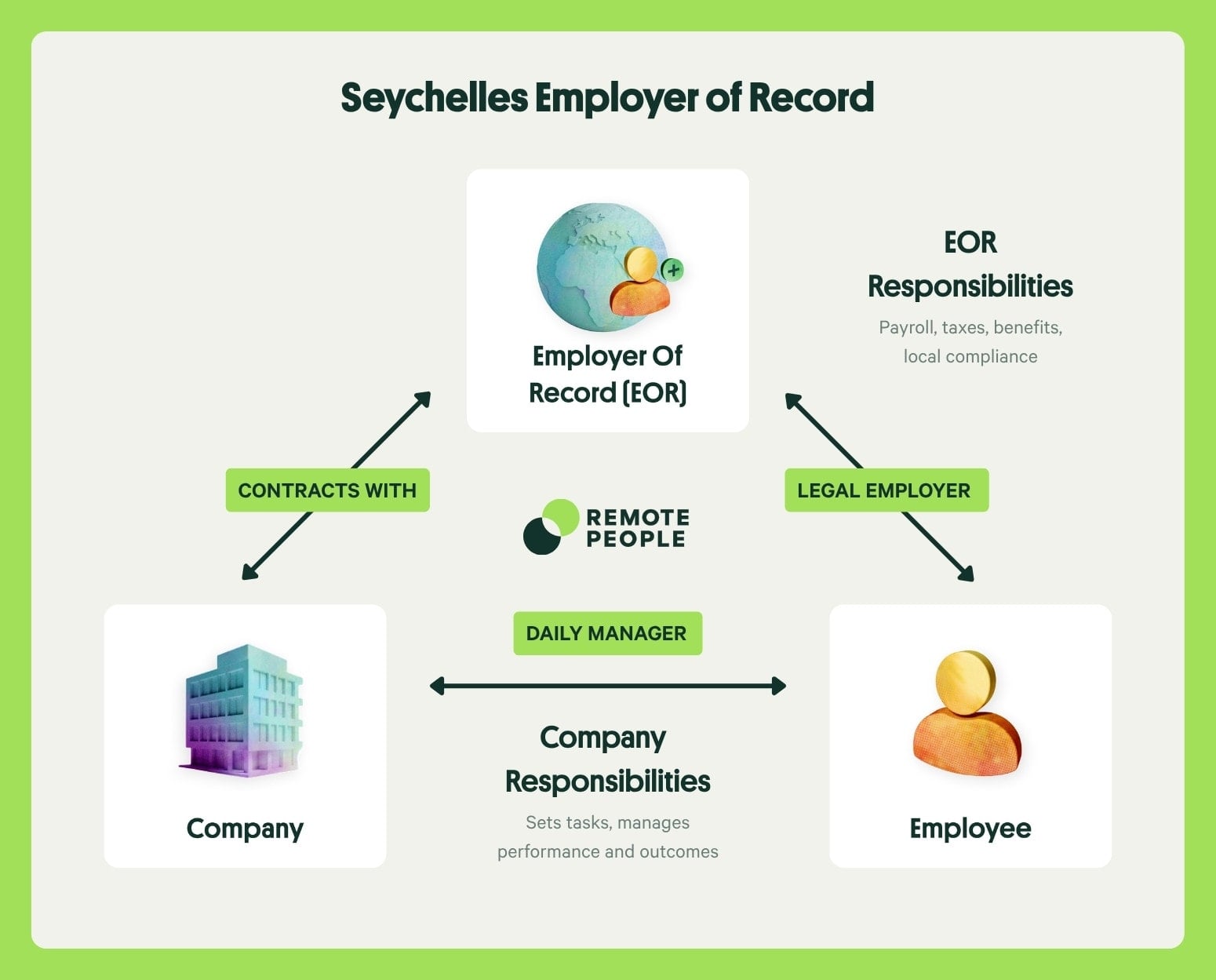
If you’d like to learn more about how Employer of Record (EOR) services work, read our What Is an Employer of Record (EOR)? guide for a complete overview of the model, its benefits, and when to use it.
If you’re comparing providers, our Best Employer of Record (EOR) Providers guide reviews the leading platforms to help you choose the right solution for your business.
Who Uses an EOR in Seychelles?
An EOR is the most efficient entry point for companies that want a presence in Seychelles without the lead time and cost of incorporating a domestic business or an International Business Company through the Financial Services Authority.
- Companies testing the Seychelles market: A business that wants to validate demand before committing to a full entity setup can hire one or two employees through an EOR and scale up or exit within weeks rather than months.
- Companies hiring small remote teams: Organisations with fewer than 15 Seychellois employees rarely see a return on the cost of running a domestic entity, so an EOR consolidates all payroll and compliance overhead into a single monthly fee.
- Companies that need to onboard quickly: Where a candidate must start in two to three weeks, the EOR route compresses registration steps that would otherwise take six to eight weeks through the Seychelles Revenue Commission and the Seychelles Pension Fund.
- Companies hiring foreign nationals: Non-Seychellois need a Gainful Occupation Permit sponsored by a local employer, and the EOR can act as that sponsor when the client has no entity on the islands.
An EOR is also a pragmatic choice for companies winding down operations, preserving an employment relationship during restructuring, or onboarding returning Seychellois nationals who want to be paid locally in rupees and participate in the Seychelles Pension Fund.
Typical Onboarding Timeline
Most EOR providers can onboard a Seychellois employee within one to two weeks. The sequence below shows the key milestones and the factors that can extend the timeline.
- EOR agreement and employee details: 1–2 days to sign the master services agreement and collect the employee’s National Identity Number, Taxpayer Identification Number, and bank details.
- Employment contract drafting and review: 2–3 days to issue an Employment Act 1995-compliant contract in English for the employee’s signature.
- Seychelles Pension Fund and tax registration: 3–5 days for the EOR to register the new hire under its existing Seychelles Revenue Commission employer file and activate Seychelles Pension Fund records.
- Payroll setup and benefits enrolment: 2–3 days to configure the first payroll run, 13th month accrual, and any voluntary benefits.
- Employee onboarding and first day: 1 day to issue the welcome pack, company equipment, and local orientation.
Foreign hires add four to eight weeks because the Ministry of Employment and Social Affairs must first approve the employment before the Immigration Department issues the Gainful Occupation Permit, and the employee cannot begin work before the permit is granted.
Hire in the Seychelles
Onboard your first Seychelles employee in 1–2 weeks. No local entity. Full Employment Act 1995 and Seychelles Pension Fund compliance, handled end-to-end.
Employment Laws and Regulations in Seychelles
Employment Contracts
The Employment Act 1995 (Act 2 of 1995, Cap. 69) is the principal employment statute in Seychelles, supplemented by the Conditions of Employment Regulations 1991 (Statutory Instrument 34 of 1991) which prescribe the detailed rules on hours, leave, and termination. The Act is administered by the Ministry of Employment and Social Affairs, which also operates the Employment Tribunal for individual employment disputes. A consolidated version of the Employment Act as at 16 September 2021 is published on the Seychelles Legal Information Institute (SeyLII consolidated text), and the full schedule of acts and regulations is maintained by the Ministry of Employment and Social Affairs (Ministry of Employment and Social Affairs).
Every employment relationship must be documented in a written contract signed before the employee starts work. Required terms include the start date, job description, remuneration, hours of work, place of work, probation period if any, leave entitlements, and notice period. English is the working language of contracts; French is accepted but English prevails in the event of a dispute before the Employment Tribunal. The Act distinguishes between continuous contracts, which are presumed to be indefinite unless the worker signs a fixed-term agreement for genuinely temporary work, and part-time and casual contracts, each of which carries different entitlements.
Working Hours and Overtime
The statutory normal working week is 45 hours, typically spread over five or six days. The daily maximum is 60 hours per week for general workers and 72 hours per week for watchmen, with overtime permitted only where compensation is paid at the statutory multiplier. Every worker is entitled to a continuous weekly rest period of at least 24 hours, usually taken on Sunday. Overtime is voluntary except where the nature of the work requires it, and must be compensated at the multipliers shown below under the Conditions of Employment Regulations 1991 (SeyLII regulations).
Seychelles overtime and premium pay rates · Per Employment Act 1995 | |||
Hour Type | Rate Multiplier | Cap / Basis | Notes |
|---|---|---|---|
Standard weekday overtime (beyond 45 hrs/week) | 1.5× | Per hour worked | Payable in cash or as equivalent time off in lieu at the same multiplier. |
Weekly rest day work (usually Sunday) | 2.0× | Per hour worked | Employee is also entitled to a substitute rest day within the following week. |
Public holiday work | 2.0× | Per hour worked | Applies to the 16 gazetted public holidays in the Public Holiday Order. |
Maximum weekly hours (general workers) | n/a | 60 hrs/week | Absolute cap including all overtime under the Conditions of Employment Regulations 1991. |
Maximum weekly hours (watchmen) | n/a | 72 hrs/week | Separate cap for watchmen reflects the nature of the work. |
Exemptions apply to certain managerial staff, who are not entitled to overtime pay but retain the full 24-hour weekly rest entitlement. Overtime payable is always calculated on the employee’s basic hourly rate, excluding allowances and bonuses, and cannot be offset against the mandatory 13th month pay. Records of every overtime hour worked must be kept by the employer for inspection by the Ministry of Employment and Social Affairs.
Minimum Wage
The national minimum wage was last revised on 1 April 2025, when the Ministry of Employment and Social Affairs issued a 7% increase under the National Minimum Wage Regulations. The revised rate is SCR 40.95 per hour for continuous and part-time workers and SCR 47.19 per hour for casual workers, which translates to approximately SCR 7,981 per month for a 45-hour week. The higher casual rate compensates for the absence of paid leave and 13th month pay, which continuous workers receive (Ministry of Employment and Social Affairs).
- Continuous and part-time workers: SCR 40.95 per hour, applicable to all employees on indefinite or continuous fixed-term contracts.
- Casual workers: SCR 47.19 per hour, applicable to workers engaged on a day-to-day basis with no expectation of continuous employment.
- Sectoral variations: None. The minimum wage applies uniformly across all sectors and occupations in Seychelles.
Probation Period
The probationary period under the Employment Act 1995 is capped at six months from the first day of work, and may only be extended beyond that period with the approval of a Competent Officer at the Ministry of Employment and Social Affairs. During probation either party may terminate the contract on seven days’ written notice, without the requirement to state a reason and without any severance payment. Probation counts toward the employee’s continuous service for the purpose of later notice and length-of-service compensation, so a hire confirmed after six months of probation is treated as a worker with six months of continuous service from day one.
Leave Entitlements
Seychelles’s statutory leave framework is prescribed in the Employment Act 1995 and the Conditions of Employment Regulations 1991. The framework covers annual leave, sick leave, maternity leave, paternity leave, and compassionate leave, with distinct rules on eligibility, pay, and who funds each category.
Annual Leave
Continuous workers are entitled to 21 working days of paid annual leave after completing 12 months of continuous service, which accrues at 1.75 days per month worked. Annual leave is fully paid by the employer at the employee’s normal rate of pay and accrues during probation, so a worker who completes the six-month probation has already accumulated 10.5 days. Up to 14 days may be carried over to the following leave year with the employer’s agreement, and the balance must be paid out on termination.
Sick Leave
After six months of continuous service, a worker is entitled to up to 21 days of paid sick leave in any 12-month period. If the worker is hospitalised, an additional 30 days of paid sick leave is available, followed by up to 60 days of unpaid sick leave before the employer may terminate on incapacity grounds. A registered medical practitioner’s certificate is required for any sickness absence exceeding two consecutive days, and the employer funds sick leave in full, with no partial sharing with the Seychelles Pension Fund (Ministry of Employment and Social Affairs).
Maternity Leave
Female workers are entitled to 14 weeks of paid maternity leave, which may be taken as a continuous block starting from any point in the last six weeks of pregnancy. Maternity leave is fully paid by the employer at the worker’s normal rate of pay, and the employee’s job and seniority are protected during the leave period. Maternity leave does not affect annual leave accrual, and the worker returns to the same or an equivalent position. Additional unpaid leave may be granted on medical advice where the pregnancy or birth presents complications.
Paternity Leave
Male workers who have completed 12 months of continuous service and probation are entitled to five working days of paid paternity leave, to be taken within four months of the child’s birth. Paternity leave is funded by the employer at the worker’s normal rate of pay and is additional to any annual leave entitlement. The leave may be taken as a single block or split across the four-month window, subject to agreement with the employer on timing.
Other Statutory Leave
The Conditions of Employment Regulations 1991 provide for several further paid and unpaid leave categories that employers must honour on request.
- Compassionate leave: Up to four days of paid compassionate leave per 12-month period on the death or serious illness of a close relative, with any excess at the employer’s discretion.
- Caring leave for a sick child: Up to seven days per 12-month period to care for a sick child under 12, separate from the worker’s own sick leave entitlement.
- Civic duty leave: Unpaid leave to perform jury service, give evidence in court, or fulfil any other statutory civic duty, with time off granted on presentation of a summons.
- Study leave: Unpaid leave for approved study, granted at the employer’s discretion and typically subject to a minimum period of service.
The Employment Act 1995 and the Conditions of Employment Regulations 1991 together define every statutory leave entitlement available to a Seychellois worker, and the table below summarises the main categories. The single most important takeaway for employers is that annual leave begins to accrue from the first day of employment, including during probation, so a worker’s leave balance is never zero at the point of confirmation.
Seychelles statutory leave entitlements · Per Employment Act 1995 | ||
Leave Type | Duration | Eligibility & Notes |
|---|---|---|
Annual leave | 21 working days | Accrues at 1.75 days per month from day one. Fully paid by employer. Up to 14 days carryover with agreement. |
Sick leave | 21 days paid | After 6 months of continuous service. Medical certificate needed beyond 2 days. Fully employer-funded. |
Hospitalisation leave | +30 days paid, +60 days unpaid | In addition to sick leave when the worker is hospitalised. Employer may terminate after unpaid period on incapacity grounds. |
Maternity leave | 14 weeks paid | Fully employer-funded. Job protection during leave. Available to all female workers regardless of service length. |
Paternity leave | 5 working days paid | After 12 months of continuous service and probation. Must be taken within 4 months of the birth. |
Compassionate leave | 4 days paid per year | On bereavement or serious illness of a close relative. Excess at employer’s discretion. |
Caring leave (sick child under 12) | 7 days per year | Separate from the worker’s own sick leave. Supporting medical certificate required. |
Civic duty leave | As required | Unpaid leave for jury service and court attendance under summons. |
Statutory Employee Benefits
Beyond paid leave and social security contributions, Seychelles employers must provide several further statutory benefits. The most important are pension enrolment, 13th month pay, and the Non-Monetary Benefits Tax that governs any in-kind remuneration.
- Seychelles Pension Fund: Every employer must enrol each worker in the Seychelles Pension Fund and contribute 5% of gross monthly salary, matched by the worker’s own 5% deduction, for a combined 10% (Seychelles Pension Fund).
- 13th month pay: An additional month of basic salary payable in December to every continuous worker, calculated on pro-rata service for mid-year joiners and leavers under the Thirteenth Month Pay Regulations (Ministry of Employment and Social Affairs).
- Public health coverage: Public healthcare is free at the point of use for residents, so no private health insurance is mandated, though many employers top up with private cover for expatriates and senior staff.
- Length-of-service compensation: On lawful termination for non-disciplinary reasons, a worker with six months or more of continuous service is entitled to one week of basic pay per completed year of service under the Employment Act 1995.
- Non-monetary benefits: Accommodation, utilities, school fees, and other in-kind benefits are taxed at 15% under the Non-Monetary Benefits Tax, paid monthly by the employer to the Seychelles Revenue Commission (Seychelles Revenue Commission).
The exact employer and employee contribution rates are set out in the contribution tables in Section 4. Employers should note that the Seychelles Pension Fund is a funded defined-contribution scheme operated by a statutory body, not a pay-as-you-go system, and that the fund credits an accrual rate of 1.23% per year of contributions to the worker’s individual account for 2025.
Recent Regulatory Updates (2026)
Three material changes have affected Seychelles payroll and employment compliance in the last two years. The first is the 7% national minimum wage increase that took effect on 1 April 2025, raising the continuous rate to SCR 40.95 per hour and the casual rate to SCR 47.19 per hour under an amendment to the National Minimum Wage Regulations issued by the Ministry of Employment and Social Affairs (Ministry of Employment and Social Affairs).
The second is the Employment (Amendment) Bill 2025 laid before the National Assembly in December 2025, which removes the prior requirement that 13th month pay calculations depend on the outcome of an annual appraisal, and simplifies the computation to a straight proportional share of basic salary earned during the year (Seychelles Government Gazette). The third is the reduction of the Non-Monetary Benefits Tax from 20% to 15%, effective 1 January 2023, which lowered the cost of providing housing and school-fee packages to expatriate hires. The core progressive income tax structure introduced in 2018 remains unchanged, with no bracket or rate revisions announced for 2026.
Work Permits and Visas in Seychelles
Work Permit Requirements
Who Needs a Work Permit
Every non-Seychellois national who takes up employment in Seychelles requires a Gainful Occupation Permit, regardless of nationality. There is no bilateral free-movement agreement that exempts citizens of other African Union, East African Community, or Indian Ocean Commission states from the permit requirement, and the Seychelles visa-on-arrival system issues only a Visitors’ Permit that does not authorise paid work. Seychellois citizens and holders of permanent residency are exempt and require no permit. Dependants and spouses of permit holders receive separate Dependant’s Permits that do not authorise employment unless a separate Gainful Occupation Permit is granted.
Eligibility and Required Documents
The Ministry of Employment and Social Affairs must first approve the employment by confirming that the position cannot be filled by a Seychellois candidate, then the Immigration Department issues the permit. The employer must submit a certified copy of the employment contract, a certified copy of the employee’s passport valid for at least six months, academic qualifications, a medical fitness certificate issued by an approved practitioner, proof of accommodation in Seychelles, and a bank guarantee or deposit of at least SCR 20,000 for stays exceeding one month (Immigration and Civil Status Department).
Processing Time and Validity
The Ministry of Employment and Social Affairs processes the labour market test in four to six weeks, after which the Immigration Department issues the Gainful Occupation Permit in a further three to nine working days. The initial permit is typically valid for one year and may be issued for up to five years in line with the employment contract. Applications should be submitted at least ten weeks before the intended employment start date, and delays most commonly arise from incomplete medical certificates, missing academic attestations, or accommodation approvals that fail the Immigration Department’s standards.
Renewal Process
Renewal applications should be lodged at least eight weeks before the existing permit expires. The employer resubmits the labour market approval, an updated medical certificate, and evidence of tax and pension compliance for the preceding permit period. The employee may continue working during the renewal processing window provided the application was filed before the expiry of the current permit and an acknowledgement receipt has been issued. Changes of employer require a new Gainful Occupation Permit application rather than a renewal.
Common Visa Types for Foreign Workers
The Immigration and Civil Status Department administers the Gainful Occupation Permit and a small number of specialist visa categories. The table below lists the work-authorising categories available in Seychelles in 2026 and indicates whether an EOR can sponsor each one and whether the visa leads to long-term residency.
Seychelles work visa types for foreign workers · 2026 | ||||
Visa Type | Duration | Best For | Leads to Residency? | Processing |
|---|---|---|---|---|
Gainful Occupation Permit (GOP) | Up to 5 years | Foreign national employees working for a Seychelles-registered employer | Yes, after 10 years | 4–8 weeks |
Intra-company transfer (under GOP) | Up to 5 years | Employees transferred from a foreign affiliate to a Seychelles branch or subsidiary | Yes, after 10 years | 4–8 weeks |
Self-employment Gainful Occupation Permit | Up to 5 years | Foreign nationals running an own account business or consultancy | Yes, after 10 years | 6–10 weeks |
Workcation Retreat Programme (digital nomad) | Up to 1 year | Remote workers employed by foreign companies, not working for a Seychelles employer | No | Under 24 hours |
Investor Permit | Up to 5 years | Foreign investors meeting a minimum capital threshold in an approved sector | Yes, after 10 years | 6–12 weeks |
Dependant’s Permit | Matches principal permit | Spouses and minor children of permit holders | Follows principal permit | 2–4 weeks |
Other visa categories do not permit employment in Seychelles. The Visitors’ Permit issued on arrival allows a stay of up to three months and can be extended, but holders cannot take up local work. Student permits, transit permits, and cruise-ship crew permits are similarly non-work visas.
- Visitors’ Permit: Tourism and short business visits only; no paid work in Seychelles is authorised.
- Student Permit: Full-time study at an approved institution; no employment authorised.
- Transit Permit: Airport transit for onward travel; no stay beyond 24 hours.
How an EOR Handles Work Permits
A Seychelles EOR can sponsor a Gainful Occupation Permit on behalf of its client for any foreign national hire, acting as the local employer on the application and carrying the corresponding compliance obligations. The EOR prepares the labour market test filing with the Ministry of Employment and Social Affairs, assembles the supporting documentation with the employee, lodges the application with the Immigration Department, and manages renewals. The employee is responsible for their own medical certificate, passport validity, and any police clearance requested by the Immigration Department.
The permit application process extends the onboarding timeline discussed in Section 1 by four to eight weeks, so clients hiring foreign nationals should plan for a total lead time of six to ten weeks from agreement signature to the employee’s first working day. The Workcation Retreat Programme digital-nomad permit is an exception because it is designed for remote workers employed outside Seychelles, and cannot be used for employment by a Seychelles EOR or any other Seychelles-registered employer.
Payroll, Taxes, and Social Security in Seychelles
Employer Contributions
Seychelles imposes only a small set of employer-side statutory contributions on payroll, which makes the employer cost loading among the lowest in Africa. The Seychelles Pension Fund is the only social-insurance contribution, payable in addition to the Non-Monetary Benefits Tax on any in-kind remuneration. The rates below are those currently in force for 2026 and are confirmed by the Seychelles Pension Fund and the Seychelles Revenue Commission.
Seychelles employer social security contributions · 2026 rates | ||
Contribution | Rate | Notes |
|---|---|---|
Seychelles Pension Fund (SPF) | 5.0% | On gross monthly salary, no ceiling. Remitted by 21st of following month to the Seychelles Pension Fund. |
Non-Monetary Benefits Tax | 15.0% | On the value of any in-kind benefits (housing, utilities, school fees). Paid by the employer to the Seychelles Revenue Commission. |
Total employer cost on cash salary | 5.0% | Excluding the 15% Non-Monetary Benefits Tax, which applies only when in-kind benefits are provided. |
Employee Contributions
Employee deductions in Seychelles consist of the Seychelles Pension Fund contribution and Pay As You Earn income tax. The pension deduction is a flat 5% of gross salary with no ceiling, and income tax is withheld monthly under the progressive schedule for Seychellois citizens or the flat 15% rate for non-Seychellois. All deductions are remitted by the employer to the Seychelles Pension Fund and the Seychelles Revenue Commission by the 21st of the following month.
Seychelles employee payroll deductions · 2026 monthly withholdings | ||
Deduction | Rate | Notes |
|---|---|---|
Seychelles Pension Fund (SPF) | 5.0% | On gross monthly salary, no ceiling. Matched by employer 5% for combined 10% contribution to individual account. |
Income tax (Seychellois citizens) | 0% / 15% / 20% / 30% | Progressive schedule applied monthly on earnings above SCR 8,555.50. See bracket table in Section 4.3. |
Income tax (non-Seychellois employees) | 15.0% | Flat rate on all emoluments from the first rupee. No tax-free threshold. |
Typical total employee deduction (Seychellois in 20% bracket) | ~20–25% | 5% pension plus blended effective income tax rate depending on salary. |
Income Tax
Seychelles operates a monthly progressive income tax for Seychellois citizens under the Income and Non-Monetary Benefits Tax Act 2010, with bracket thresholds applied on each month’s gross emoluments. Non-Seychellois employees are taxed at a flat 15% with no tax-free threshold. The rates below are those set by the 2018 progressive tax reform and have remained unchanged through 2026 (Seychelles Revenue Commission).
Seychelles income tax brackets · 2026 | |
Monthly Gross Emoluments (Seychellois citizens) | Tax Calculation |
|---|---|
SCR 0 – SCR 8,555.50 | 0% (tax-free threshold) |
SCR 8,555.51 – SCR 10,000.00 | 15% on the amount above SCR 8,555.50 |
SCR 10,000.01 – SCR 83,333.00 | SCR 216.68 plus 20% on the amount above SCR 10,000 |
SCR 83,333.01 and above | SCR 14,883.28 plus 30% on the amount above SCR 83,333 |
Non-Seychellois employees (flat rate) | 15% on all monthly emoluments from the first rupee |
Payroll Cycle
Payroll in Seychelles is run monthly, with salaries typically paid by bank transfer on the last working day of the month or within seven days thereafter. Pay slips are mandatory and must show gross emoluments, each statutory deduction, any non-monetary benefits subject to tax, and the net amount paid. The employer files a combined Pay As You Earn and Seychelles Pension Fund return by the 21st of the following month, remitting the employee and employer share together through the Seychelles Revenue Commission e-services portal and the Seychelles Pension Fund online filing system. Late filings attract interest at 0.5% per month on the outstanding amount and an administrative penalty under the Revenue Administration Act.
13th Month Salary and Bonus Pay
The 13th month salary is a mandatory statutory benefit under the Thirteenth Month Pay Regulations, payable to every continuous worker in December of each year. It is calculated as one month of basic salary for a worker who has been in continuous employment for the full calendar year, prorated on a daily basis for mid-year joiners and leavers. The Employment (Amendment) Bill 2025 confirmed that the calculation no longer depends on the outcome of an annual performance appraisal, so every continuous worker who meets the service condition is entitled to the full prorated share regardless of performance rating. The 13th month pay is subject to income tax and Seychelles Pension Fund contributions in the same way as basic salary. There is no statutory 14th month, profit-share, or vacation bonus in Seychelles; any such payment is discretionary and must be provided for in the individual employment contract.
Cost of Hiring Through an EOR in Seychelles
EOR Service Fees
RemotePeople charges a flat monthly fee per Seychellois employee, which covers employment contract drafting, monthly payroll processing, Pay As You Earn and Seychelles Pension Fund filings, leave tracking, and full compliance with the Employment Act 1995 and the Conditions of Employment Regulations 1991. The fee typically falls between USD 300 and USD 600 per employee per month depending on the complexity of the role, the presence of any foreign-national work permit sponsorship, and the level of benefits administration required. Because Seychelles imposes only a 5% employer pension contribution on cash salary, the all-in employer cost sits well below the African average, which makes the country an attractive destination for remote hires compared with neighbouring Mauritius or Kenya.
Total Employment Cost Breakdown
The table below illustrates the full monthly employer cost for a hypothetical Seychelles hire on a USD 3,000 gross salary, with all statutory contributions and the RemotePeople EOR service fee broken out. Only the Seychelles Pension Fund contribution applies on cash salary, so the employer-side loading is just over 5% before the EOR fee is added. Figures are converted at an approximate rate of USD 1 = SCR 14.2, April 2026.
Seychelles employer cost example · USD 3,000 gross · 2026 | ||
Employer Cost | Amount (USD) | % of Gross |
|---|---|---|
Gross salary | $3,000.00 | 100.0% |
Seychelles Pension Fund (employer 5%) | $150.00 | 5.0% |
13th month pay accrual (1/12 of annual salary) | $250.00 | 8.3% |
RemotePeople EOR fee (est.) | $450.00 | 15.0% |
Total monthly employer cost | $3,850.00 | 128.3% |
Exchange rate: USD 1 = approximately SCR 14.2, April 2026. EOR fee shown at midpoint of the USD 300–600 range.
Ready to hire in Seychelles? Get started with RemotePeople. We handle employment contracts, payroll, tax withholding, and full Seychelles compliance. No local entity needed. Contact our Seychelles EOR team.
Benefits of Using an EOR in Seychelles
Hiring through an EOR in Seychelles removes the capital, time, and compliance overhead of running a local entity, and lets a company onboard Seychellois and foreign-national employees within weeks rather than months. The main benefits cluster around speed, compliance, and cost predictability.
- Rapid market entry: An EOR onboards Seychellois workers in one to two weeks, compared with the six to eight weeks needed to incorporate a domestic company and register with the Seychelles Revenue Commission and the Seychelles Pension Fund.
- Full statutory compliance: The EOR carries all liability for Pay As You Earn, pension contributions, the 13th month pay calculation, and the Non-Monetary Benefits Tax, so the client never has to interpret the Employment Act 1995 or the Conditions of Employment Regulations 1991 directly.
- Cost efficiency versus a local entity: Running a Seychelles entity typically costs USD 8,000 to USD 15,000 in first-year legal, accounting, and registration fees before payroll, whereas the EOR fee of USD 300 to USD 600 per employee per month includes every compliance service.
- Local employment expertise: A Seychelles EOR knows the Employment Tribunal’s procedural quirks, the Ministry of Employment and Social Affairs’ labour market test requirements, and the filing rhythms of the Seychelles Revenue Commission e-services portal.
- Scalability and exit flexibility: Headcount can go up or down within the employment contract’s notice rules without affecting the underlying entity, and a complete exit from Seychelles avoids the costly dissolution process required to wind up a domestic company.
- Risk mitigation on work permits: The EOR sponsors the Gainful Occupation Permit and manages the labour market test with the Ministry of Employment and Social Affairs, absorbing the compliance burden of immigration filings and renewals.
- Predictable employee experience: Employees receive a standard Seychelles employment contract, monthly pay slips, Seychelles Pension Fund enrolment, and access to the Ministry of Employment and Social Affairs dispute-resolution framework exactly as they would from any domestic employer.
For companies evaluating whether to enter Seychelles, the EOR route is the lowest-risk way to test market demand and build a small team before committing capital to a domestic entity. Speak to the RemotePeople team for a detailed cost comparison.
Termination and Offboarding in Seychelles
Notice Periods
Both parties must give written notice to end an employment contract in Seychelles, and the length of the notice depends on the stage of employment and the type of contract. The statutory floor is seven days during probation and one month after confirmation, and no distinction is drawn between junior and managerial grades under the Employment Act 1995. Notice can be paid in lieu at the worker’s choice, in which case the employer remits the equivalent salary and terminates the contract immediately.
Seychelles statutory notice periods by position level · Per Employment Act 1995 | |||
Position / Status | Notice Period | During Probation | Notes |
|---|---|---|---|
Continuous worker (confirmed) | 1 calendar month | 7 days | Same notice applies to both employer and employee. May be paid in lieu. |
Managerial / senior staff | 1 calendar month | 7 days | No enhanced statutory period; longer notice may be agreed contractually. |
Fixed-term contract (before expiry) | As specified in contract | 7 days | If no period specified, the 1-month rule applies. |
Casual / day worker | No statutory notice | No statutory notice | Casual hourly rate already compensates for lack of job security. |
Redundancy (collective) | 1 month + 42 days’ prior notice to Chief Executive | 7 days | Ministry of Employment and Social Affairs must be informed 42 days before notice to employees. |
Summary dismissal (serious misconduct) | None | None | Employer must prove just cause if challenged before the Employment Tribunal. |
Exceptions apply for summary dismissal on just cause, where no notice is required but the employer must be able to defend the decision before the Employment Tribunal, and for mutual termination where both parties agree in writing to a shorter or longer notice. Fixed-term contracts may also be terminated early for operational reasons, subject to compensation for the unexpired portion of the term.
Severance Pay
Seychelles uses a single length-of-service compensation formula rather than a tiered severance schedule. A worker with at least six months of continuous service is entitled to one week of basic salary per completed year of service on any termination that is not for serious misconduct, with the calculation based on the worker’s basic monthly salary at the date of termination. The entitlement is mandatory and applies to dismissal for operational reasons, redundancy, end of fixed term, and voluntary resignation after five years of service.
Seychelles severance pay schedule by years of service · Per Employment Act 1995 | |||
Years of Service | Severance Amount | Base Salary | Notes |
|---|---|---|---|
1 year | 1 week of basic pay | Basic monthly salary at termination | Minimum service for entitlement is 6 months; below that, no severance. |
3 years | 3 weeks of basic pay | Basic monthly salary at termination | Calculated as SCR (monthly basic ÷ 4.33) × 3 weeks. |
5 years | 5 weeks of basic pay | Basic monthly salary at termination | Also triggers length-of-service compensation on voluntary resignation. |
10 years | 10 weeks of basic pay | Basic monthly salary at termination | No statutory cap on total weeks; formula accrues linearly. |
Serious misconduct (just cause) | Nil | n/a | No severance; employer must prove just cause if the dismissal is challenged. |
Calculation Method
The base salary used for the length-of-service compensation is the worker’s basic monthly salary at the date of termination, converted to a weekly rate by dividing by 4.33. Allowances, overtime, and the 13th month pay are excluded from the base. Service is rounded down to the nearest completed year, so a worker with three years and eight months of service receives three weeks. The worked examples in the table above illustrate the straight-line calculation for the most common tenure bands.
Caps and Exceptions
There is no statutory cap on total weeks of length-of-service compensation, so the entitlement continues to accrue for the full duration of service. The main exceptions to the formula are summary dismissal for serious misconduct, where no compensation is owed, and resignation before five years of service, where the worker forfeits the entitlement. Fixed-term contracts that run to their natural end also do not trigger the formula, though they do attract the unexpired-portion compensation described above.
Grounds for Termination
The Employment Act 1995 permits termination for just cause (serious misconduct such as theft, violence, or repeated insubordination), for operational reasons (redundancy, restructuring, or poor performance), and by mutual agreement. Protected categories include pregnant workers, workers on maternity leave, and workers who have filed a grievance with the Ministry of Employment and Social Affairs, all of whom can only be dismissed for just cause. Any termination can be challenged before the Employment Tribunal, which has the power to order reinstatement or compensation for unfair dismissal, so employers should document the grounds thoroughly and follow a fair procedure before issuing notice.
EOR vs. Other Hiring Models in Seychelles
EOR vs. Setting Up a Local Entity
Seychelles EOR vs local entity comparison · Setup time, cost, risk and best-fit | ||
Comparison | Employer of Record | Own Entity |
|---|---|---|
Setup time | 1–2 weeks | 6–8 weeks |
Upfront cost | $0 | $8,000–$15,000 |
Ongoing cost | $300–$600/employee/month | $6,000–$12,000/year maintenance |
Local partner required | No (EOR is the local entity) | No, but a local director is often required |
Social insurance registration | Handled by EOR | You manage it |
Payroll and tax filing | Handled by EOR | You manage it (or outsource) |
Best for team size | 1–15 employees | 15+ employees |
Scale down or exit | Easy; no entity to unwind | Costly; legal dissolution required |
Government contracts | Not eligible | Eligible (requires local entity) |
For companies hiring fewer than 15 employees, the EOR route almost always wins on total cost of ownership, because the fixed annual cost of maintaining a domestic Seychelles entity (audited accounts, secretarial filings, and compliance with the Beneficial Ownership Act 2020) typically exceeds USD 6,000 per year before any salary is paid. The break-even point rises sharply once the team exceeds a dozen workers, at which stage the per-employee EOR fee begins to approach the fixed cost of a local entity with an in-house accountant.
Companies with a strategic reason to hold a Seychelles entity (for example, to bid on Government of Seychelles procurement contracts, to qualify for International Business Company tax residency, or to anchor a regional distribution centre) will still need their own incorporation. In those cases, the EOR route is often used as a bridge while the entity is being set up, ensuring that early hires can start work immediately rather than waiting for the Registrar of Companies.
EOR vs. Hiring Independent Contractors
Seychelles EOR vs independent contractors · Compliance, cost, and risk | ||
Comparison | EOR (Full-Time Employee) | Independent Contractor |
|---|---|---|
Legal relationship | Employee of the EOR | Self-employed, no employment relationship |
Compliance risk | Low; EOR ensures local labour law compliance | High; misclassification risk if the relationship resembles employment |
Payroll and tax | EOR handles PAYE, pension, and 13th month | Contractor invoices you and handles their own taxes |
Benefits and leave | Statutory benefits, paid leave, Seychelles Pension Fund | No entitlement to employee benefits |
IP protection | Stronger; employment contract assigns IP by default | Weaker; requires explicit IP assignment clause |
Termination | Subject to local notice periods and length-of-service compensation | Contract can be ended per agreement terms |
Best for | Long-term, core team roles | Short-term projects, specialised tasks |
Cost structure | Salary plus 5% pension plus EOR fee | Contractor fee (typically higher gross, lower total cost) |
Seychelles applies a substance-over-form test to contractor relationships, and the Ministry of Employment and Social Affairs can reclassify a contractor as an employee where the worker is subject to the client’s direction, works fixed hours, uses client equipment, or is not genuinely free to work for other clients. A finding of misclassification triggers back-payment of Pay As You Earn and Seychelles Pension Fund contributions, interest at 0.5% per month, and administrative penalties under the Revenue Administration Act.
The contractor route is only appropriate in clear cases of genuine self-employment, such as a specialist consultant engaged for a defined project, a freelance designer working for multiple clients, or a short-term advisory engagement with a defined deliverable. RemotePeople’s contractor management solution can handle the compliant engagement of Seychellois contractors where the relationship genuinely meets the self-employment test, with RemotePeople invoicing the client and paying the contractor against agreed milestones.
EOR vs. PEO (Professional Employer Organization)
Seychelles EOR vs PEO comparison · Legal employer, liability, and setup | ||
Comparison | Employer of Record (EOR) | PEO |
|---|---|---|
Legal employer | EOR is the legal employer | You remain the legal employer (co-employment) |
Local entity required | No; the EOR is the local entity | Yes; you must have your own entity in Seychelles |
Best for | Companies without a local entity | Companies that already have a local entity |
Compliance liability | EOR assumes compliance responsibility | Shared liability between you and the PEO |
Setup time | 1–2 weeks | Depends on your entity setup (weeks to months) |
Control over HR policies | EOR manages within local law framework | More direct control, PEO advises |
Typical use case | Market entry, small remote teams, testing new markets | Established local operations needing HR outsourcing |
Seychelles has no formal PEO or co-employment framework under its statutes, and the Employment Act 1995 recognises only a single legal employer at a time. Any arrangement that attempts to share employment liability between a client and a service provider falls under the EOR model in practice, with the provider taking on the full legal employer role and the client retaining operational direction of the worker.
For companies that already have a Seychelles entity, the practical alternative to a PEO is a local payroll bureau combined with an HR outsourcing contract, which handles payroll processing, pension filings, and advisory work without substituting as the legal employer. That route is only economic for entities with a meaningful headcount, and typically does not offer the same risk transfer or speed-to-hire as a dedicated EOR engagement.
Public Holidays in Seychelles
Sixteen public holidays are gazetted in the Public Holiday Order 2026 (Statutory Instrument 2 of 2026) issued under the Public Holidays Act (Cap. 190). Where a public holiday falls on a Sunday, the following Monday becomes an additional paid holiday unless it is itself a public holiday. Work on any gazetted holiday attracts a 2.0× pay multiplier under the Conditions of Employment Regulations 1991.
Seychelles public holidays · 2026 calendar year | ||
Date | Holiday | Type |
|---|---|---|
1 January 2026 | New Year’s Day | Public |
2 January 2026 | New Year Holiday | Public |
2 February 2026 | Abolition of Slavery Day (observed, 1 Feb Sunday) | Public |
3 April 2026 | Good Friday | Religious |
4 April 2026 | Easter Saturday | Religious |
6 April 2026 | Easter Monday | Religious |
1 May 2026 | Labour Day | Public |
4 June 2026 | Feast of Corpus Christi | Religious |
18 June 2026 | Constitution Day | National |
29 June 2026 | Independence Day | National |
15 August 2026 | Feast of the Assumption | Religious |
2 November 2026 | All Saints’ Day (observed, 1 Nov Sunday) | Religious |
8 December 2026 | Feast of the Immaculate Conception | Religious |
25 December 2026 | Christmas Day | Religious |
Holidays affect payroll in two ways. First, any work performed on a gazetted holiday attracts a 2.0× pay multiplier under the overtime schedule, or equivalent time off in lieu on the next working day. Second, employers should plan around clusters of holidays such as the four consecutive Easter days in April and the short gap between Constitution Day on 18 June and Independence Day on 29 June, both of which tend to drive reduced operational output in the hospitality, public, and financial sectors.
How to Get Started with an EOR in Seychelles
Launching a Seychelles hire through an EOR is a five-step process that typically completes within ten business days for a Seychellois national, or six to ten weeks where a Gainful Occupation Permit is required.
- First, scope the role and confirm eligibility: Agree the job description, salary range, working location, and nationality of the candidate with the EOR, and confirm whether a Gainful Occupation Permit is needed.
- Second, sign the master services agreement: Execute the EOR master services agreement, which sets out the monthly fee, billing cycle, and IP assignment terms, and upload candidate identity documents.
- Third, issue the local employment contract: The EOR drafts an Employment Act 1995-compliant contract in English covering salary, probation, leave, and 13th month pay, and sends it to the employee for signature.
- Fourth, complete statutory registrations: The EOR registers the new hire with the Seychelles Revenue Commission and activates Seychelles Pension Fund enrolment, typically within five working days.
- Fifth, run first payroll and benefits enrolment: The EOR processes the first monthly payroll, issues the pay slip, and remits Pay As You Earn and Seychelles Pension Fund contributions to the relevant authority.
For foreign national hires, the Gainful Occupation Permit process adds a further four to eight weeks for the labour market test and three to nine working days for Immigration Department processing. Ready to hire in Seychelles? Get started with RemotePeople today and onboard your first Seychelles employee within two weeks.
Where companies hiring in Seychelles expand next
Hiring in Seychelles frequently leads to recruitment across East Africa’s English-speaking cluster and the wider Indian Ocean corridor. Common expansion paths include hiring in Kenya (the regional East African talent pool) and an EOR partner in Uganda (aligned East African English-first hiring profile). Teams scaling further usually add Tanzania for shared East African workforce norms, with a team in Rwanda extending coverage through overlapping East African talent profile.
Frequently Asked Questions About Hiring in Seychelles
RemotePeople's Seychelles EOR service costs between USD 300 and USD 600 per employee per month, depending on the complexity of the role and whether a Gainful Occupation Permit is required for a foreign national. The fee is flat (not a percentage of salary) and includes employment contract drafting, monthly payroll and Pay As You Earn filings with the Seychelles Revenue Commission, Seychelles Pension Fund contributions, 13th month pay administration, and leave tracking. Additional employer-side costs are limited to the 5% Seychelles Pension Fund contribution on gross salary and the mandatory 13th month accrual, which together add roughly 13% to the base salary.
Most Seychellois national hires can be onboarded within one to two weeks from agreement signature. The sequence involves a one to two day master services agreement execution, two to three days for contract drafting, three to five days for Seychelles Revenue Commission and Seychelles Pension Fund registration, and a final payroll setup and first day. Foreign national hires requiring a Gainful Occupation Permit add four to eight weeks for the labour market test and Immigration Department processing, so the total lead time extends to six to ten weeks.
Seychellois citizens pay progressive income tax on a monthly basis: 0% on the first SCR 8,555.50, 15% between SCR 8,555.51 and SCR 10,000, 20% between SCR 10,000 and SCR 83,333, and 30% above SCR 83,333 under the Income and Non-Monetary Benefits Tax Act 2010. Non-Seychellois employees pay a flat 15% on all emoluments from the first rupee, with no tax-free threshold. The Seychelles Pension Fund contribution is a further 5% on both the employee and employer sides. Rates are administered by the Seychelles Revenue Commission (Seychelles Revenue Commission).
Yes, 13th month pay is a mandatory statutory benefit in Seychelles under the Thirteenth Month Pay Regulations, payable to every continuous worker in December of each year. It is calculated as one month of basic salary, prorated for mid-year joiners and leavers. The Employment (Amendment) Bill 2025 removed the prior requirement that the calculation depend on the outcome of an annual appraisal, so the entitlement is now a straight proportional share of basic salary earned during the year.
The national minimum wage in Seychelles is SCR 40.95 per hour for continuous and part-time workers and SCR 47.19 per hour for casual workers, effective 1 April 2025 under an amendment to the National Minimum Wage Regulations issued by the Ministry of Employment and Social Affairs. For a standard 45-hour week, this translates to approximately SCR 7,981 per month for a continuous worker.
You can, but only where the relationship meets the Ministry of Employment and Social Affairs substance-over-form test for genuine self-employment, such as a specialist consultant with multiple clients and project-based deliverables. If the contractor is under your direction, works fixed hours, or uses your equipment, the Ministry can reclassify the relationship as employment and trigger back-payment of Pay As You Earn, Seychelles Pension Fund contributions, interest, and administrative penalties under the Revenue Administration Act. For recurring or full-time work, RemotePeople's contractor management solution can manage compliant engagements that genuinely meet the test, or you should route the hire through an EOR instead.
Under the Employment Act 1995, the statutory notice period is seven days during probation and one calendar month after confirmation, applying equally to employer and employee. Managerial staff carry the same one-month floor, though longer notice can be agreed contractually. Summary dismissal for serious misconduct requires no notice, but the employer must be able to prove just cause if the dismissal is challenged before the Employment Tribunal. Collective redundancy additionally requires 42 days' prior notice to the Chief Executive at the Ministry of Employment and Social Affairs before any notice of termination is issued to affected workers.
The client company (you) owns all intellectual property created by the employee in the course of their duties, not the EOR. RemotePeople's standard Seychelles employment contract contains an IP assignment clause that vests all rights in work product (code, designs, written materials, and inventions) in the client company from the moment of creation, with the EOR acting purely as a conduit for the employment relationship. The clause is enforceable under Seychelles common-law principles and international IP treaties to which Seychelles is a party.
Private health insurance is not statutorily required because Seychellois citizens and permanent residents have free access to the public healthcare system funded through general taxation. Many employers still top up senior staff and expatriates with private medical cover for access to private clinics, specialist treatment abroad, and dental or optical benefits. Any such private cover is treated as a non-monetary benefit and taxed at 15% under the Non-Monetary Benefits Tax (Seychelles Revenue Commission).
Employer of Record in
Employer of Record in
Employer of Record in
Employer of Record in
Employer of Record in
Employer of Record in
Employer of Record in
Employer of Record in